
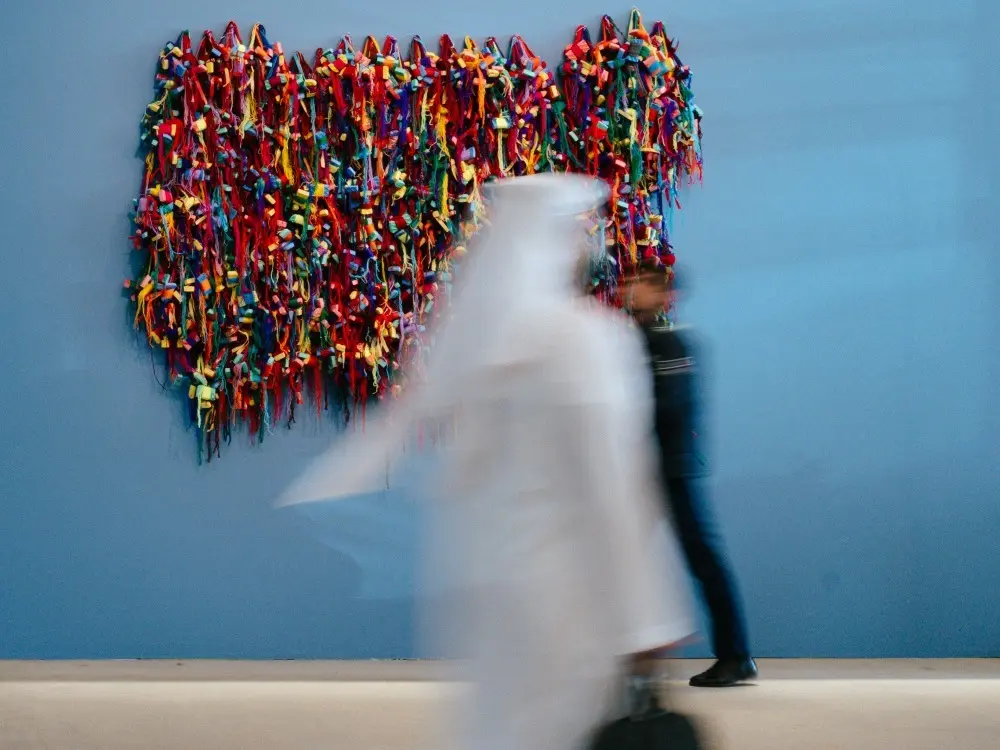
On the morning of the inaugural edition of Frieze Abu Dhabi, a stark contrast emerged between the geopolitical realities of the region and the high-octane atmosphere of the art market. While reports surfaced that Saudi Arabia’s financial hub in Riyadh had been targeted by Yemen’s Iran-backed Houthi rebels, the mood inside the Abu Dhabi venue remained focused on the commerce and culture of the global art scene. For the collectors, gallerists, and celebrities gathered in the United Arab Emirates, the fair represented a significant milestone, with millions of dollars in inventory prepared for immediate acquisition.
The opening day was marked by a high-profile crowd, including members of the royal family who returned to the fair following an exclusive preview the previous day. They were joined by an international contingent of politicians and cultural icons, most notably tennis legend Venus Williams and acclaimed architect Kulapat Yantrasast. For Yantrasast, the launch of Frieze in the emirate felt like a long-awaited arrival. “It’s about time,” he remarked to ARTnews. “Frieze is bringing its A-game to Abu Dhabi, where they have the best museums.” Yantrasast, visibly engaged with the fair’s offerings, noted that he had been busy placing red dots on works from galleries including The Third Line, Taymour Grahne Projects, Experimenter, and Pearl Lam Projects.
A Streamlined Vision and Heightened Energy
The transformation of the event—rebranded from the long-standing Abu Dhabi Art fair to the prestigious Frieze umbrella—was immediately noticeable to attendees. The most significant shift was the curation of the exhibitor list, which was intentionally streamlined to 89 galleries, a sharp reduction from the 142 participants that populated the fair’s previous iterations. This move toward a more exclusive, boutique experience appeared to pay off, with many dealers reporting high spirits and a brisk pace of sales within the first hour of the public opening.
Asmaa Al-Shabibi, co-founder of Lawrie Shabibi, reflected on the shift during her walk through the new entrance, noting that the atmosphere felt distinct from its predecessor. “It felt a little bit like going into Frieze London, and it feels like a different fair,” she observed. This sentiment was echoed by Samy Ghiyati, co-founder of the art advisory firm NG Partners. “The quality is definitely higher, and galleries made an effort to bring very good inventory,” Ghiyati said. “Usually, fairs in the region are slower and sales happen over the course of several days, but the energy here is different.”

The early results supported these observations. Ghiyati’s own clients were active participants, with one collector placing three orders for pieces ranging from $10,000 to $400,000. Similar urgency was visible across the floor. Dealer Sundaram Tagore reported that within the first hour of opening, two works—one by Hiroshi Senju and another by Chun Kwang Young—had already been placed on hold, with price points between $40,000 and $400,000.
By late afternoon, the success stories were mounting. The London-based gallery Timothy Taylor sold its entire solo presentation of paintings by Hilary Pecis, with works fetching between $65,000 and $205,000, destined for both regional and international collections. Meanwhile, the antiquities specialist David Aaron secured a seven-figure sale for a 2,000-year-old funerary stele to a private collector. Local galleries also saw significant success, with Dubai-based Taymour Grahne Projects reporting a sell-out booth featuring mosaic works that captured the architectural spirit of 1970s-era Abu Dhabi.
Regional Collectors and a Maturing Market
The financial muscle of the regional collector base was a primary driver of the fair’s success. Iris Projects, for instance, facilitated the sale of two works by Shamsa Al Omaira, including a sculpture acquired by a new UAE-based foundation for $32,000, and an acrylic on canvas by Juma Al Haj for $20,400. The local interest extended to diverse mediums, with UAE-based collectors purchasing ceramics by Eman Al Hashemi for $17,000 and $15,000, an oil pastel by Dhabia Al Qubaisi for $10,500, and a photograph by Ammar Al Attar for $12,500.
Lawrie Shabibi reported the sale of seven pieces by artists Hamra Abbas and Shaikha Al Mazrou, with prices ranging from $10,000 to $120,000. Al-Shabibi noted a shift in the collectors’ sophistication, stating, “People are recognizing the work when they’re coming here.” She pointed specifically to a new client who acquired a piece by Al Mazrou, whose work is simultaneously featured in a solo exhibition at the Cultural Foundation, demonstrating a synergy between the fair and the city’s broader institutional landscape.

Waddington Custot, which brought a selection of works by Etel Adnan, Sophia Vari, and Fabienne Verdier, noted that their reserves were held by a large contingent of collectors hailing from across the Gulf, including Abu Dhabi, Dubai, Qatar, and Bahrain. This confirms a broader trend observed by dealers: while many collectors in the region began their journeys by acquiring blue-chip Western art, they are now increasingly looking inward, deepening their holdings with historical and contemporary works by regional artists.
Global Outlook and the Indian Ocean Trade
The fair’s thematic focus provided a unique counterpoint to the contemporary offerings. The Frieze Masters section was dedicated to trade across the Indian Ocean, a concept inspired by the Louvre Abu Dhabi’s current exhibition, “Spices and Wonders: Sailing the Indian Ocean.” This intellectual grounding resonated with visitors and dealers alike.
Efie Gallery, which specializes in artists of African descent, found a receptive audience for this global perspective. An hour into the fair, the gallery had placed two works by Malian artist Abdoulaye Konaté on reserve, priced between $45,000 and $65,000, alongside two works by Cuban artist Maria Magdalena Campos-Pons, priced between $27,500 and $55,000. “Frieze Abu Dhabi has got off to a strong start for us with a high volume of enquiries,” said co-founder Kwame Mintah. He noted that the Gulf’s collecting community is witnessing a “gradual maturation,” characterized by an appreciation for artistic practices that extend beyond established geographical and institutional frameworks.
This appetite for diverse, historical, and rare items was further evidenced at Daniel Crouch Rare Books. A private collector purchased the first map to name Abu Dhabi, a historic document dated 1832. While the exact sale price remained confidential, the gallery’s booth—with a total value estimated between $10,073 and $1.19 million—spoke to the high stakes of the market. “Abu Dhabi is becoming a cultural hub in the region with a lot of development,” Crouch remarked. “It’s the logical place to come to for dealing in the larger Indian Ocean region.”

A Cultural Hub in the Making
The presence of major blue-chip powerhouses like Gagosian, Pace Gallery, and Victoria Miro further solidified the fair’s standing. Gagosian’s booth, dedicated to the work of Roy Lichtenstein, became a focal point for the fair’s social scene, serving as a popular backdrop for visitors. The gallery confirmed it had placed many orders throughout the day, reinforcing the notion that Abu Dhabi is no longer just a regional player but a mandatory stop on the global art calendar.
This integration into the international circuit is not happening in a vacuum. The emirate has been methodically building a cultural infrastructure that includes the recently hosted Christie’s fine art auction and an upcoming sale by Sotheby’s. These events align with a busy cultural calendar that includes the Formula 1 Abu Dhabi Grand Prix, Abu Dhabi Finance Week, and the Culture Summit Abu Dhabi.
Many dealers pointed to the imminent opening of the Guggenheim Abu Dhabi as the key driver for their enthusiasm. The museum is viewed by the trade as a vital bridge between the East and the West, a permanent institution that will provide the necessary gravity to sustain the fair’s growth. “The Guggenheim is going to open now in the next few weeks,” said Milo Gatti, fair coordinator at Galleria Continua, which presented works by Anish Kapoor, Barbana Bojadzi, and Hank Willis Thomas. “It’s literally where contemporary art gets space to breathe and to grow.” As the fair concluded its opening day, the consensus among participants was clear: Abu Dhabi has successfully staked its claim as a new, formidable center for the art world.