
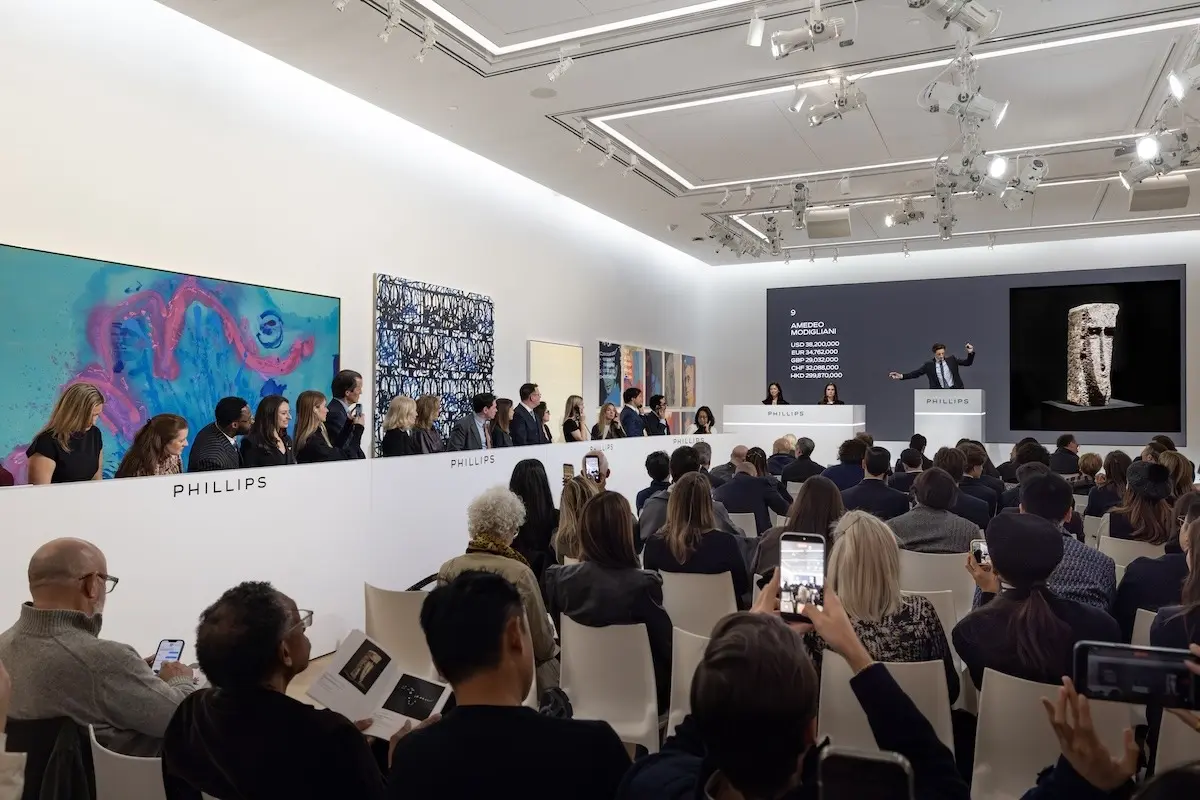
Phillips, the auction house currently navigating a high-stakes period of organizational restructuring, demonstrated the enduring power of top-tier trophy art on Tuesday night. Held at its Park Avenue headquarters in New York, the modern and contemporary evening sale realized a total of $104.4 million, inclusive of fees. While the headline figure represents a significant milestone for the house, particularly in light of recent internal shifts, the sale’s narrative was anchored by the performance of a single, monumental masterwork that carried the auction’s momentum.
The centerpiece of the evening was Amedeo Modigliani’s 1911–12 limestone sculpture, Tête. A rare and highly anticipated lot, the piece commanded a total of $44.6 million, comfortably exceeding its presale estimate of $28 million to $35 million. For Phillips, which has recently contended with cost-cutting measures and a sweeping leadership shake-up in August—including the exits of senior figures such as Miety Heiden and Jonathan Crockett—securing such a high-profile consignment was a necessary victory. The result underscored the house’s ability to remain competitive in a landscape dominated by the traditional duopoly of Christie’s and Sotheby’s.
The technical performance of the auction was robust, characterized by a lean selection of 22 lots. With only one lot withdrawn prior to the start of the proceedings and just one item failing to find a buyer, the sale achieved a 95 percent sell-through rate by lot. When measured by value, the success rate climbed even higher to 99 percent, a statistic that highlights how concentrated the evening’s financial weight was in the works that actually traded hands.
In the immediate aftermath of the sale, Phillips issued a statement framing the $104.4 million total as a 55 percent increase over the equivalent sale from the previous year. While mathematically accurate, the comparison requires nuance to fully appreciate the current market climate. The 2025 edition of the same sale generated $67.3 million across 33 lots, with two unsold. When the outsized contribution of the Modigliani is removed from this year’s total, the remaining $59.8 million is spread across 20 lots, rather than the 31 that comprised the 2025 auction. This suggests that while Phillips is enjoying a stronger headline number, the growth is heavily reliant on the presence of “mega-lots” rather than a broader, across-the-board increase in market depth.
Nevertheless, the specialists at Phillips deserve credit for curating a selection that resonated with a cautious but highly selective buyer base. Beyond the Modigliani, several other works performed with notable strength, proving that when the quality is indisputable, the capital is still available.
A primary example of this was David Hockney’s eight-panel group portrait, David, Celia, Stephen and Ian, London 1982. The work, a significant piece in the artist’s oeuvre, realized $12.2 million, landing squarely within its $10 million to $15 million estimate. Phillips highlighted the result as the artist’s highest auction performance of the year, a distinction that carries weight given the frequency with which Hockney’s work appears at auction. To provide context, three other paintings by the artist were offered at Christie’s and Sotheby’s earlier in the week, with the highest of those reaching $8.05 million at Sotheby’s. The Phillips result serves as a reminder that the secondary market for Hockney remains selective, with buyers prioritizing major compositions over smaller or less significant examples.

Other highlights included Alexander Calder’s 1959 sculpture Snow Flurry, May 14, which fetched $7.5 million, significantly outperforming its $4 million to $6 million estimate. Similarly, Helen Frankenthaler’s atmospheric 1980 landscape Seabreeze saw spirited bidding, eventually selling for $4.5 million—well above its $2.5 million high estimate. These results reflect a broader market trend where works by established, blue-chip names continue to see aggressive competition, even as the overall volume of the art market remains tempered.
Robert Manley, the chairman and global head of modern and contemporary art at Phillips, addressed the results in a post-sale communication. He attributed the evening’s success to a deliberate strategy of offering “fresh-to-market, museum-quality material.” According to Manley, the night served as a “powerful reminder that truly exceptional works continue to inspire extraordinary competition in the market.”
This assessment aligns with the broader observations from the rest of the week’s marquee auctions. Across the city, Sotheby’s held its "The Now" and contemporary evening sales on Monday, while Christie’s conducted its 20th-century evening sale on Tuesday. At both institutions, the pattern was strikingly similar: deep, competitive bidding for works that could be categorized as “A+” grade, contrasted by a more tepid, selective reception for everything else. The presence of unsold lots and a lack of momentum for secondary material suggest that the market is currently defined by a "flight to quality."
Art advisor Ralph De Luca, observing the market dynamics firsthand during the Christie’s sale on Tuesday, captured the prevailing sentiment with brevity: “The flight to quality is astounding.” This phenomenon explains why Phillips—despite its internal corporate turbulence—was able to generate such a strong evening total. By focusing its resources on a smaller, high-value group of lots, the house managed to bypass the softer segments of the market that have caused difficulties for other auctioneers this season.
For Phillips, the challenge moving forward will be sustaining this level of performance without the luxury of having a guaranteed star lot like the Modigliani in every sale. The 99 percent sell-through rate by value is a reflection of a curated, high-end strategy, but it also underscores the volatility of relying on a limited number of high-priced assets. As the house continues to navigate its post-leadership-transition era, its ability to maintain its reputation as a venue for elite, fresh-to-market works will be the primary metric by which its success is judged by collectors and stakeholders alike.
As the week of major sales concludes, the industry is left with a clear picture of the current art market: it is not a rising tide that lifts all boats, but rather a hyper-competitive environment where the best works remain in high demand, while the rest of the market faces a more discerning and often hesitant audience. Phillips’ Tuesday night result, while bolstered by a single, spectacular sculpture, confirms that even in a climate of scrutiny and economic caution, the hunger for undisputed masterpieces remains as potent as ever. Whether this trend can be extended into the next season, particularly as the house continues to refine its identity under new leadership, remains the most pressing question for the market at large. For now, however, the Park Avenue sale stands as a successful assertion of relevance in a challenging global art economy.