
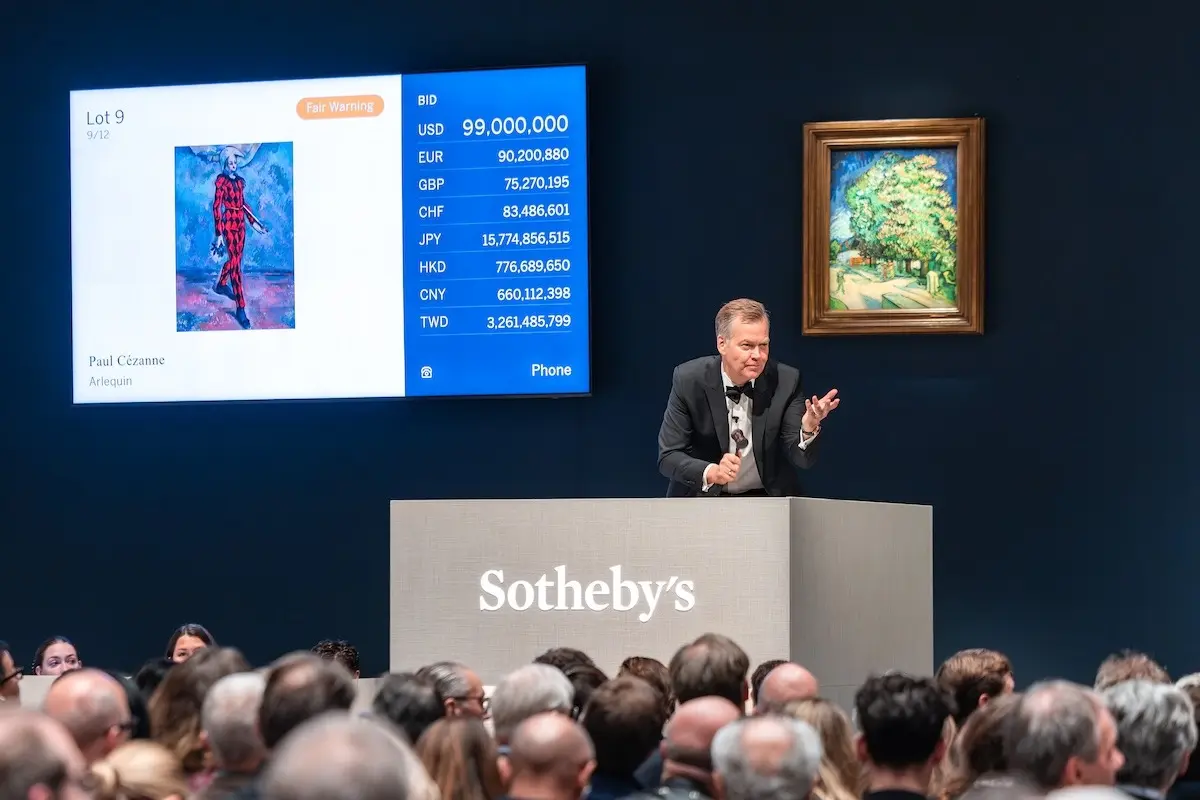
It was an evening defined by superlatives at Sotheby’s New York, where two back-to-back auctions of Impressionist and modern art concluded with a staggering total of $777.8 million. The figure represents the highest single-night haul in the auction house’s storied history, narrowly surpassing the $706 million achievement recorded last November during the inaugural evening double-header at the Breuer building.
The centerpiece of the evening was the prestigious Blaquier-Arrieta collection. The 12 lots presented from this storied assembly realized a total of $412 million. While that sum fell just shy of the $414.5 million presale low estimate, the performance nonetheless secured a record for a single-owner evening sale dedicated specifically to the Impressionist and modern art categories. (Unless otherwise specified, all prices cited include auction house premiums.)
High-Stakes Bidding on Blue-Chip Masterpieces
The evening was framed by the anticipation surrounding two of the season’s most discussed paintings: Vincent van Gogh’s Châtaigniers en fleurs (1890) and Paul Cézanne’s Arlequin (1888–90). Both works achieved monumental prices—$190.4 million for the Van Gogh and $111 million for the Cézanne. The Van Gogh result stands as the artist’s highest price to date and represents the most expensive work of art ever sold at Sotheby’s. Meanwhile, the Cézanne result marks the second-highest auction price ever achieved for the artist.
Despite these headline-grabbing figures, the atmosphere in the saleroom was surprisingly muted. Both works hammered below their respective presale estimates, with the Van Gogh attracting only a smattering of bids. The Cézanne saw a similarly restrained trajectory, with the bidding moving slowly between Sotheby’s specialists Lisa Dennison, Chairman of Sotheby’s Americas, and Helena Newman, Chairman of Sotheby’s Europe. The gavel eventually fell in favor of Newman.

When questioned after the proceedings regarding whether recent publicity surrounding a restitution claim against the Van Gogh had dampened the enthusiasm of potential buyers, Sotheby’s CEO Charles Stewart dismissed the notion. “First of all, it’s a record price for the artist,” Stewart noted, highlighting that the work also now holds the title of the fourth-highest price ever achieved by any artist at auction. “I think you have to separate auction heat from auction results,” he added, signaling confidence in the strength of the market for top-tier masterworks.
Diverse Competition and Market Resilience
As the evening progressed, the energy in the room shifted. The final two paintings of the Blaquier-Arrieta session, both carrying more modest estimates, ignited far more spirited competition. Henri de Toulouse-Lautrec’s Femme assise de profil vers la gauche (1890) drew aggressive participation from phone bidders Edith Eustis and Simon Stark, as well as several individuals on the floor. It was ultimately claimed by a bidder in the second row for $3.8 million.
The momentum continued with the sale of Camille Pissarro’s landscape, Maison de Piette à Montfoucault, effet de neige, avec un homme portant un fagot (1875). A heated contest between specialists Wendy Lin and Alina Davey resulted in a $2 million sale to Davey. Notably, the buyer of the Pissarro was the same collector who, just moments earlier, had secured Edgar Degas’s Avant la course (c. 1893) for $18 million through Sotheby’s specialist Ben Doller.
Following the single-owner session, the 47-lot, multiple-owner sale saw an uptick in intensity. With no fewer than 33 Sotheby’s specialists fielding phone bids, the sale realized $365.8 million, with an impressive sell-through rate that saw all but one lot find a buyer.

Modern American Highlights and Institutional Success
The second half of the evening was anchored by significant results for American and European modernists. The top performer was Edward Hopper’s 1944 seascape, The Martha Mckeen of Wellfleet, hailing from the collection of Baroness Carmen Thyssen-Bornemisza. While the $47.8 million final price (including fees) remained well below the record $91.8 million achieved for Hopper’s Chop Suey at Christie’s in 2018, it still stands as the second-highest price ever paid for a Hopper at auction. The painting sparked a intense four-way phone bidding war, with Scott Niichel, Vice Chairman and Head of Middle Market for Modern and Contemporary Art, ultimately securing the lot.
Rene Magritte also saw a strong showing, with his 1964 work L’Ami de l’ordre—featuring the artist’s iconic bowler-hatted figure—fetching $45 million. The work was consigned by Sydell Miller, who had originally acquired the piece in 1998 for $5.3 million, marking a substantial appreciation in value.
A particularly poignant moment occurred during the sale of Aaron Douglas’s 1931 painting of Harriet Tubman. The work served as a historic highlight, far exceeding its $2.5 million to $3.5 million estimate to reach $14.1 million. The proceeds are destined for Bennett College, a historically Black women’s college, providing a transformative financial windfall. The bidding was a family affair, initially pitting specialist Jackie Wachter against her father, George Wachter, Sotheby’s Chairman of North and South America. After several floor bidders entered the fray, Sotheby’s Head of American Art, Stefany Morris, successfully won the lot.
David Galperin, Sotheby’s Vice Chairman and Head of Contemporary Art, reflected on the intensity of that moment: “We knew it was going to make a big price. That’s one of the most exciting auction moments—when you have something that is so categorically the very best by an artist whose work rarely comes to auction.”

Strategy and Market Sentiments
The evening was not without its complications. A drawing by Remedios Varo failed to find a buyer, and three other lots—works by Magritte, Cézanne, and Matisse—were withdrawn mid-sale without the customary prior notification. Two of those withdrawn works were part of a group of 11 lots consigned from the collection of George Weiss, the hedge fund founder currently involved in bankruptcy proceedings.
The reliance on high-level guarantees for the Blaquier-Arrieta collection prompted some industry observers to question the house’s broader strategy. Phillip Hoffman, founder and chairman of the Fine Art Group, suggested that the aggressive guarantee structure may have actually stifled competition. “The guarantees were just too high,” Hoffman told ARTnews immediately following the sale. “I think these guarantees are just pushing the limit.” He argued that by setting the bar so high, the auction house left little room for organic bidding, resulting in several lots that lacked meaningful competition.
Despite such critiques, Sotheby’s leadership remained steadfast. When asked about the potential for overconfidence in pricing, CEO Charles Stewart remained measured. “Our estimates weren’t shy,” he acknowledged. “You can read into that whatever you like. We were happy with the result of everything.”
As the gavel fell on the final lots, it was clear that while the market for blue-chip works is evolving, the demand for high-caliber, historic art remains robust, even as the mechanisms of the auction room continue to be a subject of intense scrutiny and debate among collectors and dealers alike.