
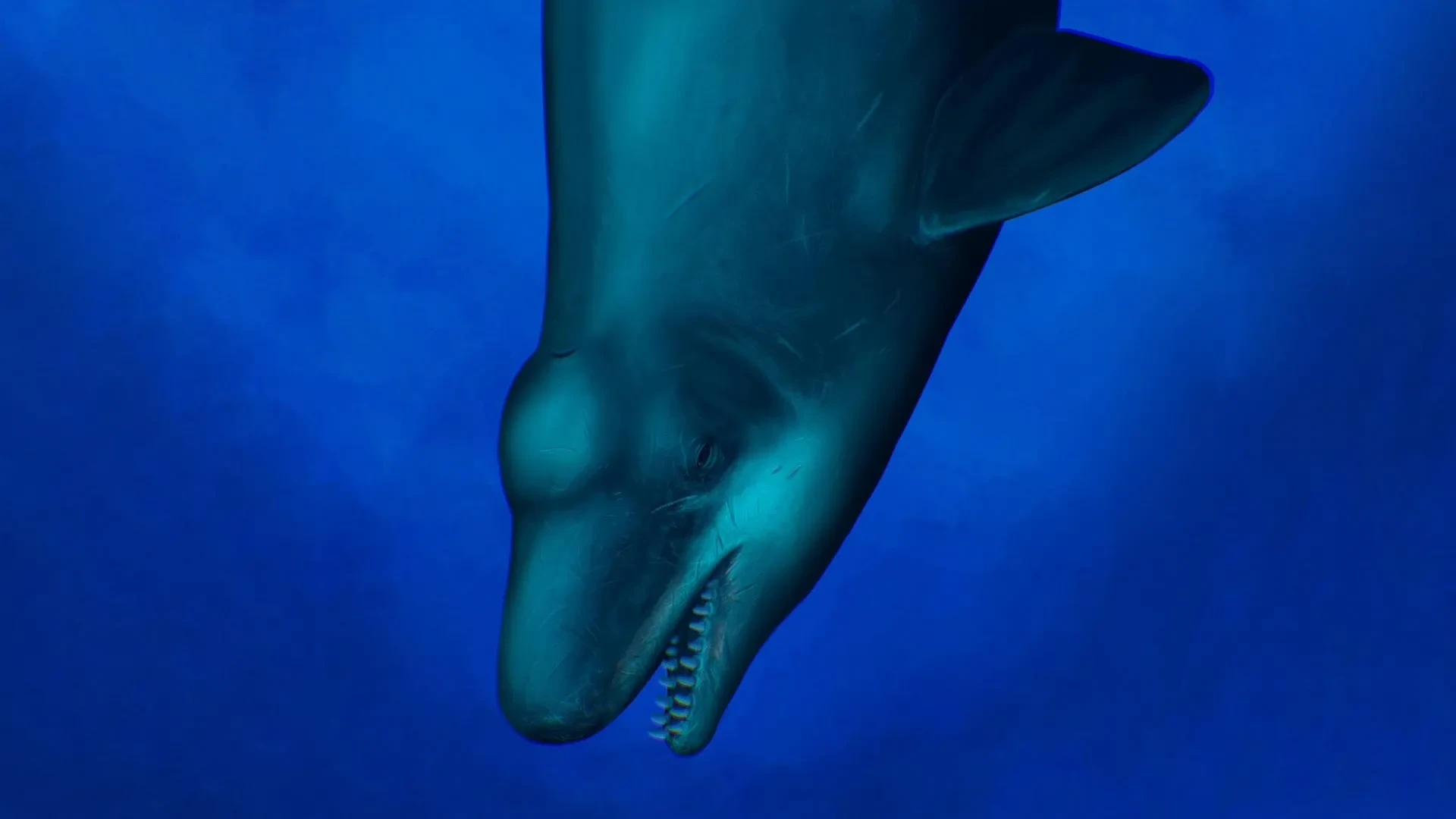
A bizarre prehistoric whale that swam the ancient seas roughly 6 million years ago possessed a face so radically crooked that researchers initially suspected its fossilized remains had been severely distorted by geological forces after its death. However, a detailed scientific examination has revealed that its extraordinary, lopsided shape was entirely natural. According to an international team of researchers, the creature represents the most extreme case of facial asymmetry ever documented in any mammal.
While the vast majority of vertebrates possess bodies and skulls that maintain a roughly symmetrical structure on both sides, toothed whales have long been known exceptions in the animal kingdom. These marine mammals have evolved uneven skull designs to accommodate highly specialized internal organs responsible for sound production and navigation through echolocation.
Now, scientists have identified an extinct species of pygmy sperm whale that took this unusual biological architecture to an unprecedented extreme. Named Scaphokogia huachafo, the prehistoric cetacean inhabited the marine environments of the Late Miocene epoch, roughly between 6.3 and 5.6 million years ago. Measuring approximately 2.7 meters in length, the animal possessed a fossilized skull that displays a degree of facial asymmetry previously thought impossible in any whale, dolphin, or broader mammalian species.
A Prehistoric Whale With an Extraordinary Skull
The unusual anatomical features of the ancient marine mammal immediately set it apart from both its modern relatives and other known fossil species. In modern toothed whales, cranial asymmetry is intimately connected to the development of fatty structures located in the forehead region, which play a crucial role in communication and echolocation. However, in Scaphokogia huachafo, this developmental shift extended far beyond the immediate area surrounding the blowhole.
Both of the whale’s bony nostrils were shifted entirely to the left side of the skull, while the surrounding facial bones differed dramatically in both size and relative position. The net result was a skull that appeared completely distorted and crooked to the naked eye.
"Cranial asymmetry in toothed whales is directly linked to the development of fatty structures in the forehead that are involved in sound production," explains Aldo Benites-Palomino, the lead author of the scientific study detailing the discovery. "लेकिन in Scaphokogia huachafo, this asymmetry went far beyond the area around the blowhole. Both bony nostrils are shifted entirely to the left side of the skull, while the facial bones differ dramatically in size and position. The skull looks completely crooked."
At the time of his initial investigation, Benites-Palomino was conducting research for his doctoral studies at the University of Zurich’s Department of Paleontology. He has since transitioned to an academic position as an assistant professor at Friedrich-Alexander-Universität Erlangen-Nürnberg.
The striking and unconventional appearance of the fossil also directly inspired its scientific nomenclature. The species designation, huachafo, is drawn from Peruvian Spanish, where it is commonly used to characterize something excessively flashy, bizarre, extravagant, or unconventional to the point of defying standard aesthetic categories.
"In Peru, huachafo is an everyday word for anything that is flashy, over-the-top, bizarre, extravagant or difficult to categorize aesthetically," Benites-Palomino notes, describing the rationale behind the name. "When we looked at the proportions of this whale—with its face strongly shifted to the left and its oversized, downward-curving snout—it broke every rule of symmetry and elegance seen in living cetaceans. Its anatomy is so extravagant and odd that huachafo seemed the perfect name for it."
Scientists Initially Suspected the Skull Was Deformed
The remarkable fossil specimen at the center of the discovery did not surface recently; it was originally recovered during the mid-1990s from the richly fossiliferous deposits of the Pisco Formation in southern Peru. This arid desert region has long earned international renown among paleontologists for yielding exceptionally well-preserved fossils of ancient marine animals, ranging from giant sharks to baleen and toothed whales.
Aldo Benites-Palomino first encountered the unique specimen back in 2015 while preparing his Bachelor’s thesis at the Museo de Historia Natural in Lima. The dramatically uneven contours of the skull immediately prompted a critical scientific inquiry: Was the bone structure genuinely configured this way while the whale was alive, or had millions of years of intense geological pressure warped and twisted the fossil after burial?
"The initial suspicion with skulls this distorted is always taphonomy—that the specimen may have been flattened or twisted by sediment pressure over millions of years," Benites-Palomino explains, referring to the processes that affect an organism from the time of its death until its fossilization.
However, a closer microscopic and structural examination quickly ruled out post-mortem distortion. Researchers observed that the cranial sutures were fully closed, and there were no telltale fractures, pathological conditions, or secondary deformations anywhere else on the skull structure. These observations confirmed that the extreme asymmetry was a product of genuine biology rather than a consequence of poor preservation or geological stress.
A Bizarre Adaptation for Hunting Along the Seafloor
Beyond its striking appearance, the unusual architecture of the whale’s skull provides valuable behavioral clues regarding how the species hunted and survived in its ancient marine ecosystem. While modern sperm whales typically target squid in deep pelagic waters, Scaphokogia huachafo appears to have pursued an entirely different ecological strategy, exhibiting anatomical adaptations well-suited for foraging along the bottom of shallow coastal waters.
Among its most distinctive features was a large, tube-shaped snout that was reinforced by dense bone and cartilage that had undergone ossification, hardening into solid bone over the animal’s lifetime. These heavy structural elements functioned as a natural ballast system, shifting the center of gravity significantly forward and downward.
Furthermore, the whale’s snout pointed downward at an angle of roughly 31 degrees relative to the horizontal plane of the rest of the skull. By carefully reconstructing the articulation points connecting the skull to the first neck vertebra—known anatomically as the atlas—scientists determined that Scaphokogia possessed the neck flexibility required to bend its head downward by as much as 55 degrees.
"The entire cranio-cervical complex is modified to point the snout directly toward the bottom," explains Gabriel Aguirre-Fernández, co-author of the research and doctoral advisor at the University of Zurich. "The combination of dense bone, the downward-curving snout and the flexible neck articulation allowed the animal to move directly above the seabed and feed close to the sediment."
In addition to these skeletal adaptations, researchers believe the whale may have relied heavily on its highly specialized echolocation system to detect and capture prey hidden beneath the soft sediments of shallow coastal environments. Unlike other marine predators that forage along the ocean floor and often depend on sensitive facial whiskers or specialized visual enhancements to find food in murky substrates, Scaphokogia lacked these conventional sensory tools.
Instead, its remarkably asymmetrical skull likely supported an advanced biological sonar apparatus, enabling the animal to navigate and hunt efficiently in murky benthic habitats where vision was of limited use.
This specialized feeding strategy represents an evolutionary path that has no direct modern equivalent among contemporary marine mammals. As global ocean conditions, temperatures, and current patterns shifted significantly toward the end of the Miocene epoch, the specific ecological niche occupied by Scaphokogia gradually vanished. Over evolutionary time, this paved the way for the establishment of the marine mammal communities recognized in the world’s oceans today.
The discovery of Scaphokogia huachafo offers a rare window into the immense plasticity of vertebrate evolution, demonstrating how natural selection was once capable of producing an animal whose dramatically crooked face was not a sign of pathology or deformity, but a finely tuned adaptation to a specialized, vanished underwater world.