
If planning your next day trip, weekend getaway, or holiday excursion feels like a burdensome and overwhelming task, technology companies are ready to step in. Google has announced its latest and most ambitious artificial intelligence-driven planning feature designed to take over the heavy lifting of organizing travel itineraries.
The feature, integrated directly into Google Maps and powered by the company’s Gemini AI, aims to lay out comprehensive travel schedules for users. Whether individuals are planning a brief afternoon adventure or an intricate multi-day journey, the technology promises to streamline the entire process. The announcement was strategically timed to roll out ahead of the busy holiday travel season in the United States. According to forecasts from the American Automobile Association (AAA), an estimated 81.5 million people are expected to travel during the Thanksgiving and Black Friday holiday weekend, creating a massive demand for efficient routing and scheduling tools.
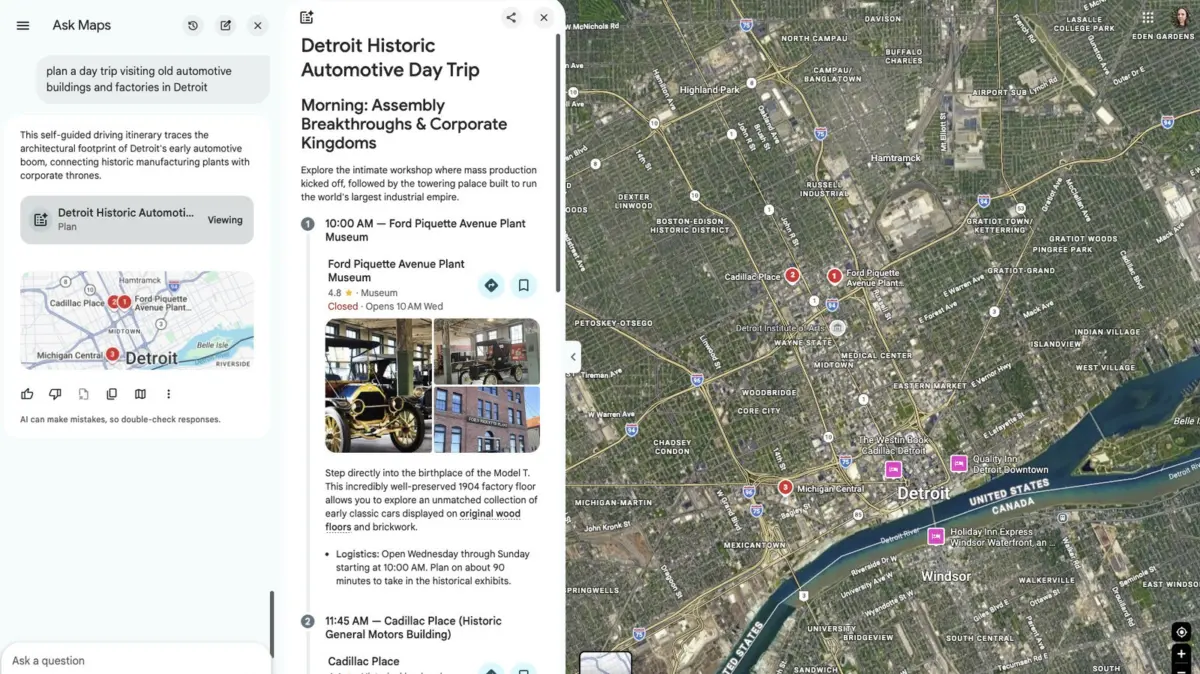
To get started with the new capability, users simply interact with Google Maps to outline their travel duration and general preferences. Google explains that the system can handle a wide variety of requests, ranging from a straightforward day trip focused on holiday shopping to much more complex travel plans, such as a multi-day road trip complete with specific stops for coastal hikes and oceanfront dining. Once a query is processed, the system generates a day-by-day schedule equipped with insider tips and numbered map pins for each designated stop, allowing travelers to easily visualize their route. Furthermore, once users are satisfied with the AI-generated itinerary, they can seamlessly share it with friends and family members or export the entire plan directly to Google Docs on a desktop computer.
This level of automation could prove particularly handy for motorists planning long-distance journeys in electric vehicles, where finding reliable charging stations along the route is critical. It also lends itself to localized adventures, such as planning an automotive day trip through historically rich areas like Detroit. However, early impressions suggest that while the technology offers a strong starting point, itineraries generated by the system still benefit from careful human review and manual editing to ensure accuracy and personal preference.
Ask Maps Will Do It All Without You Needing to Lift a Finger
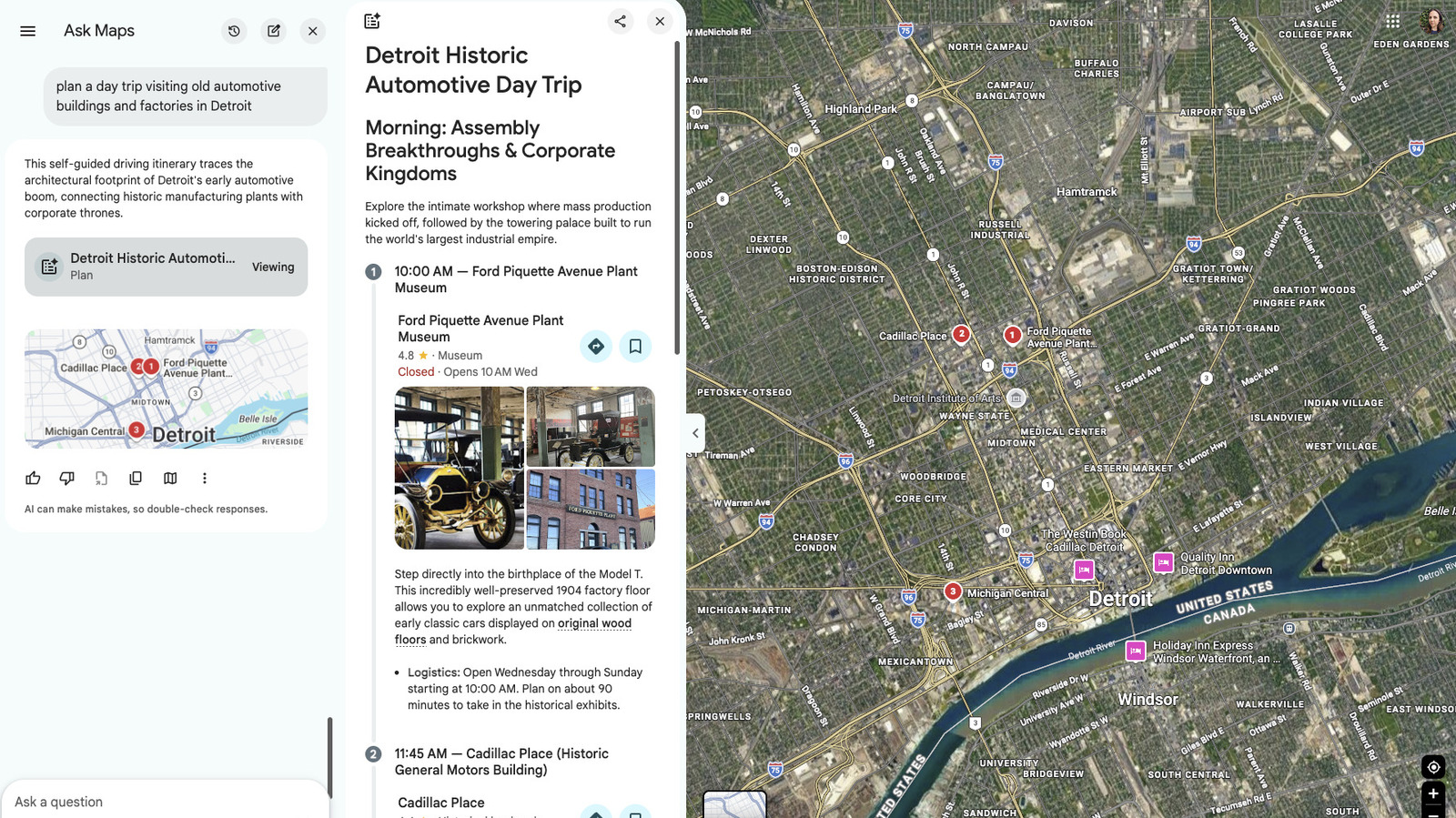
In the United States, travelers can modify their itineraries in real-time as circumstances change on the ground. If a specific destination ends up being closed, or if a sudden detour or additional stop becomes necessary, users can simply ask Maps to adjust the schedule accordingly. The system is designed to handle logistical adjustments on the fly, reducing the friction typically associated with spontaneous travel changes.
Beyond traditional mapping and routing, the integration points toward a future where digital assistants manage broader personal logistics. The technology is capable of assisting with scheduling appointments, managing upcoming days filled with errands, and even facilitating takeout orders directly through the platform rather than requiring users to open separate food delivery applications. In essence, the feature aspires to manage nearly every aspect of daily outing coordination. For most users, the only physical effort required will be typing a query into the interface, or increasingly, simply using a voice command to prompt the system to execute the task.
Perhaps the most curious conversation surrounding this technological leap, aside from broader societal questions regarding the potential loss of traditional human curiosity and self-sufficiency, concerns the commercial future of these recommendations. As users increasingly rely on artificial intelligence to curate their experiences, observers are questioning how long Google will serve these trip recommendations organically. Industry analysts note that it is likely only a matter of time before the platform begins integrating commercial placements, feeding destinations, and appointments sponsored by the highest bidder into its AI-generated itineraries, mirroring the trajectory of traditional search results and digital mapping ads. Many consumers are already familiar with unwanted commercial prompts appearing in navigation applications, raising questions about how impartial AI-driven travel advice will remain over the long term.
Despite these lingering questions regarding commercialization and algorithmic reliance, the rollout is set to expand rapidly. The feature is expected to reach Google Maps users across more than 30 countries in Europe and approximately 200 countries and territories worldwide. This global expansion means that millions of people will soon have access to automated itinerary planning.
At the same time, the broader integration of artificial intelligence across consumer technology continues to face scrutiny. While tech companies promote AI as an infallible assistant, past deployments have occasionally encountered significant hiccups in areas requiring fundamental logic, such as basic math calculations or automated municipal enforcement systems like incorrect parking citations. As Google brings its Gemini-powered planning tools to a global audience this holiday season, users will ultimately decide whether automated convenience outweighs the value of traditional, self-guided exploration.