
This story is a collaboration between Grist and Documented.
Earlier this year, riding his e-bike through New York City’s bustling streets on a sweltering July afternoon, José Yos began to smell smoke. It wasn’t coming from a nearby burning building or a beat-up yellow cab. Instead, the smell came from hundreds of miles away in Canada, where raging wildfires in Quebec had sent a cloud of thick, smoky air toward the city, blanketing it in a strange orange haze.
It wasn’t the first time Yos, a 40-year-old from Guatemala who delivers food and groceries on apps like DoorDash, had experienced this. In 2023, Canada experienced its worst wildfire season on record, with around 37 million acres of land going up in flames. Wildfire smoke traveled down from Quebec to New York, polluting the air and turning the skies a deep shade of orange. This summer, though, the city was also in the middle of a heat emergency—its second in as many weeks. The temperature was projected to reach close to 100 degrees Fahrenheit that day, and the real-feel temperature was expected to be even higher.
In response to the extreme weather double whammy, the city deployed cooling vans, opened additional cooling centers, and urged New Yorkers to stay home in air conditioning. But Yos was on the clock. He couldn’t afford to go home or take a real break. He had reserved his hours on Uber Eats a week in advance and feared that taking longer than usual to fulfill orders would lower his in-app rating, risking account deactivation.
Before the enactment of the city’s deactivation protection bill in January 2026, app workers could be deactivated without cause and with little recourse. Now, apps are required to give 72 hours’ notice before deactivating a worker, and workers have the right to an investigation. Still, workers avoid the hassle if they can. Even with the new law, dozens of workers visit the Brooklyn offices of the Worker’s Justice Project, an advocacy group for low-wage immigrant workers, every day seeking help to reopen accounts.
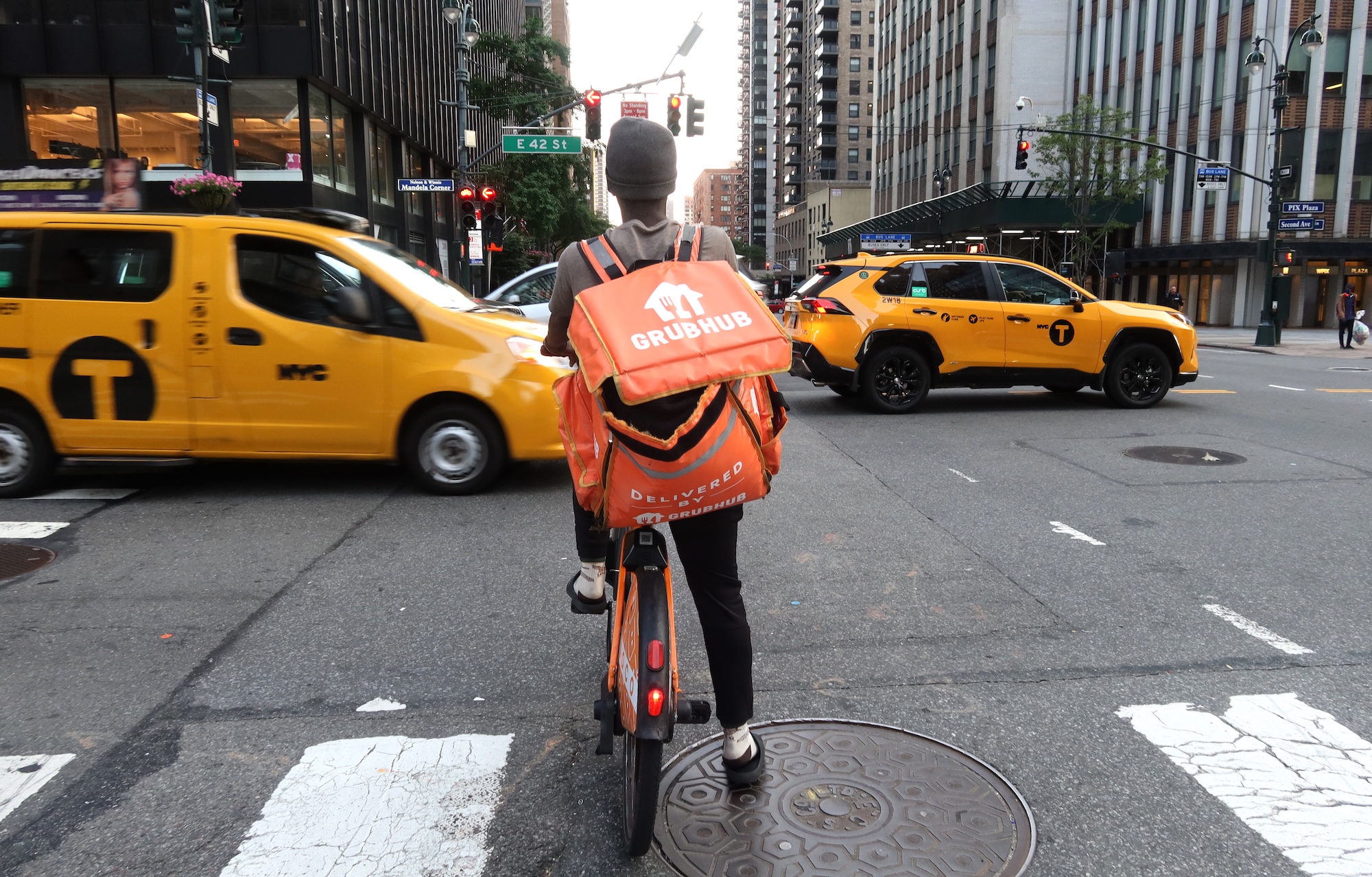
Too much was at stake. Undeterred by the smoke, Yos pulled his balaclava over his nose and mouth and kept riding.
Yos is one of roughly 70,000 app-based delivery workers across New York City’s five boroughs, many of whom say that, regardless of extreme weather, they have no choice but to work.
“Everything that happens with the weather affects us in two ways,” Yos said in Spanish. “First, it puts our health and safety at risk. And second, it puts our livelihoods on the line.”
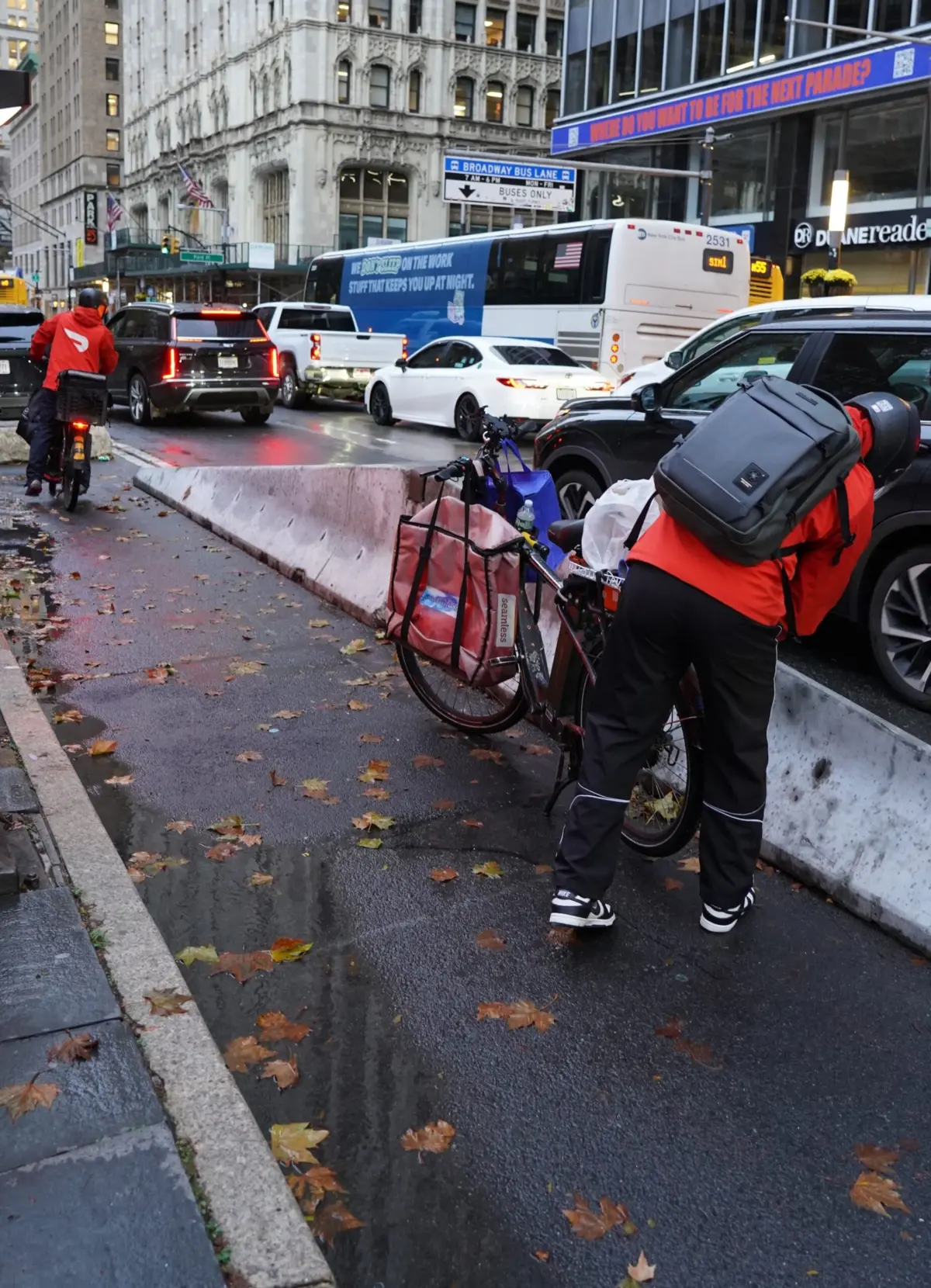
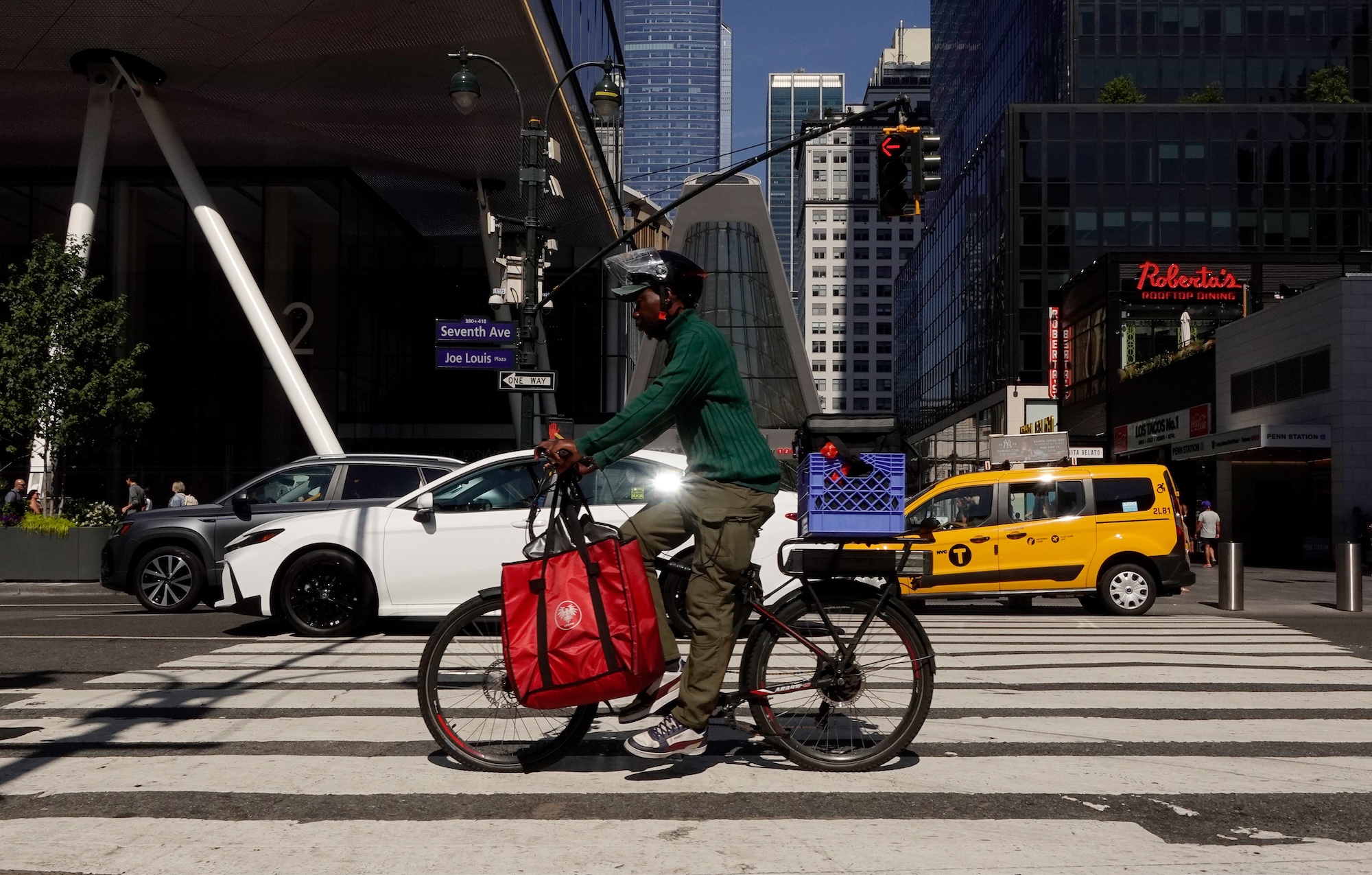
Most delivery workers ride e-bikes or e-scooters instead of cars, allowing them to bypass traffic and cut delivery times. But working outside takes a physical toll. Exposure to extreme heat can cause dehydration, dizziness, nausea, heatstroke, and heart failure, while heavy rainfall lowers visibility, creating dangerous road conditions. The delivery apps take none of this into consideration, Yos said.
“They don’t care, and they don’t give us extra time to pick up and drop off orders,” Yos said. “When it’s bad outside, we can’t hurry as well, and that in turn lowers our ratings.”
Many delivery workers hail from Latin America, with a growing number of migrants from sub-Saharan Africa and South Asia—regions facing the brunt of global climate change. Yos moved from rural Guatemala to New York City partly because his family could no longer reliably depend on farming as a source of income due to unpredictable rainfall. In recent years, Guatemala has suffered from both droughts and severe flooding that have suppressed crop yields, volatility linked by researchers to climate change and El Niño weather patterns.
In New York City, Yos struggles with different extreme weather impacts. As members of the gig economy, Yos and other delivery workers are considered self-employed freelancers and lack adequate health and safety protections on the job.
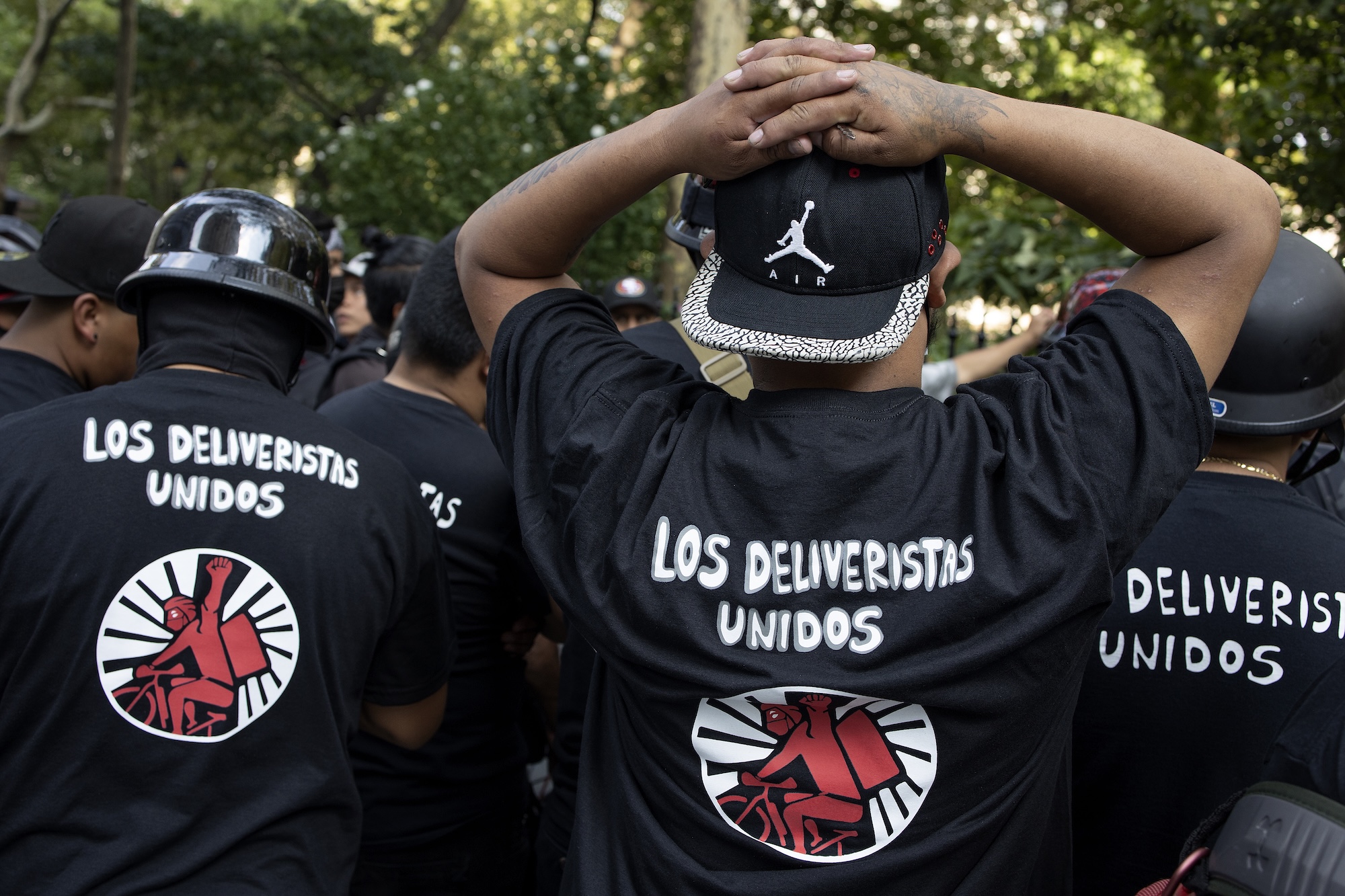
Building on the recent successes of including gig workers in the broader labor movement, Los Deliveristas Unidos, a labor union representing delivery workers, is working to make city officials aware of their needs on the road. At the same time, climate change makes their work increasingly dangerous.
“During heat waves, snowstorms, floods, and wildfire smoke events, they continue delivering essential goods—including water, medication, and groceries—to help people stay safe,” said Ligia Guallpa, executive director of the Worker’s Justice Project, which helps run Los Deliveristas Unidos. “In many ways, delivery workers serve as essential responders during emergencies.”
Recognizing delivery workers as experts with firsthand knowledge of how extreme weather collides with New York City’s infrastructure is critical. Back home in Chimaltenango, Guatemala, Yos worked from a young age growing produce with his family. Now, at the other extreme of the food supply chain, he sees how extreme weather disrupts modern food systems. The challenges Yos and his peers face—dangerous summer heat, flash flooding, and slippery roads during storms—will ultimately impact most New Yorkers, too.
The Evolution of Delivery and the Birth of a Movement
Before app-based delivery companies proliferated in the mid-2010s, most delivery workers in New York City were employed directly by restaurants. Customers placed orders by phone, and restaurants dispatched workers within a specific range. During the pandemic, however, delivery apps like DoorDash and Uber Eats exploded in popularity. Spending via food delivery apps at quick-service restaurants tripled from about $400 million in December 2019 to $1.4 billion by 2022, while third-party delivery spending nearly quadrupled at full-service restaurants over the same period, rising from $100 million to $400 million.
As New Yorkers endured lockdowns, they grew reliant on deliveries. Working the streets while others hunkered down inside, delivery workers Gustavo Ajche and William Medin realized how essential they were—and how unappreciated by apps that provided no healthcare or workers’ compensation. That realization sparked their organizing efforts.
Initially, members of Los Deliveristas Unidos focused on protecting themselves from robbery rings targeting their e-bikes, which cost around $2,000 and serve as their essential tools. Soon, the union’s scope expanded to address wage theft by the companies.
In 2018, the mobile delivery app industry was valued at $25.7 billion. Today, the market is worth $428.2 billion. This expansion transformed the city’s streetscape and labor force, which now includes some 20,000 more workers than before the pandemic. As app companies surged in revenue, immigrant workers felt left behind.
Los Deliveristas grew into a political force of nearly 15,000 active members, with influence in City Hall and the state capital. In 2021, workers won a historic, first-in-the-nation minimum wage law, raising pay from well below the federal minimum of $5.39 per hour before tips to at least $19.56 per hour before tips.
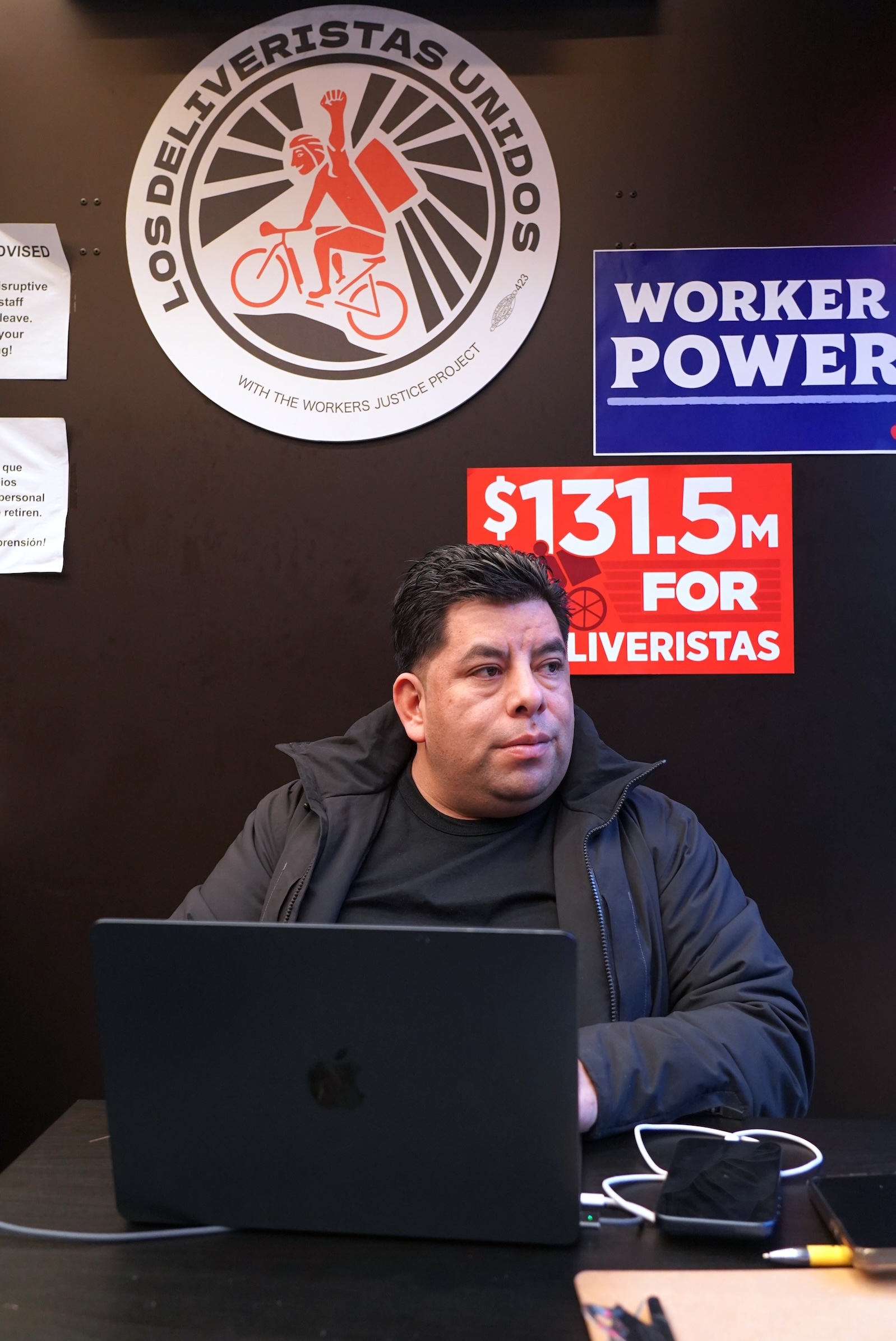
That same year, Los Deliveristas won the right to use restaurant bathrooms and secured tip transparency. In 2024, Mayor Eric Adams proposed a licensing law that advocates feared would lead to criminalization, which the union successfully pushed back against. A slate of new labor protections also took effect this year.
Still, delivery work remains one of the city’s most dangerous jobs, exacerbated by climate-driven heavy rainfall and warmer days. This summer was the wettest in five years, recording 16.92 inches of precipitation from June to August, with nearly 40 percent of days seeing wet weather. When it pours, subways leak, storm drains clog, and streets flood.
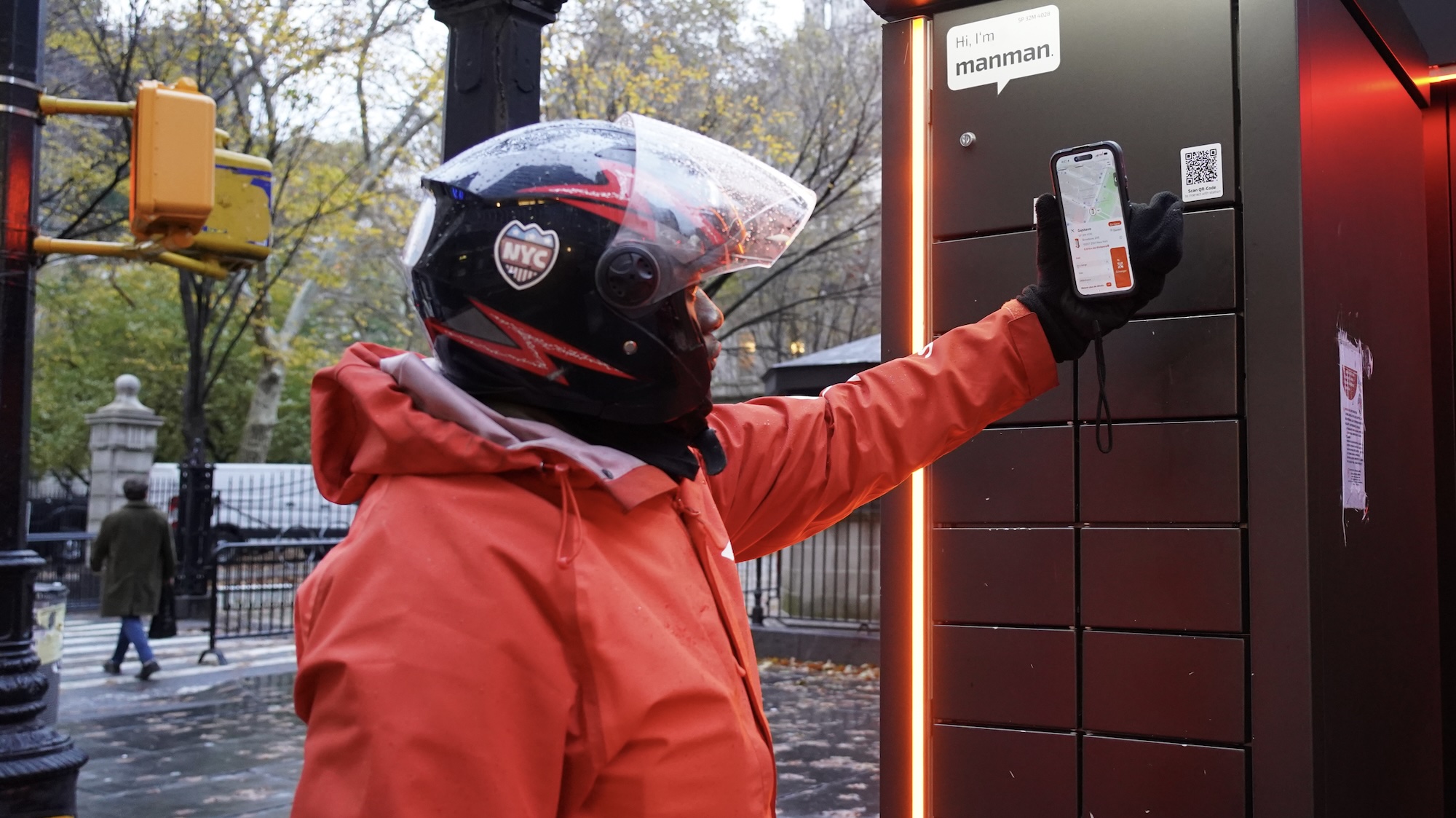
During the pandemic, Ajche conceived the idea of converting unused newsstands into rest areas for delivery workers. In 2020, Senate Majority Leader Chuck Schumer biked through Manhattan with Ajche, pitching the concept. Schumer and Adams threw their weight behind the idea in 2022, announcing $1 million in city and federal funding.
“Part of our goal is how the city of New York can bring in deliveristas as part of the conversation on city planning or emergency response,” Guallpa said.
By the time Adams’ term ended in 2025, the newsstand conversions had not begun. Upon taking office this year, Mayor Zohran Mamdani made opening the first hub a priority within his first 100 days. Design and engineering teams compressed a standard two-year process into months, and the first hub opened in April. However, the compressed timeline led to setbacks: the hub lacked electricity on opening day, and plans for a second hub on the Upper West Side stalled following community pushback.
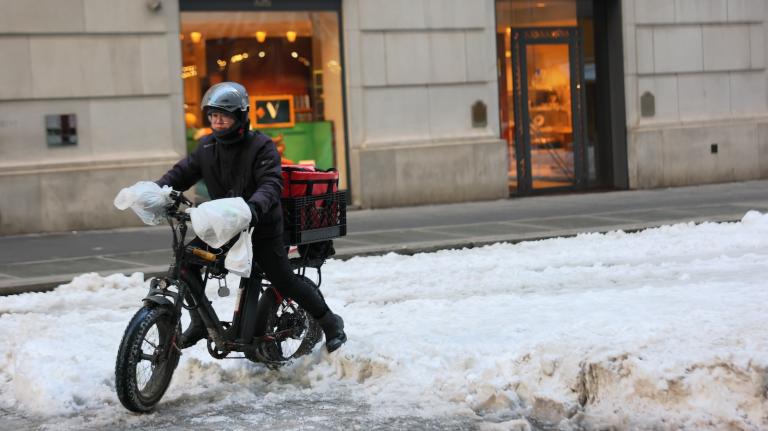
Due to worker organizing, apps have taken steps to improve safety. While Uber Eats declined to comment, it noted its partnership with the Governors Highway Safety Association to develop a bike safety checklist and provide safety gear like helmets and vests, as required by city law. GrubHub declined to comment, referring instead to its online safety policies.
Samantha Ramirez, policy communications manager at DoorDash, said the company protects workers through a Severe Weather Protocol, monitoring weather changes, issuing proactive warnings, and temporarily suspending operations during extreme conditions.
“We also send reminders to Dashers on how to stay safe in cases where it’s hotter or colder outside than normal, or if there’s exceptionally bad air quality,” Ramirez said.
Despite mixed results, Guallpa and Los Deliveristas Unidos want the city to include delivery workers in its climate adaptation plans.
“We need policies that reflect the realities delivery workers face, including safe working conditions, hazard pay, and meaningful protections that allow them to prioritize their health and safety without risking their livelihoods,” Guallpa said.
Deputy Press Secretary Jeremy Edwards stated that Mayor Mamdani recognizes that delivery workers keep the city running and acknowledged that they have no choice but to brave the elements. He affirmed the administration’s commitment to protecting all New Yorkers from extreme weather through continued collaboration with the Worker’s Justice Project.
To improve conditions, City Council Member Harvey Epstein recently introduced a bill forcing delivery apps to provide bathroom access, rest stops, e-bike charging stations, and bike storage facilities.
“I support delivery workers’ right to make deliveries in our neighborhood, and delivery app platforms must be held accountable for the hazardous working conditions that impact both deliveristas and our neighborhoods,” Epstein said.
The Complex Realities of Climate Migration
Whether workers like José Yos and Hari Sharan Tripathi should be classified as climate migrants is a complex question. According to Erica Bower of Human Rights Watch, individuals must relocate as a direct response to environmental factors intensified by climate change to be considered climate migrants. Because proving climate change as a direct driver is difficult, terms like "climate migrant" and "climate refugee" are used sparingly by researchers, who often categorize workers like Yos as labor migrants seeking economic opportunity.
Migrants themselves may not initially cite climate volatility, often prioritizing immediate economic survival. However, research from organizations like the Mixed Migration Centre shows that when prompted about environmental challenges, a significant percentage of migrants acknowledge that natural disasters and environmental degradation contributed to their economic struggles and decision to move.

For instance, Hari Sharan Tripathi grew up tending his family’s orange groves in Pokhara, Nepal, which eventually yielded fewer fruits due to rising global temperatures. Witnessing the receding snow on Mount Machhapuchhre, Tripathi observed environmental changes firsthand. Nepal ranks high in climate vulnerability, and glacier melts contributing to flash floods have driven outward migration. Now in New York City, Tripathi works as a delivery worker for Uber Eats, battling heavy rainfall, flash floods, and winter hazards like black ice.
The question of whether workers count as climate migrants has real-life ramifications for accessing municipal services. Proposals for a climate migration services coordinator in New York City illustrate how cities might better reach vulnerable populations.
Meanwhile, for migrant delivery workers, rainfall presents severe hazards. Saliou Ndiaye, a 26-year-old Senegalese delivery worker, was hit by a car during a rainstorm in 2022 due to low visibility, breaking his leg and preventing him from working for a year. Ndiaye noted that worsening floods in his hometown of Thiès mirror the heavy rain and street-level flooding he navigates in New York. Similarly, Mansour Thioye, a 37-year-old delivery worker from Kaolack, Senegal, described routine flooding at home, noting that families frequently take shelter in schools during extreme weather. In New York, where he has lived for 15 years, rain presents ongoing traffic and road hazards.
As cities adapt to climate change, local governments can learn by listening directly to the experiences of migrants and workers whose livelihoods are tied to the weather. As delivery workers emphasize, the worse the weather gets, the more dependent cities become on the very workers braving the elements to keep them fed.