
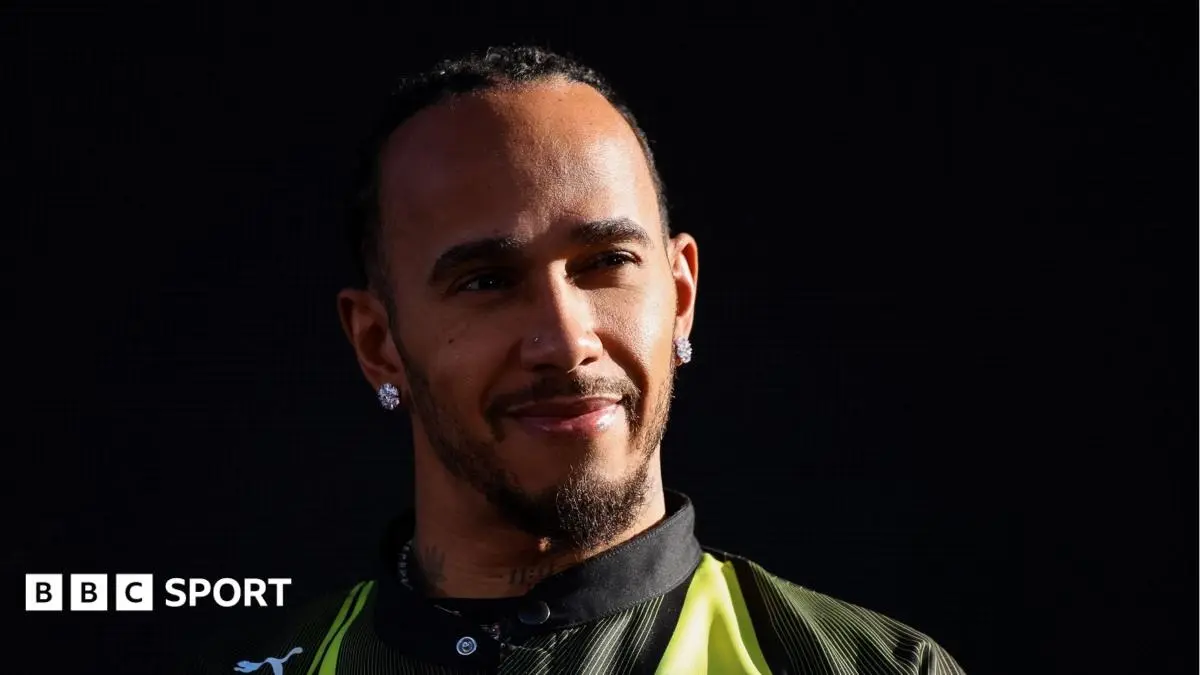
Lewis Hamilton has firmly dismissed suggestions of a growing trust deficit between himself and his Ferrari race team, insisting that their working relationship remains entirely solid as the Formula One paddock arrives in the desert for the high-stakes Las Vegas Grand Prix.
The seven-time world champion has found himself under the microscope in recent weeks after twice ignoring direct instructions from the pit wall to pit for fresh tyres across the span of the past four race weekends. On both occasions, the British racing icon’s calculated gamble to override the team’s strategic advice ultimately worked to his competitive disadvantage, raising questions among pundits and fans alike regarding the internal dynamics of one of the sport’s most famous partnerships.
The most recent occurrence of this tactical defiance came just weeks ago during a chaotic and rain-soaked Sao Paulo Grand Prix on November 8. In treacherous conditions at Interlagos, Hamilton chose to stay out on a deteriorating set of worn slick tyres as the rain intensified across the circuit. The decision backfired dramatically when he lost control of his machine, spinning off the asphalt before he was finally forced to limp into the pit lane on the very next lap to rectify the situation.
Yet, addressing the media ahead of the upcoming weekend of racing on the glittering Las Vegas Strip, Hamilton adopted an entirely positive tone when discussing his day-to-day collaboration with race engineer Carlo Santi. Having transitioned to work with Santi following a different engineering partnership last year, the veteran driver emphasized that the communication channel between the cockpit and the pit wall has undergone significant refinement and improvement throughout the ongoing championship campaign.
"We’re constantly working on our communication," Hamilton stated, reflecting on the evolutionary process of their partnership. "It’s been a lot better this year. Carlos has done an amazing job. And those particular two times, particularly the last time, was just I didn’t have the information I needed. I got the call right at the last minute."
Providing further context into the frantic nature of high-speed decision-making on the track, the British driver elaborated on the operational adjustments the team is actively pursuing to ensure smoother race execution moving forward. "We’ll just continue to work on the processes. We’re super united in what’s working, in the right direction," he added, firmly shutting down any narrative that a breakdown in faith exists within the Maranello-backed camp.
The incident in Brazil mirrored a similar strategic divergence earlier in the season during the Singapore Grand Prix. On that occasion, Hamilton once again chose to ignore a direct pit call from his engineers, opting instead to stay out on track during a crucial virtual safety car period. The gamble failed to yield the desired reward, prompting the seasoned champion to issue a public apology in the aftermath of the race.
At the subsequent race weekend in Austin, Texas, Hamilton offered deeper insight into the competitive mindset that drives these split-second overrides. He explained that his instinct as a multi-time world champion is rooted in a relentless pursuit of victory, noting that he is constantly searching for alternative paths to the front of the grid rather than passively accepting a predictable outcome. "I was always looking at ways to win, always looking at doing potentially something different," Hamilton explained in Austin. "And I wanted to be on a different strategy, not just the same strategy as Charles (Leclerc), where we just follow each other."
While tactical disagreements with the pit wall have occasionally flared up, Hamilton has also had to navigate the delicate internal politics of sharing a garage with high-performing teammate Charles Leclerc. Tensions had briefly threatened to boil over following a dramatic first-lap collision between the two Ferrari cars at the Mexico City Grand Prix. That unfortunate tangle on the opening lap saw both drivers squander a golden opportunity to secure a dominant one-two finish for the Scuderia, inadvertently handing the race victory on a plate to Red World Championship rival Max Verstappen.
However, any lingering animosity or intra-team friction was swiftly addressed behind closed doors during clear-the-air discussions held in Brazil immediately following the Mexican Grand Prix weekend. Speaking to reporters on Wednesday in Las Vegas, Hamilton was quick to praise his teammate and reaffirm that mutual respect remains the cornerstone of their partnership on the track.
"Charles is a great driver," Hamilton noted. "The detail we went into about stuff like that in terms of when we close the visor, it’s very clear we understand each other. We understand each other’s boundaries and the ultimate goal, which is to get the best result for the team. So I don’t feel that that will be a problem going forward. I have no concerns or worries about racing him, and I don’t think he does with me either."
Leclerc echoed these sentiments, detailing how quickly the two competitors were able to resolve their differences and realign their focus toward the remaining objectives of the Formula One season. According to the Monegasque driver, the initial friction dissolved almost as soon as they sat down to discuss the incident from Mexico, transforming what could have been a prolonged internal feud into a constructive conversation about the team’s future development.
"The discussion went very well," Leclerc explained. "Very, very quickly, after a few sentences already, the tension that was there was not there anymore, and it was all fine."
Leclerc emphasized that both drivers remain acutely aware of the broader strategic targets facing Ferrari as the season races toward its conclusion. Securing a strong finish in the Constructors’ Championship is of paramount importance to the Italian outfit, even if the team currently enjoys a relatively comfortable margin over their immediate pursuers in the standings.
"We both work in the direction of having that second place in the constructors’ championship. The second place in the constructors’ is important," Leclerc said. "It’s also true that we’ve got a relatively big margin behind, which doesn’t mean we need to minimise that, and we still have to work as a team. But what is really important for me now is to try and win before the end of the season and win the race."
Reflecting on the intense scrutiny that invariably accompanies life as a Ferrari driver, Leclerc pointed out that external observers often magnify normal competitive disagreements into major internal crises. Having spent many years wearing the iconic red suit, he has grown accustomed to the relentless media spotlight and the tendency for routine sporting debates to be blown out of proportion.
"Everything has been taken out of proportion," Leclerc reflected. "I’m kind of used to it now, driving for Ferrari for so many years, but things are very often taken out of proportion. Of course, the goal is not always to agree, and that will never happen. We can have different opinions, and that was the case, for example, in Mexico. But just the fact of speaking eased all tensions, and we were completely fine with it."
He added that what began as a targeted debrief about race craft and on-track boundaries naturally expanded into a wider dialogue about how the driver pairing can proactively assist Ferrari in pushing forward and closing the performance gap to the front of the field. What was expected to be a tense confrontation ultimately turned into an hour-long exchange encompassing various aspects of the team’s trajectory.
"It’s not that we had to speak for an hour, even though it ended up lasting an hour, just because we had a good time and we started speaking about also many other things in trying to bring the team and to help the team go forward," Leclerc said. "But the discussion about the tension was like maybe five or 10 minutes, and then the air was clean, and that’s it."