
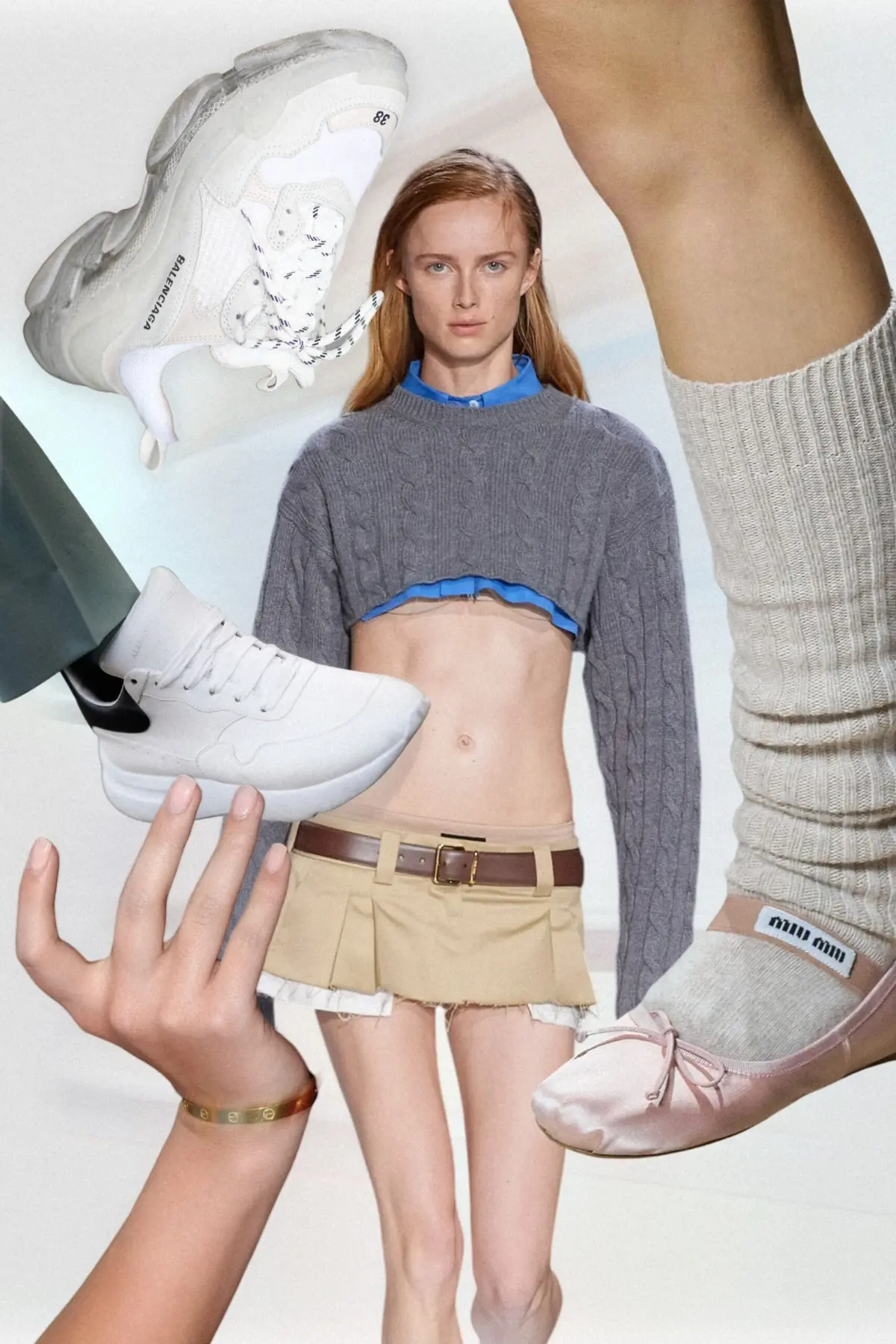
For the better part of three years, Miu Miu was the undisputed engine of the luxury sector. Between 2022 and 2025, the brand seemed to possess a Midas touch, consistently capturing the cultural zeitgeist with a succession of viral product releases. From the polarizing ultra-low-rise micro-mini skirt that redefined hemlines to the ubiquity of its logo-adorned ballet flats and a highly coveted collaboration with New Balance on the 530 silhouette, Miu Miu’s growth was nothing short of meteoric. The financial results were equally staggering: in 2024, the label reported a 93% surge in revenue compared to the previous year. By the close of 2025, Miu Miu had solidified its position as a powerhouse within the Prada Group, accounting for 31% of the conglomerate’s total retail sales—a significant jump from the 25% share it held just twelve months prior.
However, the relentless upward trajectory that defined Miu Miu’s recent history has hit a period of normalization. According to the Prada Group’s most recent earnings report, the label recorded a modest 2.4% increase in the first quarter of 2026. While to an outside observer this might appear as a sudden cooling of demand, the figure must be viewed against the monumental 60% growth the brand experienced in the same period the year prior.
This deceleration was largely anticipated by market analysts and the company’s leadership. During the first-quarter earnings call, Prada Group CEO Andrea Guerra addressed the shift, noting that Miu Miu was navigating a "disrupted environment" while contending with the "most challenging comparison base of the year." In essence, Miu Miu’s performance during its viral peak was so exceptional that even a robust, steady performance today inevitably looks like a slowdown on a balance sheet. While the brand did not respond to requests for comment on these figures, the industry consensus remains that Miu Miu is simply transitioning from an era of explosive, trend-driven expansion into a phase of structural stabilization.

The Broader Luxury Slowdown
The experience of Miu Miu is far from an isolated case; it is symptomatic of a wider trend impacting the luxury landscape. Even Hermès—a brand that had long been heralded as the resilient exception to the post-pandemic luxury slowdown—has begun to show signs of fatigue. For the nine months ending September 30, 2026, the house recorded slower-than-anticipated growth. Specifically, performance in its ready-to-wear and accessories divisions dipped 2.1% compared to the previous year, a development that weighed heavily on the company’s overall quarterly results.
During the firm’s recent earnings call, Hermès CFO Éric du Halgouët attributed the contraction in part to a dip in "high-volume" categories. This classification includes footwear and non-handbag accessories, such as belts, which have historically served as accessible entry points for aspirational consumers. A prime example is the Hermès Oran sandal, a staple of the brand’s footwear collection that retails for approximately $900. As these entry-level, high-volume products see a cooling in demand, the impact is felt across the luxury sector. Hermès, like many of its peers, has declined to comment on the specifics of this performance.
Striking the Balance: Virality vs. Longevity
Viral hit products are a double-edged sword for luxury houses. On one hand, they are undeniably effective at driving immediate revenue and maintaining brand relevance in an attention-starved digital market. On the other hand, they create a "difficult comp" problem. Once the initial fervor subsides, brands are left to manage the aftermath of high-volume sales against a backdrop of shifting consumer interest. In a volatile macroeconomic climate, the pressure to secure new customers often leads brands to lean heavily on these proven hits, making it increasingly difficult to balance short-term sales spikes with the long-term desirability of the wider brand portfolio.

"A single hit can keep sales strong while hiding softer demand elsewhere and failing to attract the next generation," says Jeanel Alvarado, founder and editor-in-chief of RetailBoss. "When demand slows, the brand must replace lost revenue and build new demand, with less money available to do either."
The sneaker category, in particular, has become a graveyard for former "hero" products. Alvarado points to the Balenciaga Triple S sneaker—the defining footwear of the Demna era—as a cautionary tale. Following its 2017 release, the shoe’s exaggerated, chunky silhouette became a status symbol that significantly inflated the brand’s sales. Its design effectively bridged the gap between high fashion and the way people were dressing in their daily lives. Yet, as the silhouette fell out of fashion, it left the brand with the challenge of overcoming the massive sales figures the sneaker had once generated. "The challenge comes when demand for those few recognizable products becomes stronger than customers’ interest in the wider collection," Alvarado notes. By 2018, while Kering’s reports were still praising the "exceptional momentum of Balenciaga," the brand was already setting itself up for a difficult comparison as the initial hype surrounding the Triple S began to fade.
A similar dynamic played out at Alexander McQueen. The house’s entry-level "Oversized Sneaker" became a massive commercial driver, representing, according to Kering CEO Luca de Meo, roughly 80% of brand revenues at its peak in the late 2010s. The subsequent decline was sharp: analysts at Bernstein noted that the house’s turnover plummeted from approximately €850 million to €200 million between 2022 and 2025.

"When sales are under pressure, brands can double down on products customers already understand and can more easily justify buying," Alvarado explains. Because popular items are backed by hard sales data, they are often prioritized in retail space and marketing campaigns, yielding short-term, "easy" wins. "The short-term need to protect revenue then leaves fewer resources to build demand for alternatives. That is how a sensible buying decision becomes a longer-term dependence."
From Breakout to Burnout
The life cycle of a viral product is accelerating, largely due to the influence of short-form video platforms where trends are born and die in a matter of weeks. For luxury brands, the primary danger is ubiquity. "A breakout, viral product can lift a brand quickly, but once it’s everywhere, it loses the exclusivity that made people want it," says Katy Lubin, VP of brand and communications at Lyst.
This loss of exclusivity is catastrophic for luxury positioning. "It’s hard to spend a lot of money on something and then see it everywhere," observes Marissa Lepor, managing director of The Sage Group. "The more prevalent that a luxury item becomes, the less interested the core customer of the luxury brand is in it. They feel like it’s everywhere, or they already have enough of them."

Furthermore, the high visibility of these hero products often invites a flood of "dupes" from high-street and contemporary brands. While the primary luxury consumer may remain uninterested in mass-market alternatives, the existence of these imitations often dilutes the aspirational appeal of the original. "It can really amplify the conversation around those hero products, but maybe doesn’t scale as much with sales," Lepor adds. "The person who is coveting that luxury item might not end up buying it; they might end up buying something similar."
Strategies for Sustainable Growth
To mitigate the risk of over-reliance on a single product, some houses have turned to the traditional luxury lever of scarcity. "Hermès and Rolex still sell less of their iconic products than their market would take," notes Luca Solca, managing director of luxury goods at Bernstein. In the case of Hermès, the scarcity is often a byproduct of a deliberate, intricate production process. As artistic director Pierre-Alexis Dumas remarked to 60 Minutes in 2024, the brand’s approach is simple: "Whatever we have, we put on the shelf, and it goes." By keeping supply below demand, hero products—even those that achieve viral status—avoid becoming truly ubiquitous, allowing the brand to maintain an air of exclusivity.
For brands that lack the historical production constraints of an Hermès, the path forward involves using a hit product as a gateway rather than a destination. "It is good to have an iconic product that everybody wants, but it is better to follow up with more products to build on this," says Solca.

Industry experts point to the Cartier "Love" bracelet as a masterclass in this strategy. Rather than resting on the success of a single item, Cartier expanded the concept into the broader "Love Unlimited" collection. "It’s less figuring out why something went wrong, and more figuring out how to iterate upon it to do something like that again," says Lepor. "Something I think is really important with the luxury world right now is not just selling people one item, but getting them to covet the world of the brand."
Emerging designers are also proving that it is possible to cultivate broad-based demand. Lyst’s data shows that Conner Ives, for example, saw a 49% rise in demand between the second and third quarters of 2026. Crucially, that demand was not concentrated in a single item; while the vintage robe from his SS27 collection led interest, the desire was spread across scarves, dresses, and shirts. Similarly, brands like Bottega Veneta and Chanel have maintained strong demand across multiple categories.
Ultimately, the lesson for the industry is clear: strength across multiple categories spreads commercial risk and protects long-term brand value. By ensuring that each hero product acts as a bridge to the wider brand universe rather than a siloed success, luxury houses can protect their future. "Brands need to invest in the next reason to buy while the current hero funds the business," concludes Alvarado. "The strategic advantage is building the next generation’s reason to purchase before the business loses the revenue supporting its current one."