
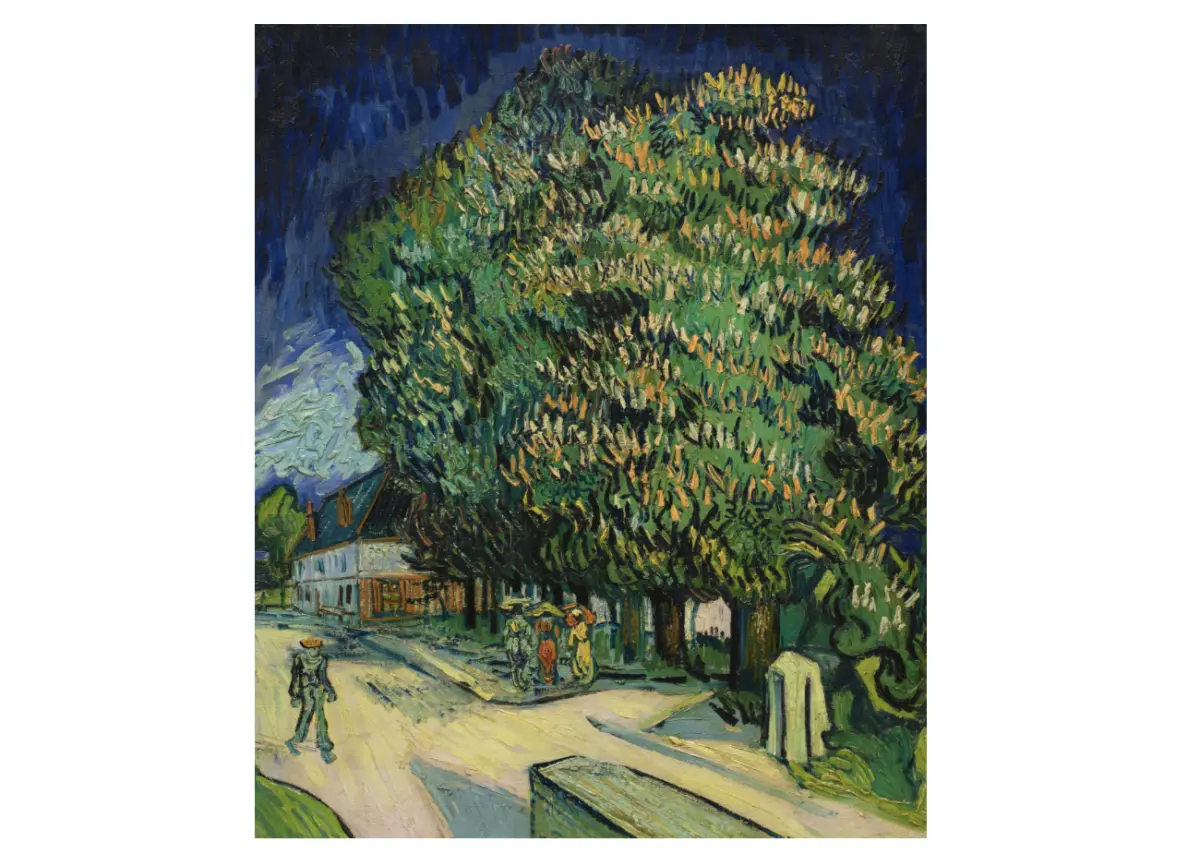
In a high-stakes resolution that has sent ripples of relief through the international art market, Sotheby’s announced on Tuesday that it has reached a settlement with the heirs of a prominent Jewish publishing family. The agreement effectively clears the path for the auction of Vincent van Gogh’s 1890 masterpiece, Châtaigniers en fleurs (Chestnut Trees in Blossom), which is estimated to fetch approximately $180 million. The painting is set to serve as the crown jewel of the auction house’s $450 million sale of the Blaquier-Arrieta collection, scheduled for Wednesday night.
The controversy, which threatened to cast a shadow over one of the most anticipated sales of the season, centered on claims made by the descendants of Hedwig and Samuel Fischer. The Fischer family argued that their ancestors had been forced to divest themselves of the painting in Amsterdam in 1936 due to the mounting financial pressures and existential threats posed by the rise of the Nazi regime.
A High-Stakes Legal Clash
The public confrontation began in earnest just last Thursday, when reports surfaced in the New York Times detailing the claims of the Fischer heirs. Their Berlin-based legal representative, Gunnar Schnabel, had issued a stern demand for the immediate withdrawal of the painting from the upcoming auction, unless Sotheby’s could provide definitive proof that the 1936 transaction was a voluntary, market-driven sale rather than a "forced sale" necessitated by state-sponsored persecution.
For Sotheby’s, the timing could not have been more precarious. With only six days remaining before the gavel was set to fall, the auction house faced a potential PR nightmare and the loss of a marquee lot that had been the centerpiece of months of global marketing. The painting had been guaranteed by Sotheby’s for an undisclosed sum, putting the firm in a position where it had significant financial exposure should the sale be derailed or the provenance of the work permanently tarnished.
Sotheby’s vehemently disputed the characterization of the 1936 sale as a forced transaction. According to documents cited by the auction house—drawn from the historical archives of the renowned art dealer Paul Cassirer—the painting was sold in June 1936 for 68,000 Swiss francs, a sum equivalent to roughly $22,000 at the time. The auction house maintained that this price represented a fair market valuation for a Van Gogh during that era and emphasized that the painting had been situated in Amsterdam for nearly three years prior to the sale, suggesting that the movement of the asset was not an immediate reaction to the Nazi seizure of power in Germany.
The Dynamics of Restitution Claims
The sudden emergence of the claim just days before the auction led to significant speculation among industry insiders. Several art market professionals, speaking on the condition of anonymity, suggested that the timing of the legal maneuver could be interpreted as a tactical pressure move. By waiting until the auction house was fully committed to the sale, the claimants held substantial leverage, forcing a quick resolution from a firm that had little room for maneuver.
Judd Grossman, a New York-based attorney specializing in art law who is not involved in this specific case, noted that this type of situation reflects a broader, evolving landscape in restitution litigation. He pointed to recent amendments to the HEAR (Holocaust Expropriated Art Recovery) Act, which governs claims regarding Nazi-looted or coerced property. Grossman cautioned that these legal shifts, while intended to provide justice for victims of the Holocaust, may inadvertently encourage "gamesmanship" by claimants who hold back until the final moments of a public sale to assert their rights, essentially seeking to negotiate a "slice of the pie" when the stakes—and the visibility of the art house—are at their highest.
The legal validity of these recent amendments has itself become a matter of contention. In other ongoing litigation, representatives for the Republic of Austria, as well as the Albertina Museum and the Leopold Museum Foundation, have formally challenged the constitutionality of the updated HEAR Act, arguing that it creates an unmanageable environment for institutions and collectors alike.
Terms of the Settlement
Despite the intense buildup, the resolution reached on Tuesday remained confidential. Sotheby’s confirmed that the settlement with the legal descendants of Hedwig and Samuel Fischer resolves all outstanding ownership claims. As a result, the buyer of the painting on Wednesday night will receive a clear, uncontested title to the work.
Whether the Fischer heirs received a financial payout as part of the agreement remains unknown. The joint statement released by the parties was notably opaque regarding monetary compensation. Instead, the announcement focused on the moral and historical recognition of the family’s ordeal. Sotheby’s stated that the agreement acknowledges both the "complicated history" of the painting and the profound persecution suffered by the Fischer family under the Nazi regime.
For the Fischer heirs, the resolution was framed as a success, albeit one rooted in a difficult past. In a public statement, the family expressed gratitude to both Sotheby’s and the Blaquier-Arrieta family—who have owned the painting since 1975—for engaging in what they described as a "trusting and fair negotiation." The family noted that the settlement serves to honor the legacy of Gisela Bermann Fischer, who spent much of her life dedicated to the pursuit of restitution for her family’s lost assets.
Bermann Fischer, who passed away in 2014, was a well-known figure in the world of restitution. Her history of advocacy included a notable decision in 2007 to decline to contest the sale of a Paul Cezanne, which had also passed through the hands of the same Amsterdam dealer as the Van Gogh. At the time, she had explicitly reserved the right to challenge other sales, a move that set the stage for her descendants to continue her work in the years following her death.
Looking Toward the Auction Block
For the Blaquier-Arrieta family, the settlement brings a conclusion to an unsettling interlude in what is otherwise a highly celebrated collection sale. The family stated they are pleased to have resolved the matter and expressed their enthusiasm for the upcoming event. "We look forward to an extraordinary result and to passing along this masterpiece to a new generation of collectors," their statement read.
As the dust settles, the focus of the art world shifts back to the auction room. The inclusion of Châtaigniers en fleurs remains the highlight of the evening, and with the cloud of litigation removed, the painting is expected to perform as a barometer for the current health of the blue-chip art market.
The resolution of the dispute underscores the complex, often fraught intersection of historical trauma, legal precedent, and the modern multi-billion-dollar art trade. While the specific terms of the settlement will remain shielded from public view, the agreement ensures that the provenance of this particular Van Gogh will not be clouded by the specter of the 1936 sale in the eyes of future collectors. For now, the focus returns to the canvas itself—a vibrant, swirling testament to Van Gogh’s final months in Auvers-sur-Oise—as it prepares to change hands once again in a room full of the world’s most significant collectors.