
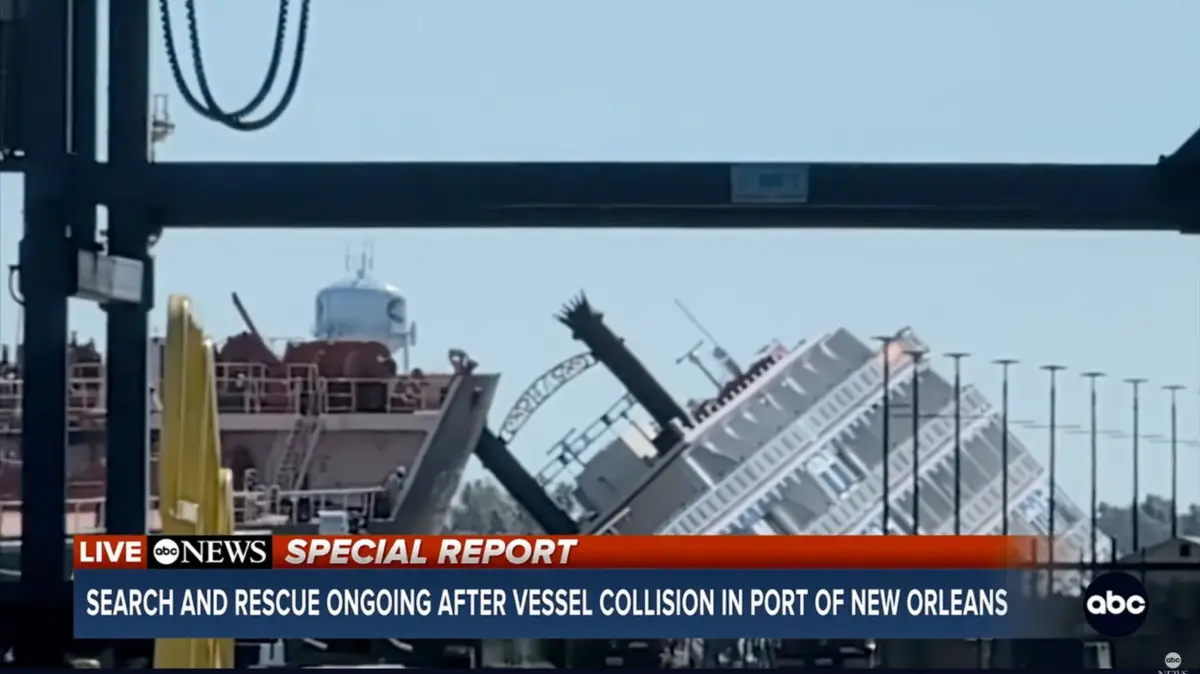
The bustling Port of New Orleans became the scene of a dramatic maritime emergency on Friday afternoon when an industrial tanker ship collided directly with a docked riverboat carrying nearly 130 passengers and crew members. The violent impact sent shockwaves through the waterfront, prompting a massive multi-agency rescue response and leaving local officials to grapple with what many are already calling a miraculous avoidance of fatalities.
The incident unfolded at approximately 12:30 p.m. Eastern Time outside 1350 Port of New Orleans Place. According to local and federal authorities, the American Cruise Lines vessel, the American Heritage, had been securely docked for roughly two hours. Passengers and crew were in the process of beginning their disembarkation routine when the situation drastically changed. An asphalt tanker ship, identified as the Atlantic Asphalt, careened into the stationary riverboat in a forceful t-bone collision.
The sheer momentum of the impact dealt catastrophic damage to the riverboat’s hull. Witnesses and emergency personnel on the scene reported that the vessel almost immediately began taking on water, listing dangerously to one side before capsizing rapidly. Within moments, the luxury river cruiser was resting entirely on its side directly against the dock, half-submerged in the murky waters of the Mississippi River.
In the immediate aftermath of the collision, city officials, emergency management teams, and first responders rushed to the scene. An estimated 32 individuals were quickly pulled from the wreckage, rescued from the water, or assisted off the listing vessel, and subsequently transported to nearby medical facilities for treatment. Authorities confirmed that all injuries sustained in the incident were non-critical, though the exact total number of individuals requiring medical evaluation remains fluid as the situation continues to evolve.
Miraculously, despite the sudden and violent nature of the crash—which completely compromised the structural integrity of the riverboat—all 129 passengers and crew members accounted for on the manifest have been located. Officials expressed profound relief, confirming that there were no fatalities resulting from the dramatic collision, a statistic that underscores the rapid response time of the emergency crews working along the harbor.
In response to the unfolding emergency, the U.S. Coast Guard took immediate action to secure the surrounding waterway. Authorities officially closed a significant stretch of the Mississippi River to all vessel traffic, restricting movement between mile markers 93 and 96 to prevent further navigational hazards and to clear the channel for ongoing rescue operations.
Local news affiliates, including WDSU News, reported a coordinated and extensive deployment of emergency resources to the waterfront. Port NOLA Harbor Police, the New Orleans Fire Department, the New Orleans Police Department, the U.S. Coast Guard, and specialized emergency medical personnel converged on the scene nearly simultaneously. Their synchronized efforts to secure the area, triage the victims, and ensure that no one was trapped inside the rapidly capsized hull have been widely praised by state leaders, with many local officials labeling the successful rescue operation a true "miracle on the Mississippi."
These river cruises attract elderly passengers
The demographic makeup of those on board quickly became a primary point of concern for state and local leaders monitoring the crisis. Louisiana Lieutenant Governor Billy Nungesser expressed deep apprehension during interviews following the crash, noting that these specific types of regional river cruises historically attract a large population of elderly travelers. Given the advanced age of many passengers, the shock of the collision, the sudden evacuation, and the freezing environmental conditions posed significant health risks.
Following their extraction from the distressed vessel, rescued passengers were escorted directly into the Port of New Orleans Administration Building. There, emergency workers set up a centralized triage and assistance station to evaluate survivors, provide warm blankets, check for signs of shock, and offer immediate medical and psychological support.
Compounding the anxiety of the rescue effort were the environmental conditions of the river itself. The U.S. Army Corps of Engineers reported that the water temperature surrounding the shipwreck hovered at approximately 66 degrees Fahrenheit. While seemingly mild to some, sustained exposure to water at this temperature presents a severe and immediate risk of hypothermia, making the rapid extraction of all passengers from the river and the adjacent docks an absolute priority for marine rescue units.
As recovery and triage operations pressed forward, federal and state investigators began the arduous process of determining what went wrong. While an official, definitive cause of the crash has not yet been established, preliminary observations and early investigative theories strongly suspect a sudden and critical loss of steering aboard the Atlantic Asphalt tanker. Investigators from the Coast Guard and the National Transportation Safety Board are expected to comb through navigational logs, radar data, and eyewitness accounts to piece together the exact sequence of events that led the tanker off its intended course and into the docked passenger vessel.
The gravity of the incident drew immediate attention from the highest levels of government. Louisiana Governor Jeff Landry rushed to the scene of the disaster to oversee the state’s response and assess the physical damage firsthand. During his briefing with reporters, Governor Landry revealed that he had spoken directly with President Donald Trump regarding the collision. According to the governor, the administration offered full federal backing, assuring state officials that Louisiana had access to every necessary resource required to manage the emergency, support the victims, and clear the blocked waterway.
With the immediate search and rescue phase concluded and all victims accounted for, the focus of the operation shifted toward environmental containment, vessel recovery, and reopening one of the nation’s most vital commercial waterways. The U.S. Coast Guard, operating in close coordination with specialized marine salvage assistance teams, is currently formulating a complex recovery plan. The primary objectives moving forward include stabilizing the sunken American Heritage, safely extracting it from its current position resting on its side against the dock, clearing any debris from the channel, and ensuring that no hazardous materials or fuel from either vessel have leaked into the Mississippi River. Only after these rigorous salvage and safety protocols are completed will the Coast Guard lift the vessel traffic restrictions and allow commerce to resume along the affected stretch of the river.