
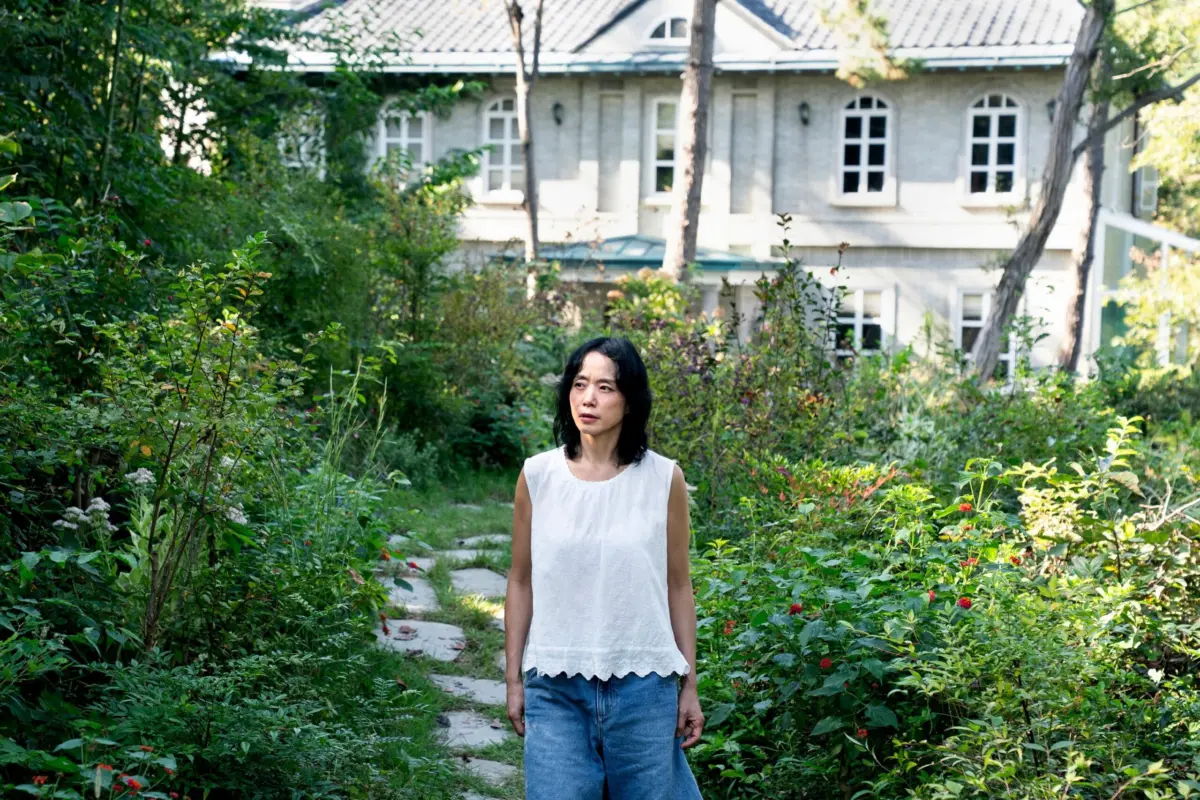
For nearly three decades, Jeon Do-yeon has occupied a singular space in the landscape of South Korean cinema. Since her auspicious big-screen debut in 1997’s The Contact, she has cultivated a reputation—both at home and across the international film community—as a performer who possesses the rare ability to dissolve the boundary between actor and character. To watch Jeon is to witness a complete inhabitation of a role, a process so seamless it often defies the conventional definition of acting. For many global cinephiles, her stature was cemented by her haunting, visceral turn in 2007’s Secret Sunshine, a performance that earned her the distinction of being the first Korean performer to secure an acting prize at the Cannes Film Festival.
Critics often characterize Jeon’s career with the term "fearless," a label that suggests a performer who moves through her craft without hesitation. However, when we connect via Zoom, following a grueling, marathon press day in Seoul, Jeon is quick to wave away such romanticized notions.
"I’m always scared, and I’m full of fear, especially in front of the camera," she admits with a disarming laugh. "I’ve been working as an actor for quite some time, but it’s an ongoing process." For Jeon, comfort is not a goal; in fact, it is an environment she actively avoids. "It’s important to me that I never get too comfortable. I actually enjoy having that fear and anxiety, and I try my best to work through it, because sometimes something completely new comes out of that struggle."
That willingness to embrace discomfort is on full display in her latest project, Possible Love. Following a successful theatrical release in October, the film is now streaming on Netflix and has been selected as South Korea’s official entry for the 2027 Academy Awards. The project represents a significant cinematic event: the return of legendary auteur Lee Chang-dong after an eight-year hiatus. Lee, whose 2018 masterpiece Burning became the first Korean film to be shortlisted for the Best International Feature Oscar and topped numerous global critics’ polls, reunites with Jeon nearly two decades after their collaboration on Secret Sunshine.

A Study in Class, Trauma, and Voyeurism
Constructed with Lee’s signature novelistic scope, Possible Love examines the fractured lives of two married couples from vastly different socioeconomic strata. Jeon portrays Mi-ok, a pragmatic woman working in a mask factory, living a quiet, unassuming life with her young son and her husband, Ho-seok, played by her frequent collaborator Sul Kyung-gu. The narrative is colored by the long shadow of the past: years after a brutal factory layoff and a violently suppressed labor strike, Ho-seok remains deeply traumatized.
The couple’s insular existence is disrupted when the funeral of a former colleague brings them into the orbit of Ye-ji (Cho Yeo-jeong, known for her breakout role in Parasite), an intellectual documentary filmmaker who is chronicling the stories of laid-off laborers. Ye-ji’s world is further defined by her wealthy, enigmatic husband, Sang-woo (Zo In-sung). When Mi-ok eventually agrees to let Ye-ji document their daily routines, the film begins as a study of liberal empathy and cross-divide solidarity. However, as the narrative progresses, it warps into something more ambiguous and unsettling, exploring the sharp fault lines of class privilege, the complexities of hidden desire, and the ethics of voyeurism.
Since its premiere at the Venice Film Festival in September, the film has generated significant Oscar buzz, particularly regarding Jeon’s performance—a masterclass in stoicism and simmering, restrained longing. Despite the mounting accolades and international attention, Jeon remains characteristically pragmatic.
"When I won the award at Cannes 20 years ago, I remember thinking, Is this going to change my life? Probably not. Am I going to change as an actor because I have a Cannes award?" she reflects. "I’m very happy that we’re competing at the Oscars, and it’s wonderful that people are talking about the film, but I don’t think it will change me or the way I perform in any way."

The Creative Process Under Lee Chang-dong
Now that Possible Love is accessible to a global audience via Netflix, Jeon has had the opportunity to observe how the film resonates across cultural borders. "I watched the movie once again as soon as it was on Netflix," she says. "I think Possible Love is a type of movie that leaves a different afterglow for different people. People can analyze it differently and interpret it in endless ways. Now that it’s on Netflix, I feel like people are finding their own ways to think about the movie—it leaves a lot of food for thought. I’m very proud that people are talking a lot about it."
The development of the film itself was a decade-long labor of love for director Lee. Jeon notes that the script evolved through numerous iterations, with the core concept of the laid-off worker and his wife remaining the anchor. "Director Lee worked on this project for quite a long time—he had it in his mind for more than 10 years," she explains. "When I knew that he finally had a script, I really wanted to know what it was about. I was waiting for that script."
Upon reading it, Jeon was immediately struck by the weight of the writing. "I could feel the 10 years’ worth of thought and effort that Director Lee put into it. I was very touched, and I thought, ‘Of course this is a Chang-dong film. It is this good.’" Regarding her character, Mi-ok, Jeon was drawn to the duality of her nature. "She holds this anxiety, and that anxiety stems from her wish to protect certain things. Although Mi-ok may seem a little bit fragile or weak from the outside, I think she’s a very strong woman inside."
The physicality of the performance—the specific, guarded way Mi-ok carries herself—was not a result of pre-planned choreography, but rather the outcome of Lee’s unique directorial philosophy. "If I hadn’t worked with Director Lee before, I would have spent a lot of time trying to learn more about this character and deeply understand her," Jeon says. "But I know how he works, and he always stresses emptying my mind as an actor. He wants me not to express, but to feel the character. The preparation process for me was mostly about making sure that I get very accustomed to the lines that my character speaks, so it really feels like it’s me speaking, but it’s actually Mi-ok speaking through me."

Trust and Spontaneity
The chemistry between Jeon and her co-star, Sul Kyung-gu, is one of the film’s most grounded elements, a benefit of their long-standing professional and personal relationship. "I really know him well in real life, and as an actor as well," Jeon says. "But while we were working on this project, and as he transformed into the character of Ho-seok, I discovered new facets of him. There’s always a new side of him that would surprise me. We have this friendship and trust that we’ve built over the years, and I’m pretty sure that they helped. If we do look like a real married couple in the movie, I think it’s partly thanks to that."
In contrast, her relationship with Cho Yeo-jeong was a new discovery. Following Lee’s aversion to over-preparing his actors, Jeon and Cho did not discuss their characters prior to production. Lee believes that a "novel and fresh" quality emerges when actors encounter one another in a scene for the first time. "I didn’t want to jinx that by speaking with her about our characters beforehand," Jeon notes. "In the beginning, Mi-ok believes that if Ye-ji films us, then that is a way of protecting my family—a way of finding hope. But as they get closer, she realizes that there is a gap between the two people, and the wall grows higher and higher as they get closer."
This commitment to naturalism means that Lee rarely relies on dozens of takes. Instead, he prioritizes the chemistry and organic flow of conversation. "He likes everything very lively and raw," Jeon says. "Instead of Director Lee saying, ‘Okay, let’s do the lines,’ he would just say, ‘Why don’t we talk? Let’s talk.’"
A Universal Resonance
Regarding the global explosion of Korean cinema, Jeon remains humble about her role in the phenomenon. "I don’t have plans on ‘going global’ or anything as an actor!" she says. "But I do hope that Korean content and Korean cinema will be beloved around the globe. It’s such a joy to be able to share different stories and different emotions with people that speak different languages and have different cultures."

While Possible Love is rooted in the specific tragedy of Korean industrial decline, Jeon believes the themes of economic displacement and class tension are inherently universal. "When we were filming, we did think about how this is a very Korea-specific sort of incident. Would people around the world be able to resonate with this story? We were a little bit worried. But I realized after screening overseas that the issue of laid-off workers is not something that’s specific to Korea—it’s happening all around the world."
Ultimately, the film transcends its local context through its focus on human emotion, a language that requires no translation. As Jeon notes, the film’s conclusion, which features the moon, serves as a poignant reminder of our shared reality. "Anybody in any part of the world can see the moon," she says. "That’s something that’s very universal."