
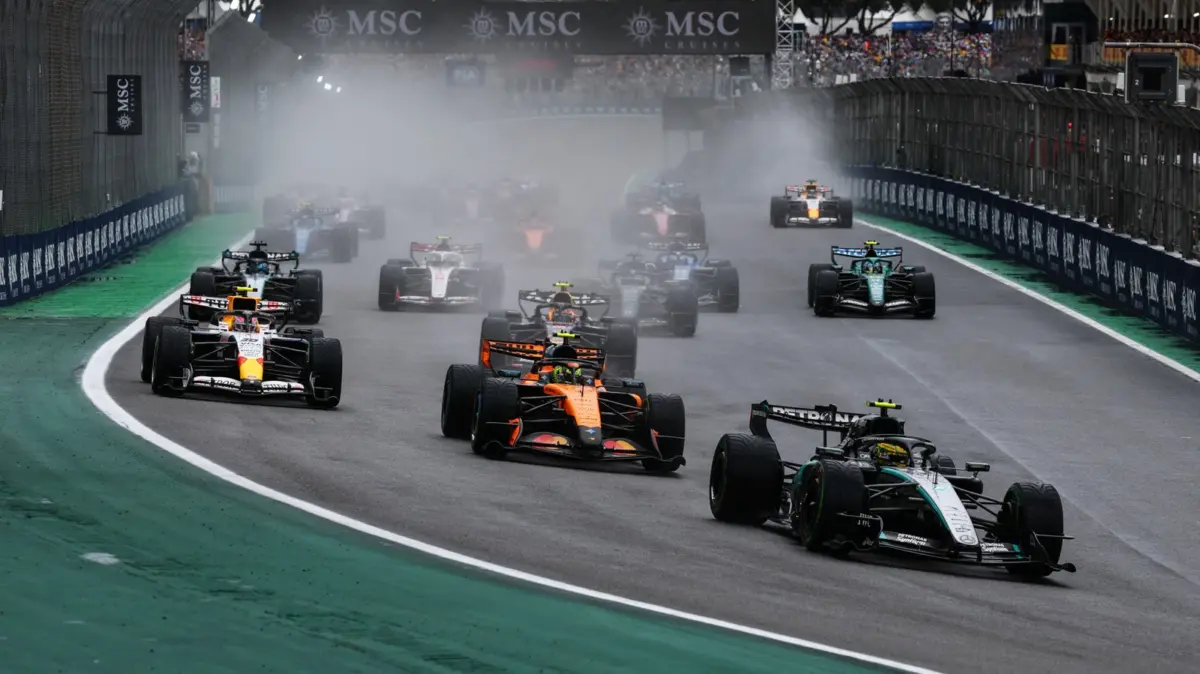
Formula 1 has long regarded rain as the ultimate equalizer, a chaotic variable that strips away pure car performance and places the spotlight squarely on raw driver skill and adaptability. That wet-weather magic was spectacularly rekindled on Sunday at the Autódromo José Carlos Pace during the São Paulo Grand Prix in Brazil. While the dominant Mercedes-AMG Petronas F1 Team ultimately secured the World Constructors’ Championship over the weekend, it was 2025 world champion Lando Norris who mastered the treacherous, shifting conditions to pilot his McLaren to a brilliant victory, claiming his third win of the season.
The dramatic weekend at Interlagos offered a welcome reprieve from a frustrating recent trend in modern Formula 1, where heavy rainfall has increasingly led to prolonged delays, safety car processions, or outright cancellations of on-track action under the banner of driver safety and visibility concerns. In recent years, actual racing in wet conditions had become as rare as spotting a dodo bird in the wild. But Brazil proved that when the conditions allow for it, wet-weather racing remains one of the most compelling spectacles in all of motorsport, testing the nerve of the world’s best drivers to their absolute limits.
The weekend’s narrative began taking shape during a chaotic Saturday qualifying session that previewed both sides of the wet-weather coin. A torrential downpour struck the circuit ahead of the schedule, forcing officials to delay the start of Q1 by more than an hour as standing water pooled across the tarmac. Once the cars were finally released onto the circuit, however, fans were treated to one of the most unpredictable and thrilling qualifying hours of the entire season.
Slippery tracks historically level the playing field, and Saturday was no exception. Wily veterans Fernando Alonso and Nico Hülkenberg extracted every ounce of performance from their machinery, masterfully dragging their subpar equipment into the fiercely contested Q3 session. They were joined in the final segment by Red Bull’s heavily scrutinized young prospects, Liam Lawson and Isack Hadjar, who thrived despite the immense pressure. By the time the dust settled on the top-10 shootout, an impressive nine different teams had managed to slot cars into the final segment of qualifying, underscoring just how much the rain disrupted the established competitive hierarchy.
An approaching storm front threatened to cut the battle for pole position short, turning the final moments into a tense, one-lap shootout. Norris managed to post a blistering lap that temporarily put his McLaren on provisional pole. Mercedes driver George Russell was poised to respond and challenge the benchmark time, but his crucial flying lap was impeded by Williams driver Alex Albon. Reassured by the Mercedes pit wall that he would have enough time to squeeze in a second consecutive push lap before the weather worsened, Russell pressed on. However, when heavy showers intensified instantly and made a second fast lap impossible, Russell lost his composure, lashing out angrily over the team radio. The outburst was so severe that Mercedes team principal Toto Wolff had to personally intervene over the comms to calm his driver down.
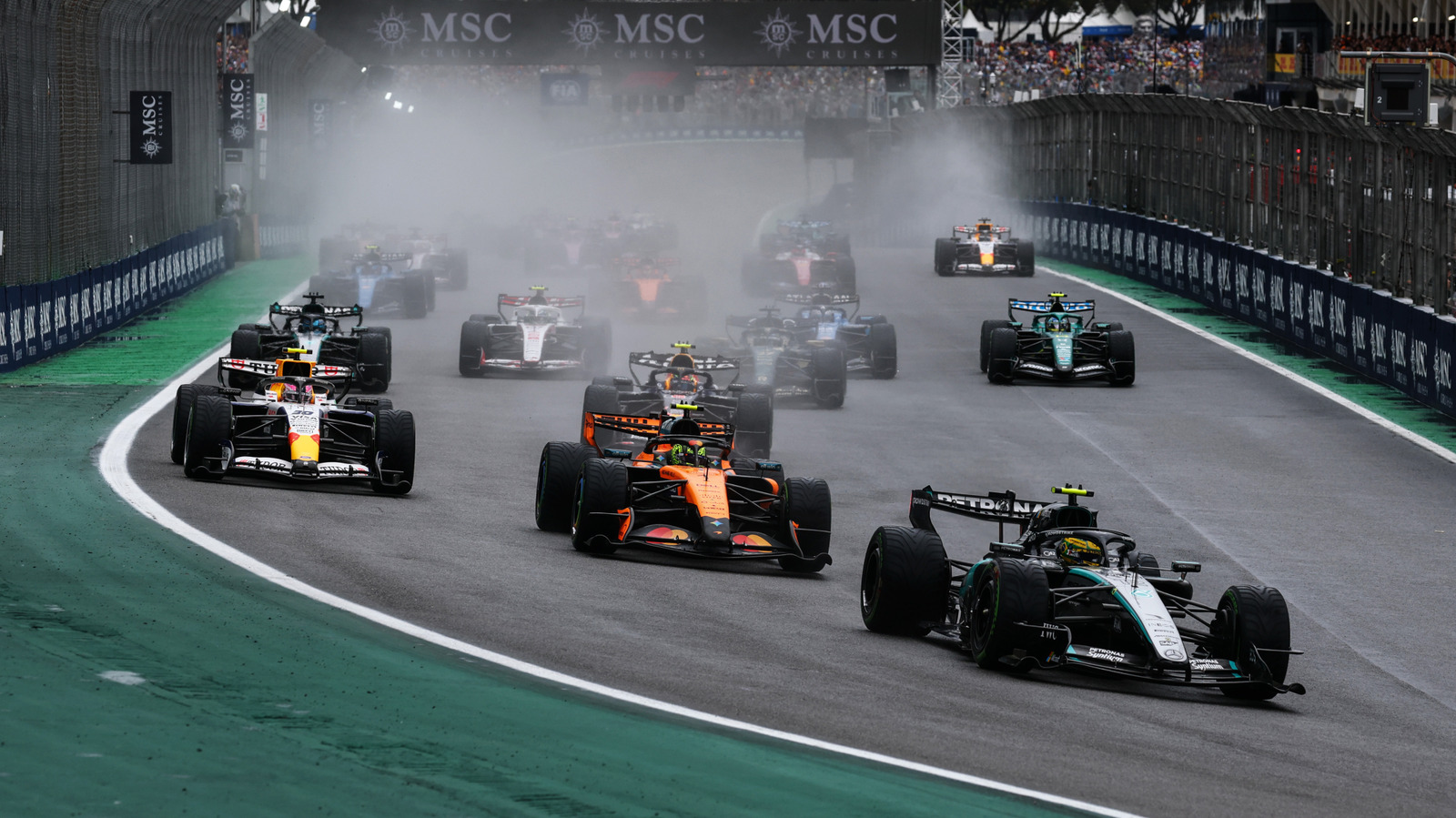
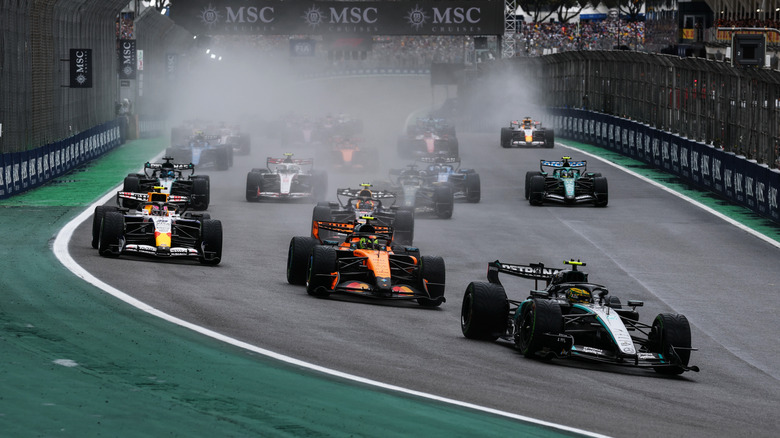
When the lights went out for Sunday’s Grand Prix, Norris faced immediate adversity. With the track still slick from residual rain, the entire field rolled onto the starting grid equipped with intermediate Pirelli tires. Mercedes’ newly crowned world champion, Kimi Antonelli, actually suffered a frightening moment on his reconnaissance lap, sliding off the slippery circuit before the race even began. Yet, when the actual start commenced, Antonelli capitalized on the traction offered by his second-place grid box. He launched brilliantly off the line, diving past Norris into Turn 1 to snatch the race lead, with Red Bull’s Lawson slotting neatly into second place behind him.
Further down the order, the chaotic opening lap triggered a flurry of high-stakes overtakes. Despite starting dead last in 20th position due to a difficult weekend, legendary driver Lewis Hamilton carved through the field with surgical precision, vaulting all the way up to ninth place by the end of the very first lap. Max Verstappen executed a similarly ferocious charge, climbing from 21st on the grid up to 11th in the opening laps.
F1’s elite drivers did not merely rely on their traditional wet-weather prowess; they also demonstrated superior strategic foresight as the track began to dry. Prodding the Ferrari pit wall to take an aggressive gamble, Hamilton became the pioneering driver to switch from intermediate tires to slick tires on lap 14 of the grueling 71-lap contest. Making the milestone 400th Grand Prix start of his storied career, the seven-time world champion immediately became the fastest driver on the circuit.
Transitioning to slicks on a still-cool track presented a monumental challenge, as drivers struggled frantically to generate the necessary operating temperatures in their tires. The transition phase caught several competitors out. Russell spun his Mercedes exiting the pit lane immediately following his stop, while other drivers ran wide across the asphalt runoff areas as they tried to find the drying racing line.
The most consequential drama at the front of the field involved Antonelli. The young Mercedes star surrendered the race lead to Norris on lap 19 after suffering a sudden spin at Turn 1. Antonelli had previously radioed his team to report a bizarre mechanical handling issue, noting that his Mercedes was inexplicably pulling heavily to one side under hard acceleration. This mysterious handling quirk would subsequently plague Russell’s car as well, severely hindering the Silver Arrows’ pace throughout the afternoon.
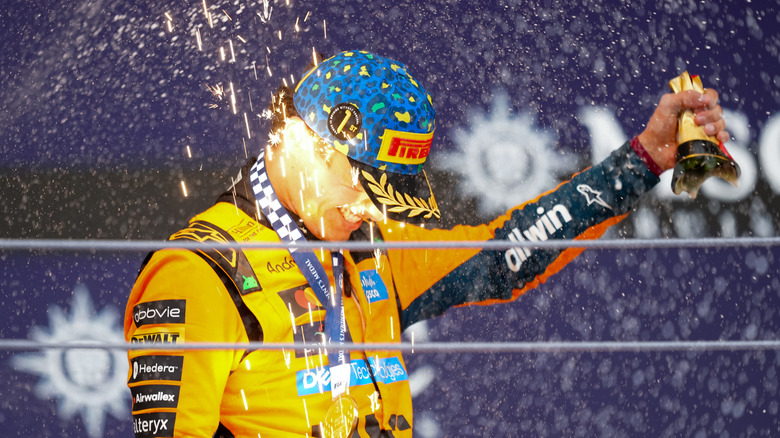
As the race entered its closing stages, the São Paulo weather delivered one final twist. Rain returned to the Interlagos circuit with just 10 laps remaining in the Grand Prix. Norris calmly reacted to the changing environment, smoothly swapping back to intermediate tires and cruising unbothered to the checkered flag. The only mishap the McLaren driver suffered after the race occurred on the podium, where he accidentally shattered his oversized celebratory champagne bottle during the festivities.
While Mercedes officially clinched the World Constructors’ Championship at Interlagos, the factory squad’s weekend celebration was somewhat muted by performance concerns. The championship-winning outfit endured a series of uncharacteristic operational errors in the garage and driving mistakes on the track. Even though Russell and Antonelli salvaged respectable fourth and fifth-place finishes, respectively, the team admitted after the race that they had no definitive explanation for the bizarre mechanical behavior that plagued both cars.
Reflecting on the strange handling characteristics after the race, Russell spoke with The Race about the team’s ongoing investigation into the afternoon’s troubles.
"Maybe it’s a small theory because we were the first ones onto the inters, even just on that outlap on the driest track, you damage the tires and the temps go up and you’re in this negative spiral. As of now, that’s the only explanation," Russell said.
The inherent unpredictability of rain-soaked races remains one of Formula 1’s most intoxicating spectacles, making it all the more frustrating for fans and competitors alike that such conditions are so rarely seen in modern racing. The São Paulo Grand Prix thankfully fell within that delicate meteorological sweet spot where the track could remain sufficiently wet to test driver skill without generating the blinding rooster tails of mist that typically reduce visibility to zero.
Although the FIA trialed experimental wheel covers during testing in 2024 aimed at mitigating heavy spray, the initiative ultimately proved ineffective. The engineering challenge stems from the fact that an F1 car’s underfloor aerodynamics act as a massive vacuum, sucking up surface water and forcefully ejecting it from the rear diffuser. Short of drastically slowing the cars down—a solution that would face universal rejection from teams, drivers, and fans alike—intermittent weather windows like the one witnessed at Interlagos remain the primary avenue for witnessing F1’s finest duel on a soaked canvas.