
Doris Salcedo is widely regarded as one of the most significant artists of our time, celebrated for her haunting “anti-monuments”—gargantuan, often ethereal installations that do not merely mark an event, but propose entirely new ways to process the trauma of historical atrocities. Her work is defined by an unflinching focus on the perspectives of victims, transforming the invisible weight of human suffering into tangible, spatial experiences. Perhaps her most iconic work, Shibboleth (2007), transformed the Tate Modern’s cavernous Turbine Hall with a massive, jagged, scar-like fissure running through the concrete floor. By physically rerouting the flow of visitors, Salcedo forced a visceral confrontation with the jarring, exclusionary nature of borders and the fracturing of societies.
This monumental scale, however, has taken on a new dimension in the years since the Colombian artist began losing her central vision. At the age of 31, Salcedo was diagnosed with Stargardt disease, a rare genetic condition that causes progressive vision loss. Now 67, she is legally blind, relying on her peripheral sight to navigate the world. Paradoxically, this personal limitation has served as a catalyst for a more expansive, collaborative, and ambitious period in her career, leading to works of a scale that would have been impossible for her to execute alone.

The Evolution of a Collective Voice
For the early part of her career, Salcedo worked in relative isolation, meticulously crafting her sculptures with her own hands. During a visit to her studio in Bogotá this past July, she reflected on that era with a mix of nostalgia and resolve. She recalled the deep satisfaction found in "the privacy of improvising and of working directly with the materiality." Yet, as her condition progressed, the necessity of solitude gave way to the practical demands of a team-based practice.
The transition was not easy. Salcedo admits that she initially mourned the loss of the spontaneity that defined her early independent work. "It was a very difficult adjustment, especially losing the privacy," she said. Beyond the loss of solitude, the change required a fundamental shift in her creative process. "Before, I was improvising; I never had a prior drawing," she explained. Working with assistants meant that her vision could no longer remain purely internal; it had to be translated into clear, actionable plans. "Things have to be absolutely defined," she noted.

However, as she leaned into this collaborative method, she discovered a profound upside. The studio, once a site of solitary struggle, became a site of collective creation. She found that working with a team "gave me the possibility of making better pieces than the ones I was making by myself." In her view, the shift has been transformative: "A collective statement is far more powerful than a lonely solo voice. It becomes like a chorus, and a really potent one."
Weaving the Domestic: A Monument to Displacement
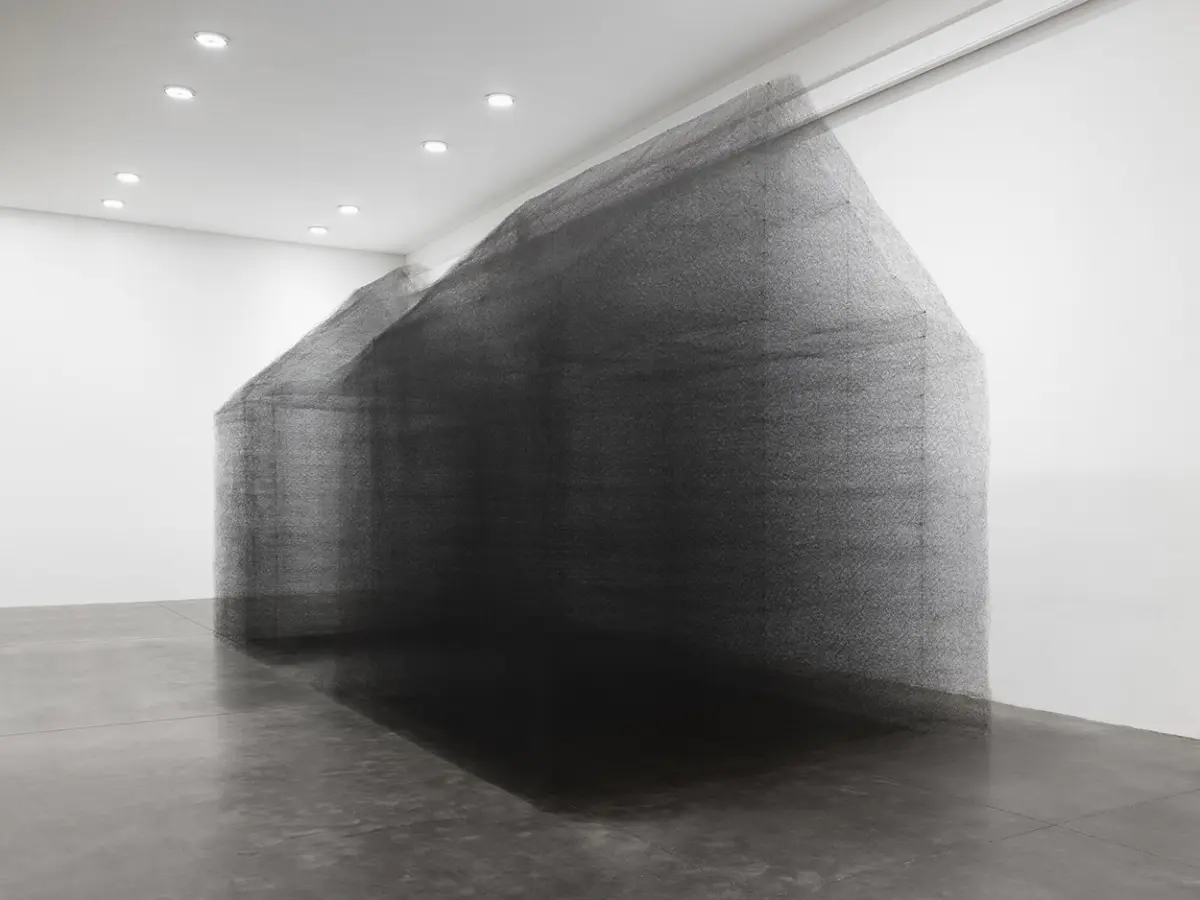
This November, at the White Cube Gallery in New York, Salcedo will debut a work that stands as the ultimate manifestation of this collaborative philosophy—a project that would have been physically impossible for her to realize solo. The installation features a full-sized house, standing nearly 30 feet tall, constructed entirely from human hair. During a visit to her studios, one could see dozens of assistants engaged in the painstaking labor of tying individual strands of hair into a fine, net-like structure. The resulting pattern, which resembles a chain-link fence or industrial chicken wire, possesses an uncanny combination of fragility and structural integrity.

The project has taken three years to complete, a timeline that Salcedo says would have stretched into decades had she worked in isolation. "To be thankful is not enough," she remarked regarding the immense effort of her team. The studio space itself, designed by architect Carlos Granada—a longtime collaborator who also worked on her 2018 project Fragmentos—is built to accommodate this scale, featuring high ceilings and glass brick walls that optimize the light for her team.
The conceptual foundation for this new work is the phenomenon of "domicide," a term coined by scholars J. Douglas Porteous and Sandra E. Smith to describe the deliberate, calculated destruction of home as a means of erasing communities and identities. As she led a tour of her workspace, Salcedo pointed to books on her desk, scanned for large-print viewing, that explore this theme. She drew clear lines between her work and the current realities of mass displacement in conflict zones like Ukraine, Gaza, Syria, and Sudan.

For Salcedo, the house is more than a structure; it represents the loss of everything that makes a life: privacy, security, and the simple, daily rituals of cooking and sleeping. By using hair—an organic, personal, and ephemeral material—she creates a bridge between the physical body and the domestic sphere. The choice of material is also a testament to her history; she previously used human hair in her Unland series (1995–98), where she intricately threaded the surfaces of severed tables. For the new house, however, she had to source hair through an extensive, ethically-vetted online trade, careful to avoid the human rights abuses often associated with the hair industry.
The Ethics of Labor and Beauty
Salcedo’s commitment to labor-intensive processes is a deliberate response to the art-historical erasure of the Global South. "My work has always been labor-intensive because in the Global South, labor is intensive," she stated. "It’s completely different from industrialized countries." She argues that the narrative of modernity has long ignored the contributions and the suffering of those outside the Western center, and her work aims to re-center that history. By combining the techniques and forms of traditional sculpture with this painstaking, collective labor, she asserts that the two are inextricably bound.

This commitment extends to the people behind the work. Her studio currently employs roughly 150 women from the Colombian countryside, providing stable, meaningful employment in regions where such opportunities are scarce. In the upper levels of her studio, one could see assistants using jeweler’s glasses and X-Acto knives to meticulously remove the starch from individual grains of rice. These grains, once prepared, are threaded with hair to form part of Grains of Sorrow (2023–26), a companion piece to the house that incorporates damaged cooking pots and pans—a poignant symbol of the domestic life destroyed by conflict.
When asked about the role of beauty in her work—a frequent point of critique—Salcedo was resolute. She rejects the idea that art dealing with violence must be inherently "abject." "In all the violence and terror I’ve been researching all my life, I think the abject part belongs to the perpetrator," she said. Instead, she views elegance and beauty as essential tools for restoring dignity to the victims.

Her work is designed to be impossible to ignore. In a world saturated with fleeting images of war on the nightly news, Salcedo uses the seduction of craft and the weight of scale to force a pause. She does not want viewers to divert their eyes from the world’s horrors; she wants them to sit with the complexity, the labor, and the humanity of those who have been displaced. As she continues to evolve her practice, working through her own physical challenges to build these massive, haunting structures, Salcedo remains a singular voice—a conductor of a collective chorus that refuses to let the world look away from the human cost of power.