
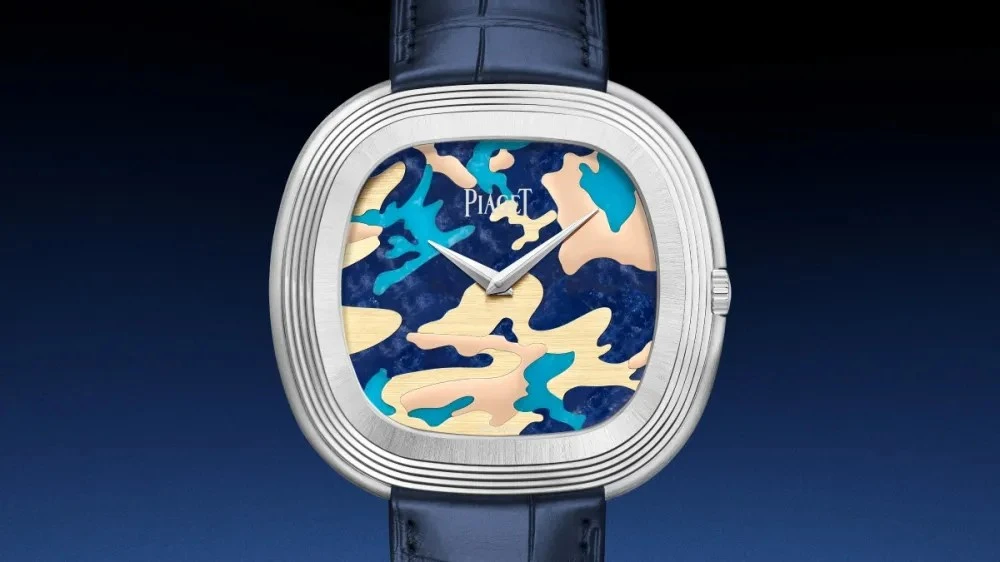
Andy Warhol was a man of many obsessions: the repetition of commercial icons, the allure of celebrity, and, perhaps less famously, a profound appreciation for horology. The legendary Pop Art icon was known to have amassed a significant collection of timepieces during his lifetime, a stash that included roughly seven watches from the storied Swiss maison, Piaget. Today, that historical connection has evolved from private ownership into a formal creative partnership. Piaget has once again joined forces with the Andy Warhol Foundation for the Visual Arts, unveiling a new timepiece that brings the artist’s aesthetic directly to the wrist: the Camouflage watch.
This latest release serves as a vibrant homage to one of Warhol’s most recognizable late-career series. Inspired by his 1986 Camouflage self-portraits, the timepiece captures the essence of the artist’s late-era experimentation with pattern and color. In a nod to the year those original works were crafted, Piaget has limited the production of this new watch to exactly 86 pieces. It is a calculated, artistic decision that ties the physical object directly to the timeline of the source material.
A Masterclass in Craftsmanship and Color
The design of the Camouflage watch is a departure from traditional horological aesthetics, favoring a bold, mosaic-like approach that mirrors the frantic energy of Warhol’s screen prints. The dial is the clear protagonist here, a technical feat that required over 100 hours of research, development, and painstaking craftsmanship to realize. Piaget has utilized a complex assembly of 27 individual pieces of stone to create the dial’s distinct camouflage pattern.
The material selection is intentional and luxurious. Sodalite and turquoise, with their deep, varying shades of blue, serve as the primary palette, echoing the chromatic intensity found in Warhol’s self-portraits. These stones are meticulously cut and fitted alongside satin-finished gold and polished rose gold, creating a play of light and texture that elevates the piece beyond a simple reproduction. The result is a tactile, three-dimensional interpretation of a flat, printed image—a transformation that feels remarkably fitting for a watchmaker with Piaget’s reputation for combining jewelry arts with mechanical precision.
The watch is housed in a gadrooned white-gold case, a signature Piaget aesthetic that adds a touch of classic elegance to the otherwise avant-garde dial. Tucked inside this protective shell is the Piaget 501 P1 caliber. This automatic movement is a workhorse of reliability, powering the elegant dauphine hands and providing a 40-hour power reserve. While the front of the watch is a celebration of visual chaos and artistic expression, the case back offers a more intimate detail: an engraving of Warhol’s signature and the unique production number, serving as a reminder of the watch’s limited-edition status.
Bridging the Gap Between Fine Art and Horology
For Stéphanie Sivrière, the artistic director of Piaget, the project was never about merely printing a copy of a painting onto a watch face. Instead, it was an exercise in capturing the spirit of the artist through the language of luxury materials.
"Our objective is to take inspiration from Andy Warhol’s creations without strictly reproducing each of his works on a dial," Sivrière noted in a press statement accompanying the launch. "The direct connection between Andy Warhol and Maison Piaget is color, particularly through the use of ornamental stones, which remains the common thread of this very distinctive timepiece."
This philosophy of "inspiration over reproduction" is what distinguishes the partnership from standard brand collaborations. By focusing on the material—the ornamental stones that Piaget is famous for using—the maison creates a dialogue between the artist’s eye for color and the watchmaker’s eye for geology and form.
A Growing Partnership
The release of the Camouflage watch marks a significant milestone in an ongoing relationship between Piaget and the Andy Warhol Foundation. This collaboration was solidified in 2024, when the foundation granted Piaget the rights to rename its "Black Tie" watch. That specific timepiece was a direct reinvention of the iconic Ref. 15102, a cushion-shaped watch that Warhol himself owned and cherished. By officially linking the watch to the artist’s name, Piaget cemented its status as the "custodian" of the Warhol horological connection.
Under the terms of this license, Piaget is permitted to develop one special watch annually that draws inspiration from the vast, multi-disciplinary oeuvre of the artist. The 2025 debut under this agreement was the "Collage" timepiece, a striking watch that utilized blocks of pink opal, green chrysoprase, and yellow serpentine. The Collage was a vibrant, almost neon interpretation of Warhol’s color sensibilities, and it set a high bar for the years to follow.
The 2026 Camouflage iteration continues this trajectory, moving away from the bright, contrasting stones of the Collage and toward a more nuanced, monochromatic blue aesthetic. As the industry looks toward 2027 and beyond, the prospect of what the Piaget and Warhol Foundation partnership will produce next remains a topic of intense interest among collectors and art historians alike. With the artist’s massive body of work—from the soup cans to the celebrity prints and the abstract camouflage patterns—the possibilities for future design iterations are virtually limitless.
Celebrating the Legacy During Art Week NYC
The launch of the Camouflage watch coincides with a broader celebration of the artist’s life and work. As part of the festivities surrounding Art Week NYC, the intersection of art and timekeeping will be the subject of a specialized discussion. Jean-Bernard Forot, Piaget’s Head of Patrimony, is scheduled to engage in a conversation with ARTnews senior editor Maximiliáno Durón regarding the evolution of Warhol’s personal watch collection and the collaborative process that has brought these limited editions to life.
The event, hosted at the PMC Studio on Saturday, November 14, provides a unique opportunity for enthusiasts to hear directly from the people responsible for bridging the gap between the world of fine art and the world of high-end watchmaking. It is a rare chance to understand the historical research and the artistic curation required to ensure that a timepiece not only functions as a mechanical instrument but also serves as a genuine tribute to one of the 20th century’s most influential creative forces.
As the watch industry continues to seek ways to remain relevant in a world dominated by digital technology, the marriage of horology and fine art has emerged as a compelling path forward. For Piaget, the Warhol partnership is not just a marketing exercise; it is a profound exploration of legacy. By placing the Camouflage watch into the hands of 86 collectors, the maison ensures that Warhol’s artistic vision continues to tick forward, one second at a time, long after his own time has passed. The price for this piece of art history is available upon request, though for those who appreciate the intersection of high-concept pop art and Swiss engineering, the value is clearly defined by the history the watch represents.