
At the terminus of Louisiana’s Highway 66 lies the Louisiana State Penitentiary. Known colloquially as “Angola,” the facility takes its name from the slave plantation that once occupied its vast, sodden acreage. To arrive at its gates is to reach a dead end in more ways than one. Past the security checkpoints, the road stretches deep into 18,000 acres of penal farmland, a landscape defined by the stark geometry of gun towers and barbed-wire enclosures. Here, incarcerated men spend their days working the “farm line,” a grim reminder that for those within, the prison runs on the labor of the forgotten.
For Gary Tyler, this landscape is not a map, but a memory. Tyler, now a renowned fiber artist and activist, first arrived at Angola in 1974. He was only seventeen years old, a child caught in the machinery of a system that had already decided his fate. He had been wrongly convicted of shooting a white student during a violent, segregationist mob attack on his school bus. For the next four decades, his world was bounded by bayous, bluffs, and swamps. To survive, he learned to retreat into his own mind, finding solace in the rhythmic, deliberate work of quilting—a craft he inherited from his grandmother. In a place where fabric was scarce, he bartered for scraps, turning the time he was forced to surrender into intricate, storied textiles. His talent eventually transcended the prison walls; craftswomen from across the South traveled to Angola specifically to find the man behind the artistry.
Today, Tyler’s work serves as the centerpiece for Rebirth, a poignant solo exhibition at the Grand Rapids Art Museum. Standing in the gallery, surrounded by the quilted and appliquéd tapestries that document a lifetime of systemic injustice, Tyler remains humble about his craft. “All that time, I never thought of myself as an ‘artist,’” he said during the exhibition’s opening. “I said, ‘Call me a hobbyist.’ Artists were people in galleries, people with an audience.”
A Chorus of Carceral Voices
Rebirth is not an isolated endeavor; it is one of three solo presentations currently on view at the Grand Rapids Art Museum, all of which explore the intersection of incarceration and the American experience. Together, these exhibitions provide a haunting, necessary meditation on what it means to be stripped of one’s freedom in a country that continues to grapple with the morality of its penal system.

Joining Tyler’s work is the exhibition Metamorphosis, featuring the intricate, palm-sized embroideries of Ray Materson. Materson developed his unique medium while serving a prison sentence for a robbery committed with a toy gun. His process is an exercise in resourcefulness: he hand-stitches his miniatures using only the threads unraveled from prison-issued socks. The result is a startling synthesis of American folk art and Renaissance precision, a testament to the human capacity for creation in environments designed to suppress it.
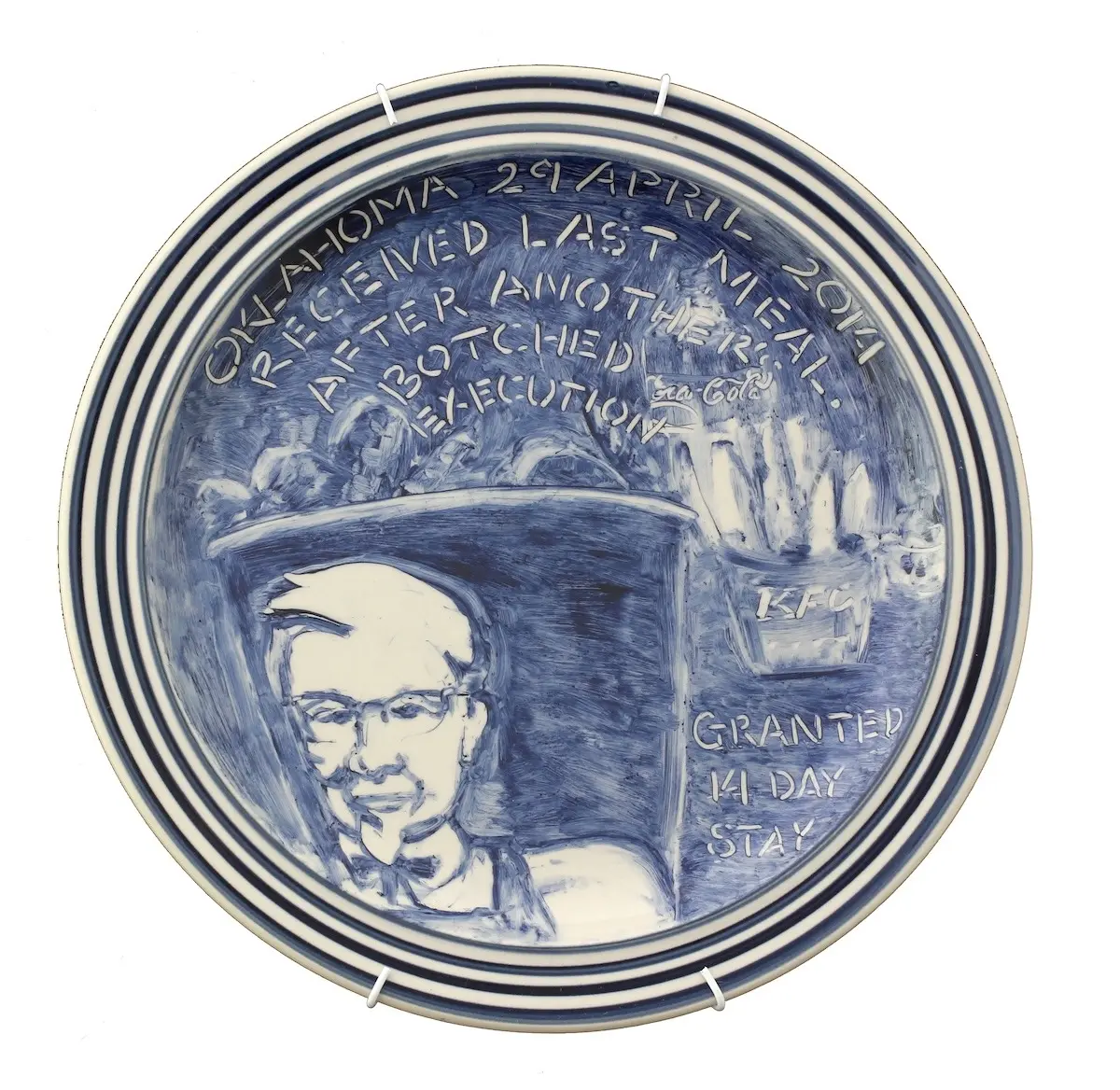
The third pillar of this triad is The Last Supper, a staggering 1,000-piece ceramic installation by the late artist Julie Green. Displayed in its entirety for only the second time, the collection serves as a somber chronicle of the final meal requests of death row inmates. For two decades, leading up to her death in 2021, Green illustrated these final selections on ceramic plates painted in a delicate cobalt blue.
The range of orders is as varied as the lives they represent: a bucket of Kentucky Fried Chicken, a single steak, a plate of burgers and fries, or a slice of pecan pie. Sometimes, there is nothing at all—a reflection of the fact that inmates can refuse a final meal or have their requests denied by a system that dictates even their final moments. While the plates might appear, at a cursory glance, to be decorative Staffordshire, a closer inspection reveals a reality that is far more unsettling.
“It’s not so much that these shows are timely,” explains Jennifer Wcisel, the curator of collections at the Grand Rapids Art Museum. “It’s that the question of what incarceration means to American life is never absent. It’s an ongoing conversation.”

The Architecture of Punishment
The urgency of this conversation is underscored by a contemporary political climate that seems increasingly comfortable with the public display of punishment. In recent years, the mechanisms of the state have been laid bare in ways that recall the pre-Civil Rights era. From a physician discussing the botched execution of a death row inmate in a magazine interview to the open calls for the televised firing-squad execution of a military prisoner, the boundaries of state-sanctioned cruelty have shifted. Even the digital sphere has been co-opted, with government-backed online games depicting the apprehension of “border crossers.”
Against this backdrop, the art on display in Grand Rapids does not attempt to match the sheer scale of the nation’s carceral cruelty. Instead, it seeks to act as a catalyst for empathy—or, at the very least, a spark of curiosity. The artists ask difficult, uncomfortable questions: Whose interest does a public execution truly serve? How is dignity manufactured, or stripped away, within the walls of a prison?
Julie Green’s The Last Supper suggests that dignity is, at best, a fickle allowance. Following an incident in 2011 where an inmate ordered an elaborate feast only to leave it entirely untouched, the state of Texas abolished special final meal requests. Green’s work captures the tragedy of such policies, pairing the “standard prison fare” with poignant, bite-sized biographies. One plate notes the request for a birthday cake for an inmate who had never celebrated a birthday in his life; another records a prisoner’s request that his meal be held until after his execution.
The exhibition also functions as a chilling map of the patchwork of capital punishment laws in the United States. Following the 2002 Supreme Court ruling that prohibited the execution of individuals with intellectual disabilities, the burden of defining “disability” fell to the states. Green’s plates document this inconsistency, recording instances where inmates with IQs as low as 61 were still processed for execution.

Portraiture as an Act of Defiance
Every piece in these exhibitions serves as a form of portraiture, stretching the definition to include the manifestation of a human spirit. Tyler and Materson utilize a representational directness that offers a sharp contrast to the symbolic nature of Green’s plates. In their work, we see faces. They invite the viewer to witness the individuals behind the prison statistics, indulging in a form of fantasy that is often the only sanctuary for the living.
In one of Tyler’s quilts, he depicts a former inmate known as “Big Toe,” dressed in the armor he wore during a production of The Life of Jesus Christ—a drama club play that Tyler himself founded while incarcerated. This is a subversion of the traditional power dynamic. Historically, portraiture was a privilege reserved for the powerful, a way to dictate how they were perceived by the world. In the carceral system, the powerful are the ones doing the watching, yet surveillance rarely captures the interior life of the subject. Insight is not something that can be extracted by a guard; it can only be offered by the person behind the bars.
Materson’s work leans into this philosophical depth. In his Self-Portrait, he depicts himself sitting before a mirror, stitching the very piece the viewer is looking at. The image creates a recursive, infinite loop: a smaller Materson stitching a smaller version of himself, repeating into the distance. The frame that cages his face is made of the same thread as his portrait, a subtle reminder that the barriers between the confined and the free are often more porous than they appear.
The Weight of Memory
Tyler’s journey from prisoner to artist culminated in his release in 2016, following years of dedicated advocacy by activists, including Rosa Parks. One of the final quilts in his show depicts a great crane, a bird that frequently roosted in the wetlands surrounding Angola and occasionally landed within the prison yard. For Tyler, the crane represents the moment his soul finally escaped the confines of the penitentiary. “It sprang skyward on my first step outside,” he reflects. “It has yet to descend.”

However, for many, the reality of the carceral system remains a hard landing. Tyler’s 2025 piece, Convict Poker, illustrates the grim spectacle of the Angola prison rodeo—the last event of its kind in the nation. Twice a year, the prison opens its doors to a paying public to watch inmates face down raging bulls in a macabre game of endurance. While the event is marketed as entertainment, the risks are all too real for the men who volunteer to participate.
Tyler never participated in the rodeo, yet he refuses to cast judgment on those who do. He notes that one of his own quilts was once raffled off at the rodeo to raise $30,000 for the prison’s hospice program. The men who enter the arena, he suggests, are often driven by a desperate need to be seen, to be acknowledged, to not be entirely forgotten by a world that has locked them away.
“These are men who may never go home,” Tyler says, gesturing toward the legacy of the institution. “The announcer mentions their names, and that they are serving life sentences; understand?” In the silence of the gallery, the art stands as a final, resonant answer to that plea.