
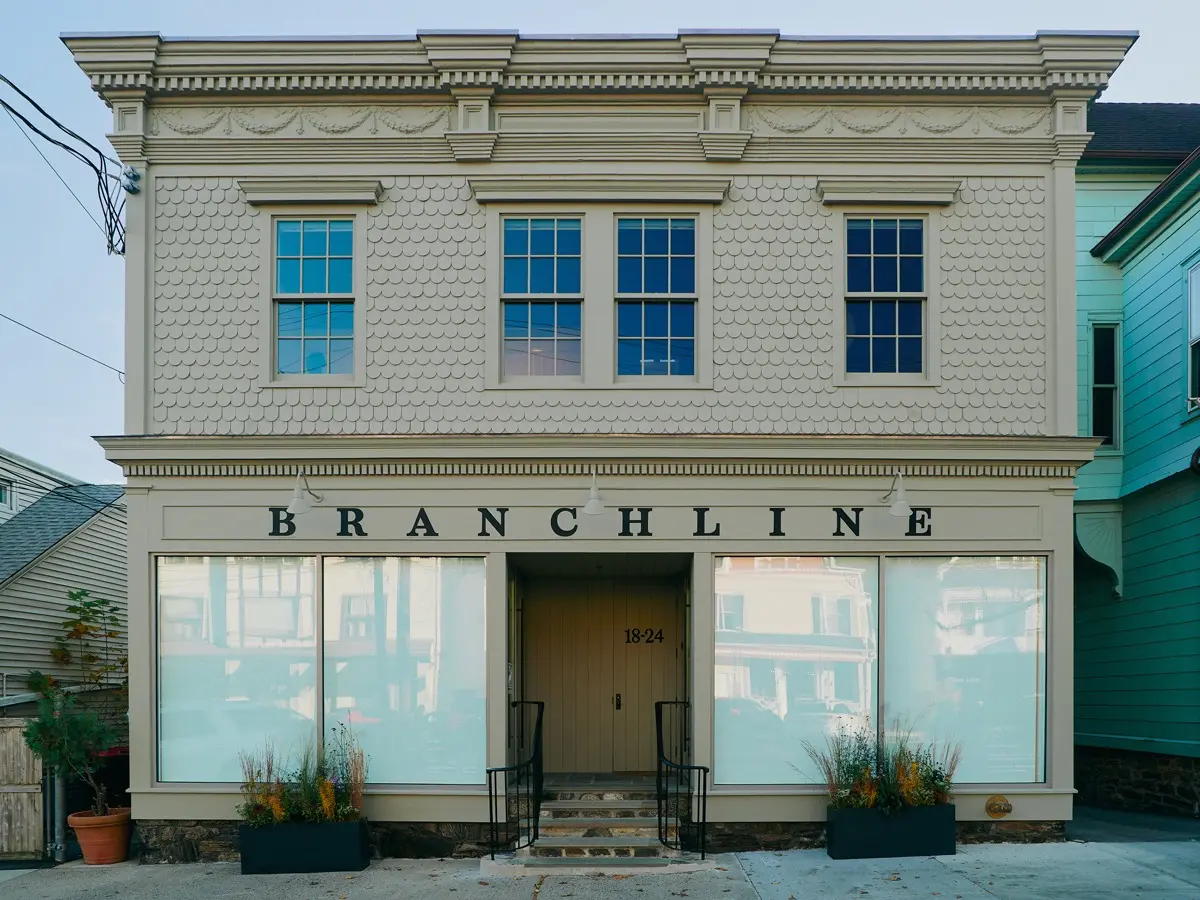
Less than two blocks from the bustling Katonah train station, tucked away on one of the primary thoroughfares of this historic Hudson Valley town, stands a nondescript, two-story gray building. To the casual passerby, the structure offers little hint of the cultural significance contained within its walls. However, emblazoned above the entrance in a sharp, kerned-out serif font is the name “Branchline.” The moniker is an intentional nod to the nearby transit hub, but more importantly, it serves as a gateway to a groundbreaking new public-facing exhibition space for the Gochman Family Collection (GFC), one of the world’s most significant repositories of contemporary Indigenous art.
Established just five years ago, the GFC has rapidly ascended to prominence, amassing a formidable inventory of more than 850 works. Until this moment, the collection has existed primarily within the private sphere—hung in the New York City apartment of Becky Gochman, the collection’s founder and custodian, and her family. While the GFC has maintained a robust presence in the global art world by keeping approximately 200 works on long-term loan to museums and institutions worldwide, the desire to foster a more direct, accessible relationship with the public has been a long-standing goal. While the Gochman family has historically opened their private residence to museum groups, school tours, and artists for intimate events, the launch of Branchline represents a shift toward a more permanent and expansive model of public engagement.
“It’s one thing to articulate a mission, but what matters to me is if I’m putting that language out into the world, then I’m making sure that our organization is following that with action,” said GFC creative director and curator Rachel Martin (Tlingit) during a recent press preview. Martin emphasizes that the vision for Branchline is rooted in community—not merely as a passive audience, but as active participants. “I see this as a place for bringing community together, which means making the Native community feel like they are very much a part of the decision-making processes, and then also inviting the local community of Katonah to come in and learn about new artists that they might not have heard of before.”
The choice of the name “Branchline” serves as both a literal and metaphorical anchor. As GFC director Laura Phipps explains, the term was selected with the expectation that many visitors would arrive via the Metro-North railroad. Beyond the transit reference, however, it signifies a place “where paths diverge and new paths begin.” For the curatorial team, the name evokes the organic growth of trees and the structural utility of train lines, both of which align with the organization’s desire to experiment, evolve, and branch out into new forms of exhibition and dialogue.

Branchline is currently in the early stages of a larger developmental vision. The organization is taking a deliberate approach to its physical growth, with plans to eventually encompass 10,000 square feet spread across four interconnected buildings. The inaugural opening marks the completion of the first phase, which includes a sophisticated three-room gallery on the ground floor, dedicated residential space upstairs for invited artists to utilize for research and creative practice, and a nearly operational ceramics studio on the lower level. This L-shaped plot, which stretches from the main building’s entrance on the Parkway toward Katonah Avenue, is designed to be an evolving site of artistic production rather than a static gallery.
Architectural renderings presented during the preview reveal an ambitious future for the site. A rear door will soon open onto a sculpture deck, connecting to a new barn facility specifically designed to accommodate large-scale installations. The original barn on the property was found to be structurally unsound and was subsequently replaced to make way for this new exhibition capacity. Further down the path, the site will lead to “the Annex,” a space designated for more experimental and ephemeral projects. The complex is intended to flow seamlessly into the local environment, culminating in a patio that provides direct access to Twig, a local retail store and café.
For its grand opening, Branchline has opted for a thematic exhibition that underscores the collection’s depth. Titled “Line Break,” the show is curated by GFC assistant curator Moonoka Begay (Ndee + Diné) alongside collection associate Nicole van Brugge. The exhibition occupies the initial 2,000-square-foot gallery space and features a tightly curated selection of 28 works by 18 Indigenous artists.
The exhibition’s introductory wall text posits that “lines are a core facet of all visual language,” but Begay and van Brugge move beyond mere formalist analysis. Instead, they position the line as a potent metaphor for bloodlines and lineage, borders and cartographic boundaries, and even the invisible barriers of sound. The resulting display offers a series of striking juxtapositions, pairing artists of different generations to illustrate the continuity and evolution of Indigenous visual traditions.

One such pairing features Jaune Quick-to-See Smith’s The Spaniard (1988), a semi-abstract aerial perspective of the Flathead Indian Reservation in Montana, hung in conversation with Sara Flores’s Untitled (Shao Pei Maya Kené) (2024). Flores’s painting utilizes the geometric abstract language of the Shipibo-Conibo people, a visual system that, according to exhibition materials, maps the community’s cosmology, environmental knowledge, and local worldview. Further highlighting the breadth of the collection, the show includes Teresa Baker’s Echoes (2024) and George Morrison’s Night Shadows. Red Rock Variation: Lake Superior Landscape (1994). While both are abstract meditations on the natural world, they highlight the diverse material practices at play, with Baker utilizing acrylic, yarn, willow, and artificial sinew on AstroTurf, and Morrison employing acrylic on canvas on board.
The intellectual rigor of the show is perhaps best captured in the work of Nadia Myre. Across from the Smith and Flores pieces, the exhibition displays two works from Myre’s “Code of Construction” series. In these pieces, the artist strings ceramic cylinders to depict ground-to-air distress signals such as “Require Map and Compass” and “Not Understood.” Myre’s choice of medium intentionally references the tradition of wampum belts—objects historically used by Northeast Woodlands Indigenous communities to codify political relationships and treaties. The work finds a thematic echo in Faye HeavyShield’s the red line II (2025), a hand-strung strand of red beads displayed in a flexible coil, serving as a subtle critique of the perceived immutability of time and physical form.
The emotional and conceptual center of “Line Break” is Raven Chacon’s Storm Pattern (2021–24). The work consists of a handwoven wool textile paired with a multichannel sound installation, the low, immersive hum of which greets visitors upon their entry into the gallery. Chacon’s project originated in 2016, when he began documenting the sounds of drones hovering over the Oceti Sakowin camp at Standing Rock during the protests against the Dakota Access Pipeline. By recording the dissonant harmony of police surveillance drones and the countersurveillance drones operated by protestors, Chacon treated the sounds as a musical score. He then translated this “score” into a traditional Diné weaving structure, literally charting the erratic flight patterns of the drones into the fabric of the textile.
The exhibition also acknowledges its own evolving nature through site-specific and ephemeral works. Matthew Kirk was commissioned to create a piece for the building’s exterior alleyway wall. Utilizing collaged painted tar paper, the work’s abstract forms have already begun to interact with the elements, showing signs of warping in the recent rain—a quality the curators embrace as part of the work’s life cycle.

Nearby, the Annex serves as a testament to the organization’s raw, process-oriented approach. Currently under construction, with exposed plywood and temporary lighting, the space is nonetheless hosting a series of drawings by Shuvinai Ashoona. Ashoona’s work maps imaginative, often surreal scenes onto the landscape of her home in Nunavut, Canada. The GFC team acknowledges that the future of the Annex remains fluid, with the ultimate configuration of the space depending on the artists who are invited to engage with it.
As Branchline opens its doors to the public, the message from the GFC is clear: they have no intention of replicating the traditional “white cube” model of a museum. “What GFC is doing is not trying to become an institution,” Martin said. “It’s trying to just meet where things are needed, and a space is definitely needed for art that is outside of the box that you’re used to seeing, so that’s what we’re offering.” By focusing on community, collaboration, and the preservation of Indigenous creative lineages, Branchline is positioning itself as a vital, evolving node in the contemporary art landscape.