
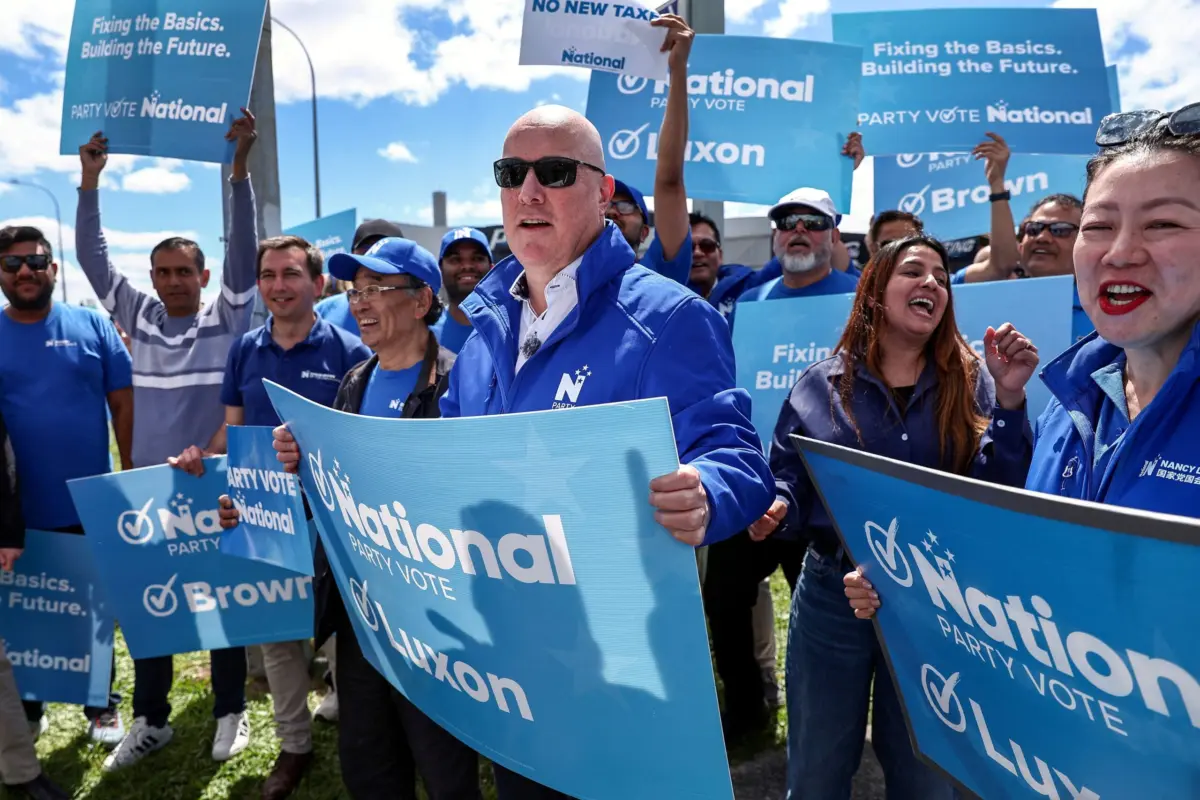
WELLINGTON — With days remaining before New Zealand’s general election on November 7, final opinion polls depict a fiercely contested political landscape. The governing centre-right National Party and the opposition centre-left Labour Party are locked in a dead heat, with neither major political force currently on track to secure the parliamentary seats required to govern alone.
Under New Zealand’s unique electoral framework, the ultimate balance of power and the composition of the next administration will likely be determined by a collection of influential smaller parties. As the campaign reaches its final stretch, both major blocs are scrambling to consolidate support, knowing that a shift of just a handful of votes could tip the scales.
How Does the Election Work?
New Zealand holds a general election every three years under a mixed-member proportional (MMP) system, an electoral model designed to ensure that the composition of parliament closely mirrors the overall popular vote.
Voters cast two distinct ballots on election day: one for a specific candidate to represent their local electorate, and another for a political party. The country is divided into 71 electorates, including seven reserved specifically for Māori, New Zealand’s Indigenous people. Māori voters are given the choice to enroll on either the Māori electoral roll or the general roll. Winning candidates in each of these local electorates take their seats in parliament automatically.
The party vote, however, determines the broader makeup of the legislature. Roughly 49 additional seats are filled from party lists so that each party’s total share of parliamentary seats matches its proportional share of the national party vote. To secure representation, a party must cross a key threshold by winning either 5 percent of the total party vote or capturing at least one local electorate. In New Zealand’s 120-seat parliament, a governing majority typically requires 61 seats.

The MMP system also accounts for anomalies. If a party wins more local electorates than its proportional share of the party vote would otherwise entitle it to, it retains those seats, and extra seats are added to parliament. This dynamic played out in the 2023 election, when Te Pāti Māori captured six of the seven Māori electorates despite securing only 3.1 percent of the overall party vote, expanding the size of the legislature.
Because parliamentary seats closely track the proportional party vote, single-party majorities are historically rare. Every government established under the MMP system since its inception in 1996 has been a coalition led by either Labour or National, with the sole exception of 2020, when Labour under then-Prime Minister Jacinda Ardern achieved a sweeping victory and governed independently.
Who Are the Two Main Candidates?
Incumbent Prime Minister Christopher Luxon is campaigning for a second term in office. A former chief executive of Air New Zealand, Luxon entered parliament in 2020 as the representative for the Auckland electorate of Botany and ascended to the leadership of the National Party a year later.
Luxon engineered National’s return to power in the 2023 election, campaigning on a platform of sound economic management and a promise to turn the page on six consecutive years of Labour-led administration. He currently leads a complex three-party coalition government alongside New Zealand First and ACT.
However, Luxon’s tenure has faced considerable headwinds. His internal party leadership has come under pressure, marked by two attempted no-confidence votes by National MPs in April and August, the latter of which was orchestrated by his own defense minister at the time. These internal challenges coincided with a decline in his personal popularity amid broader economic pressures and ongoing political friction within the governing coalition.
Challenging him is Labour Party leader Chris Hipkins, who is bidding to return to the top job. First elected to parliament in 2008, the 48-year-old politician assumed the role of prime minister in January 2023 following the unexpected resignation of Jacinda Ardern. Although Hipkins lost power in the October 2023 election, he opted to remain at the helm to lead Labour from the opposition benches.

What Are the Key Issues?
Economic management dominates the national conversation, though the major parties and their potential coalition partners offer sharply contrasting remedies.
The National Party is pledging to restore the national budget to a surplus through fiscal discipline while concurrently expanding the national pension scheme. Labour is concentrating heavily on the rising cost of living, promising relief through cheaper healthcare and transport options. Labour’s policy platform also emphasizes targeted investments in employment, housing, and infrastructure, alongside a renewed commitment to strengthening vital public services.
Smaller parties from across the political spectrum have trained their sights on corporate giants, particularly power companies and major supermarket operators. The right-wing populist New Zealand First party is advocating for the breakup of major electricity corporations and the division of one of the country’s largest supermarket operators into two separate entities.
Meanwhile, the Green Party is proposing the establishment of a state-owned power company and a publicly owned supermarket chain, coupled with stringent regulations to curb excessive grocery pricing. The Greens are also pushing for a wealth tax, higher corporate and banking taxes, and relief through reduced income taxes for middle- and lower-income earners. The centrist Opportunity Party has proposed a land value tax as its primary economic reform.
Immigration and voting rights have likewise emerged as contentious campaign themes. The ACT Party has proposed the deportation of serious criminal offenders regardless of their length of residency in New Zealand. Conversely, New Zealand First is seeking to restrict voting rights exclusively to citizens, challenging the existing provision that allows legal residents who have lived in the country continuously for more than 12 months to cast a ballot.
Why Is There No Clear Winner?
The overarching contest is fundamentally a battle between two rival political blocs. To form a government, National would likely require the continued support of its current coalition partners, while Labour would depend on an alignment with the Greens and potentially the Opportunity Party.

Recent polling indicates that the race remains too close to call, suggesting that a handful of individual seats could ultimately decide which bloc captures the administration. This dynamic places immense pressure on the 5 percent threshold required for minor parties to enter parliament independently. If a smaller party narrowly misses this threshold and fails to win a local electorate, its votes are discarded, potentially costing its broader political bloc a parliamentary majority.
The Opportunity Party, for example, must clear the 5 percent threshold or secure an outright electorate win for its votes to contribute toward a Labour-led majority coalition.
Furthermore, the final size of the legislature remains an unpredictable variable. Polling suggests Te Pāti Māori may once again win more local electorates than its party vote share dictates, which would introduce extra seats into parliament. Each additional seat raises the numerical threshold required to form a government; if parliament expands to 122 seats, a winning bloc would need 62 seats rather than the traditional 61 to govern.
Who Are the Smaller Parties?
The constellation of minor parties features several influential political figures and organizations. New Zealand First is led by Winston Peters, whose platform includes a controversial proposal for New Zealand to withdraw from the Paris climate agreement, alongside demands for the central bank to prioritize both employment and inflation targets.
The ACT Party, spearheaded by David Seymour, positions itself as a classical liberal and right-libertarian force, currently holding 11 seats in parliament. The Green Party, co-led by Chlöe Swarbrick and Marama Davidson, has anchored its campaign on social justice, environmental protection, the cost of living, and political campaign funding reform, while advocating for expanded home insulation and zero-interest financing for household solar systems.
Te Pāti Māori, co-led by Rawiri Waititi and Debbie Ngarewa-Packer, has focused its campaign on increasing enrollment on the Māori electoral roll, alongside policies addressing housing, healthcare, education, environmental conservation, and constitutional transformation. The Opportunity Party, founded by economist Gareth Morgan in 2016, has never secured representation in parliament, achieving a peak of 2.6 percent of the vote in 2017. Led by Auckland businesswoman Qiulae Wong, the party pitches itself as a centrist alternative focused on accelerating economic growth.

Who Will Be the Kingmakers?
Historically, smaller parties in New Zealand’s MMP environment frequently wield disproportionate influence, ultimately deciding which of the two major parties assumes executive power.
The mechanics of this role were demonstrated in 2017, when National won 56 seats to Labour’s 46 but was unable to assemble a parliamentary majority. Labour ultimately formed a government by securing a coalition with New Zealand First, with outside support from the Greens. New Zealand First has repeatedly played the kingmaker role for both sides of the political divide, having initially backed National following the 1996 election, the very first held under the MMP system.
Te Pāti Māori has similarly lent its support to administrations across the political spectrum, backing National-led governments following the elections of 2008, 2011, and 2014. Participating in these arrangements often secures senior executive positions for junior partners; Winston Peters served as deputy prime minister in Luxon’s government until May 2025, a post subsequently assumed by ACT leader David Seymour.
In the current election cycle, the Opportunity Party represents a new potential kingmaker. If Labour finds itself reliant on Opportunity’s seats to form a government, the centrist party would step into the role for the first time, exactly a decade after its founding.