

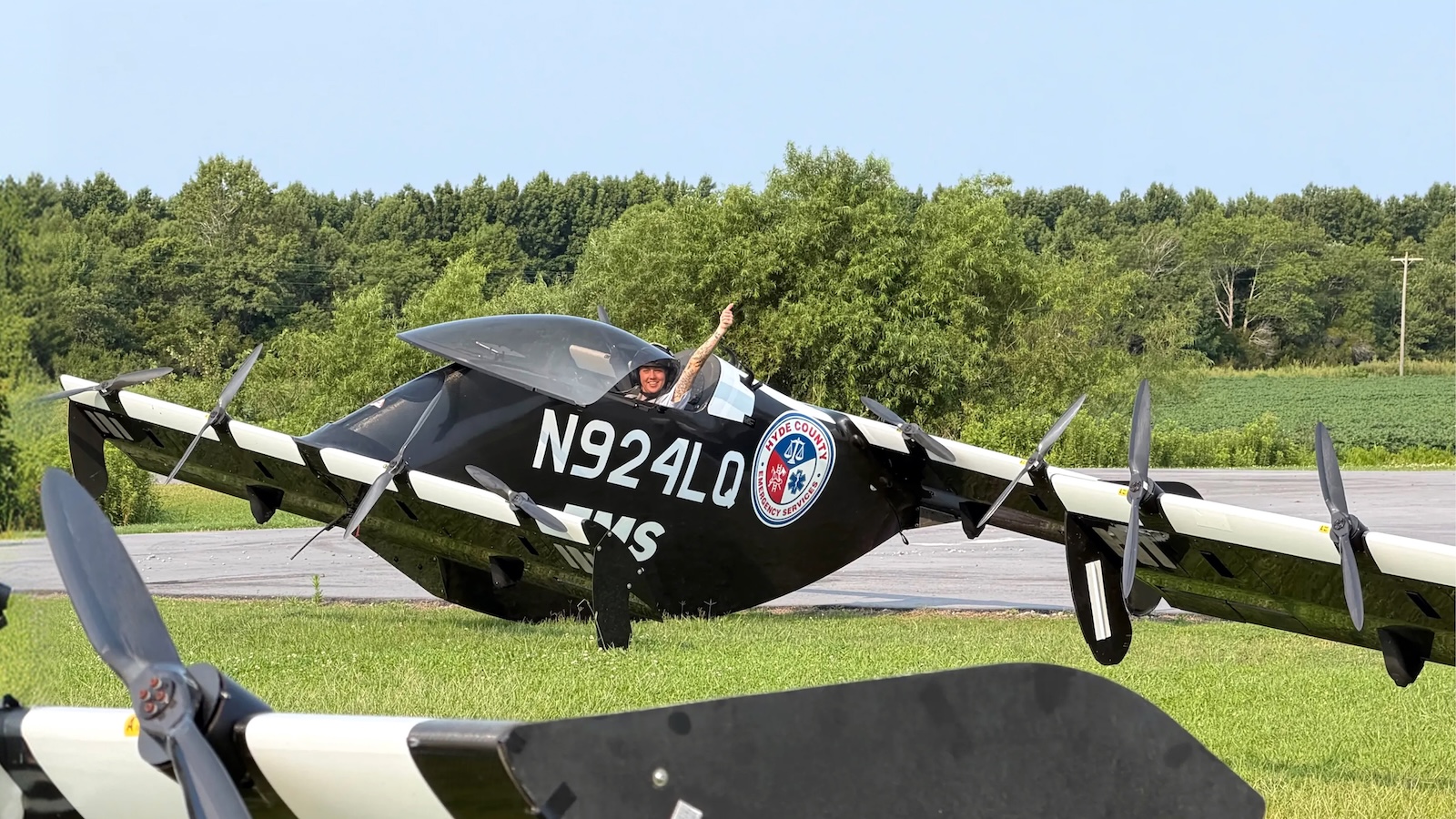
The emergency call originated from a secluded home tucked deep within Hyde County, a sprawling, rural expanse of coastal farmland, dense marshlands, and isolated waterways in North Carolina. Responding to the alert, paramedic Quinn Reece did not climb into a traditional ambulance or a conventional helicopter. Instead, she stepped directly into an experimental, single-seat electric aircraft characterized by two compact wings and a cluster of eight buzzing propellers.
Known as the BlackFly and manufactured by Pivotal, the roughly 14-foot-long vehicle bears a striking resemblance to an oversized, futuristic drone. Moments after Reece secured herself inside, the machine lifted effortlessly into the air, rising vertically like a helicopter before transitioning smoothly into forward flight like an airplane.
As she raced toward the reported emergency at a cruising speed of roughly 60 miles per hour, a dispatcher relayed the location details over the radio. Reece quickly realized a critical error: the emergency response application utilized by the county had provided an incorrect address. Fortunately, having flown reconnaissance and training routes over the marshland terrain previously, Reece possessed a mental map of the actual geography. She immediately adjusted her course in the nimble aircraft, pinpointed the true origin of the distress call, and successfully transmitted the exact coordinates to ground paramedics who were navigating the winding rural roads. Reece arrived on the scene, assessed the patient, and began administering vital medical care a full 20 minutes before the ground ambulance managed to pull up.
For Brook Cox, the emergency medical services chief for Hyde County, that precise scenario represents the realization of a long-held ambition. Cox initiated a six-month trial partnership with Pivotal in March, driven by a desire to determine whether the BlackFly could help medical professionals overcome the immense geographical hurdles of a county spanning 1,459 square miles of mixed land and water. Before deploying the aircraft for actual 911 responses, local personnel thoroughly vetted the technology, conducting more than 300 rigorous training flights to ensure safety and operational reliability.
For years, the overarching promise of electric vertical takeoff and landing aircraft, commonly known as eVTOLs, has been dominated by visions of futuristic air taxis and flying cars gliding above congested urban skylines. This commercial narrative has been actively promoted by the Federal Aviation Administration through its eVTOL Integration Pilot Program, a federal initiative designed to collaborate closely with manufacturers to test emerging aviation technologies in real-world operational environments. Just recently, commercial momentum in the sector was highlighted when Archer Aviation publicly unveiled ambitious plans to launch aerial taxi services across three major cities in Texas, while rival firm Joby Aviation commenced public flight demonstrations in Florida.
Yet, away from the glittering skylines of major metropolitan areas, Hyde County is among a vanguard of rural jurisdictions exploring more immediate, practical applications for these innovative machines. The FAA’s pilot program explicitly recognizes emergency medical response as a vital use case, particularly in underserved rural landscapes where travel times are notoriously protracted. Simultaneously, engineers are developing similar solar-powered aircraft capable of remaining airborne in the upper atmosphere for weeks at a time to monitor pressing climate threats, including fast-moving wildfires, expanding methane emissions, and accelerated polar ice melt.
The grand promise of electric aviation has always been centered on helping to decarbonize the aviation industry. These diverse developments point undeniably toward a fast-approaching future defined by electric flight, even if that future does not arrive in the precise form that aerospace analysts originally expected.
Kristina Menton, Pivotal’s vice president of flight, points to a milestone flight conducted in December 2024 as concrete proof that the technology could serve as an invaluable boon to emergency medical services. During that demonstration, a BlackFly successfully launched from a Los Angeles County fire station and touched down precisely within a residential backyard in Malibu, effectively proving that the compact aircraft could navigate complex suburban and private addresses directly.
Menton acknowledged that single-seat aircraft represent a radically new paradigm for an emergency response field that has historically relied on distinct, separate crews for flight operations and medical care. However, the BlackFly features a simplified control interface designed to allow a single qualified operator to seamlessly fulfill the dual role of pilot and paramedic.
"The aircraft is a breeze," Cox said, praising the intuitive design. "It really takes the guesswork out of it because you have a screen and you have all these prompts that you have to go through."
Carl Dietrich, who founded Jump Aero in 2019 specifically to engineer electric aircraft dedicated to emergency medical services, views Pivotal’s operational success not as industry competition, but as a crucial proof of concept that validates and accelerates the entire sector.
"It shows that other organizations believe that this is a real opportunity," Dietrich said.
Jump Aero is currently developing a distinct type of emergency response aircraft known as the JA1 Pulse, a machine that has been in development for seven years. Dietrich projects that the Pulse will achieve top speeds of roughly 288 miles per hour, significantly faster than the 63-mile-per-hour cruising speed of the BlackFly. According to Dietrich, these next-generation eVTOLs are not intended to replace traditional emergency helicopters or ground ambulances entirely. Instead, they introduce an entirely new capability to the emergency toolkit: a specialized aircraft that is exceptionally easy to fly and capable of launching almost instantly without the lengthy engine warm-up periods required by turbine-powered helicopters.
"It’s ideal for rapid response missions because you don’t pay any maintenance penalty for going to full power instantly," Dietrich explained.
That instantaneous readiness is particularly vital in an emergency medical field where the global standard aims for arrival within eight minutes of an initial call, whereas rural response times frequently average nearly 15 minutes.
Despite their clear operational potential, these aircraft come with distinct technological limitations, primarily concerning battery range and weight capacity. The BlackFly features a maximum range of approximately 20 miles on a single charge and a payload capacity of 200 pounds, while Jump Aero’s JA1 Pulse extends those metrics to a 70-mile range and a 350-pound payload capacity. Because of these constraints, the vehicles are explicitly not meant to transport patients to hospitals. Their primary utility lies in their ability to bypass ground traffic and geographical barriers to reach an emergency rapidly, allowing a trained medic to stabilize a patient until a ground ambulance arrives. During her flight in Hyde County, Reece carried a specialized cardiac monitor, critical airway management supplies, and a primary response bag packed with essential gear, enabling her to assess and treat the patient immediately upon landing.
Rural environments may ultimately offer a far more straightforward path for introducing advanced air mobility technologies than crowded cities, according to April Zhang, director of advanced air mobility at the University of South Florida’s Center for Urban Transportation Research.
"In the urban area, it’s probably more challenging to find the right landing and takeoff sites," Zhang noted.
Menton added that municipal leaders and emergency services from other counties are already closely monitoring Hyde County’s pioneering trial and actively considering similar localized programs.
Zhang views the FAA’s eVTOL Integration Pilot Program as an effective framework enabling manufacturers and public safety agencies to collaborate closely on diverse operational applications. Beyond emergency medical services, she identifies aerial traffic surveillance and rapid cargo delivery as additional domains primed for disruption.
Federal aviation policy may also provide public agencies with a smoother regulatory pathway toward adopting eVTOLs compared to commercial operators. Andrew Mearns, a commercialization consultant at Multicopter Aerospace Consulting, pointed out that emergency medical services organizations can frequently operate under the FAA’s established public aircraft rules. This regulatory classification can potentially exempt them from some of the rigorous commercial pilot credentials and licensing requirements mandated for commercial air taxi ventures.
Financial considerations provide another compelling incentive for public adoption. Pivotal’s commercial model currently sells for approximately $190,000, a stark contrast to traditional emergency helicopters, which Mearns notes can cost anywhere from $500,000 to $10 million depending on specifications and equipment. While day-to-day operating costs will inherently vary across different models, Mearns estimates that electric aircraft will generally prove to be about 20 percent cheaper to operate than similarly sized machinery running on fossil fuels.
While emergency response represents one prominent avenue where electric aviation is beginning to secure practical, real-world utility, another equally transformative application is taking shape far above the clouds, in the upper layers of the atmosphere.
Unmanned stratospheric aircraft are capable of reaching astonishing altitudes of approximately 65,000 feet, flying roughly twice as high as commercial airliners. Advanced solar-powered versions of these craft can remain continuously aloft for weeks or even months at a time, rendering them exceptionally well-suited for long-term environmental observation and disaster tracking.
"If you imagine these solar-powered aircraft just circling the L.A. County area, collecting soil moisture, vegetation moisture data, with complex math models and deep learning mapped to that, you can have improved risk profiles better than the models that are currently there," said Craig Mascarenhas, an aerospace researcher at Harvard University. He noted that such persistent aerial platforms could also spot developing wildfires with unprecedented speed and assist first responders by mapping fire perimeters in real time.
Mascarenhas leads engineering research for Harvard’s branch of the Stratospheric Airborne Climate Observing System, where he collaborates with industry partners like Electra.Aero and the Massachusetts Institute of Technology to develop and deploy solar-powered electric aircraft. He emphasizes that the potential scope of these high-altitude missions extends far beyond wildfire management.
"It’s hurricane monitoring and tracking, methane emissions monitoring, understanding ice dynamics across the world," Mascarenhas said. "The instruments will be swapped, but the topology of the aircraft will remain the same."
The deployment of electric aircraft also brings varying environmental calculations. Mascarenhas points out that while eVTOLs can successfully reduce local greenhouse gas emissions when they directly replace conventional, fuel-burning helicopters, the overarching climate benefit is less definitive when they are deployed in environments where efficient ground transportation is already available.
"Vertical flight is inherently energy-intensive, and an electric aircraft is not necessarily more energy-efficient or lower-carbon per passenger-mile than an electric car, bus, or train," he cautioned.
For Pivotal, the successful deployment of emergency medical aviation in Hyde County marks merely the initial step. Menton stated that the company’s broader corporate vision is to fundamentally revolutionize short-distance transportation by making point-to-point electric flight accessible to a much broader segment of the population.
For now, however, the most immediate and impactful uses for this emerging technology are found in specialized, high-stakes applications—whether speeding across the rural marshlands of North Carolina to save a life, or circling quietly in the stratosphere to monitor the changing planet.