
The atmosphere outside the venue for the Emmy Kasbit Spring 2027 show was electric, a testament to the brand’s enduring influence within the fashion ecosystem. A diverse crowd of fashion enthusiasts, editors, and industry insiders gathered in their finest Emmy Kasbit ensembles, creating a vibrant display of the brand’s signature aesthetic. Central to this visual identity is the akwete—a traditional, handwoven Nigerian textile that has become the hallmark of creative director Emmanuel Okoro’s work. Over the past 13 years, the brand has cultivated a loyal, cult-like following that transcends borders, anchored by a deep respect for the craftsmanship inherent in indigenous Nigerian weaving.
For the Spring 2027 collection, Okoro steered the brand into a new, global dialogue. The inspiration for this season was born from a professional collaboration earlier this year with an Indonesian designer. This partnership served as a catalyst for Okoro to explore the unexpected parallels between the Akwete weavers of Nigeria and the traditional artisans of Java, Indonesia. While the two cultures are geographically and historically distinct, Okoro found a profound resonance in the way both groups navigate the modern world while clutching tightly to their ancestral roots.
“We’re very particular about culture and its preservation,” Okoro explained following the show. He noted that while the surface-level differences between Nigerian and Indonesian traditions are vast, the underlying values of perseverance, community, and the sanctity of heritage provide a common language. This thematic bridge allowed Okoro to experiment with a fusion of aesthetics, layering the intricate, structured nature of Nigerian handwoven textiles with the fluid, soft silhouettes often associated with Asian garment construction.
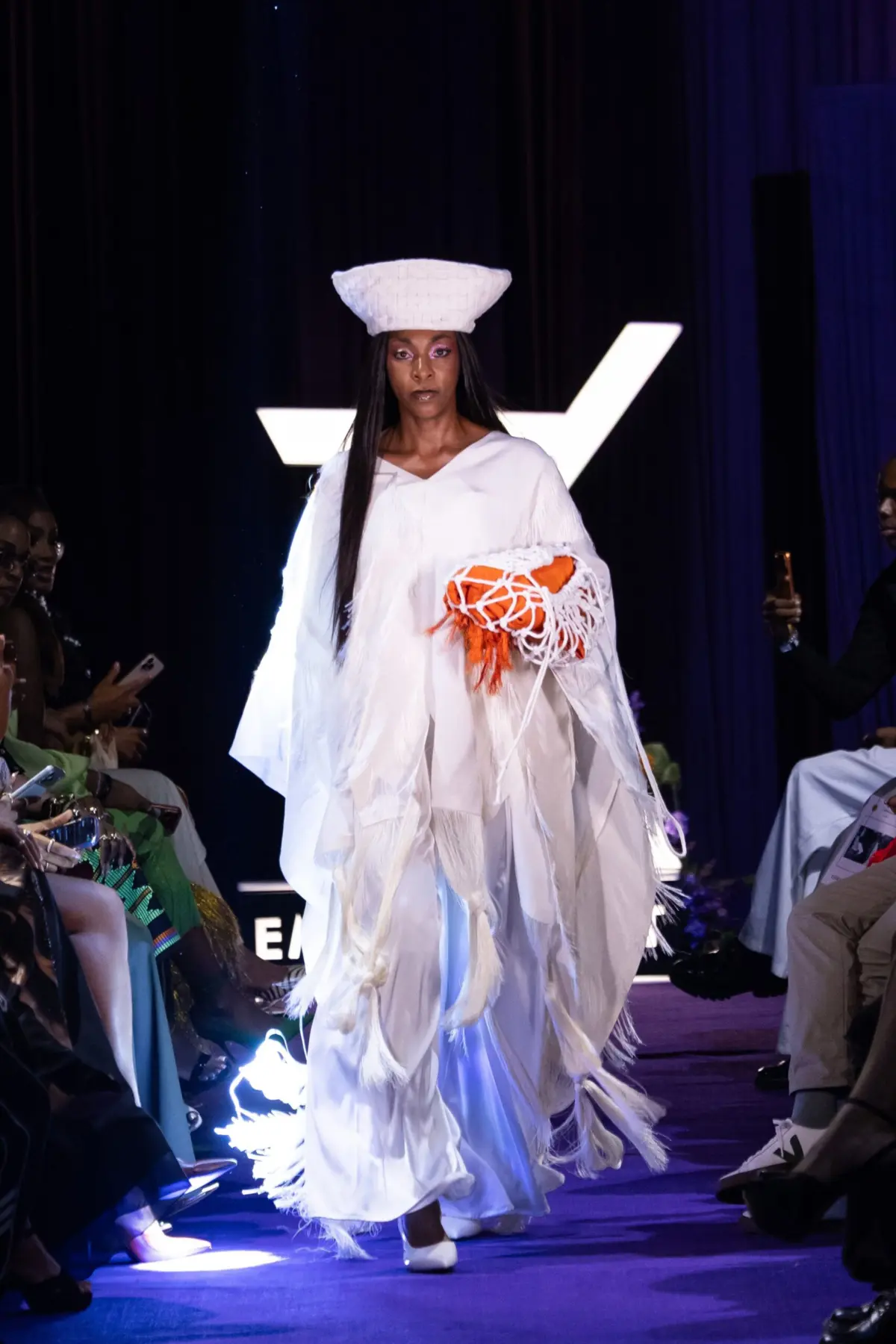
The runway presentation brought this synthesis to life through a series of thoughtful design choices. One of the most compelling examples of this cross-cultural dialogue was a poncho constructed from two distinct types of akwete fabric, which showcased the versatility and structural integrity of the material. Complementing this were lightweight trousers that drew clear inspiration from the Indonesian sarong, reimagined through the lens of a contemporary, high-fashion silhouette. By marrying the heavy, deliberate weave of the Nigerian fabric with the airy, draped sensibilities of the Javanese silhouette, Okoro created a collection that felt both grounded in history and remarkably forward-looking.
This season marks a significant departure for the brand, representing what Okoro describes as a “fresh start.” Perhaps the most notable shift in the Spring 2027 collection is the abandonment of the matching sets that have defined Emmy Kasbit’s output for over a decade. Since the brand’s inception 13 years ago, the coordinated set has been a cornerstone of the label’s commercial success. Customers have long gravitated toward the effortless uniformity of these pieces, which have become a staple in the wardrobes of the brand’s dedicated clientele. However, Okoro felt it was time to challenge both himself and his audience.
“It’s a fresh start for Emmy Kasbit,” he remarked, reflecting on the decision to move away from the rigid consistency of previous seasons. This strategic pivot serves a dual purpose: it allows for a more fluid creative expression and offers the wearer greater agency in how they construct their own personal style. By decoupling the tops from the bottoms, Okoro is encouraging his customers to interact with the clothing in a more modular fashion.
“The client doesn’t have to take the look as they see it on the runway if they don’t want to,” Okoro explained. “They can take individual pieces.” This shift toward separates is not merely a change in design philosophy; it is an invitation for the consumer to participate in the styling process, mixing the intricate, culturally rich textiles of the collection with their existing wardrobe staples. It acknowledges that the modern fashion consumer is looking for versatility as much as they are looking for a statement piece.
The collection, however, remained unmistakably Emmy Kasbit, maintaining the brand’s commitment to high-level tailoring and meticulous detail. Among the standout pieces were a white silk fringed dress that moved with a graceful, rhythmic fluidity as models traversed the runway, and an orange fringed blazer that served as a vibrant centerpiece, capturing the brand’s penchant for bold, saturated color palettes. The collection also featured a series of green tailored suits, which offered a sharper, more structured counterpoint to the softer, draped garments. These pieces highlighted Okoro’s continued mastery of cut and proportion, proving that even as he moves toward a more relaxed approach to styling, the brand’s technical rigor remains firmly intact.
The transition toward separates represents a maturing of the Emmy Kasbit brand identity. By stepping away from the "safety" of the matching set, Okoro is signaling a confidence in his own design language. He is no longer relying on the immediate, visual harmony of a set to communicate his vision; instead, he is trusting the individual strength of each garment to stand on its own. This evolution is likely to resonate with a customer base that has grown alongside the designer, shifting from those seeking the ease of a uniform to those seeking the sophistication of a curated, individual look.
The collection also underscores the importance of the designer’s role as a steward of culture. In an era of mass production and global homogenization, Emmy Kasbit’s commitment to akwete is an act of defiance and preservation. By elevating this traditional craft through a high-fashion, international lens, Okoro is ensuring that the heritage of his community remains relevant and visible on the global stage. The collaboration with an Indonesian designer further amplifies this mission, suggesting that the future of fashion lies not in the isolation of traditional techniques, but in their ability to engage in meaningful, respectful exchange with other cultures.
As the show concluded, the sense of renewal was palpable. The audience, many of whom have tracked the brand’s progress since its early days, seemed to embrace this new direction. The blend of the familiar—the textures, the colors, the craftsmanship—with the new—the silhouettes, the modularity, the global perspective—created a cohesive narrative. For Emmanuel Okoro, the Spring 2027 season is not just about the clothes; it is about the ongoing story of a brand that refuses to remain static.
Looking ahead, this transition suggests a broader, more ambitious horizon for Emmy Kasbit. By breaking the cycle of the matching set, the brand has opened up infinite possibilities for how its garments can be worn, layered, and styled. It is a bold move for a label that has built its reputation on a specific, recognizable look, but it is one that aligns with the broader shifts in the fashion industry toward longevity, individual expression, and a deeper appreciation for the stories woven into the fabric itself.
The Spring 2027 collection stands as a vibrant, thoughtful, and highly personal exploration of what it means to be a modern designer rooted in tradition. Through his work, Okoro continues to prove that heritage is not a static relic of the past, but a dynamic, living force that can be adapted, reimagined, and shared across cultures. As the brand embarks on this next chapter, it does so with a renewed sense of purpose, continuing to weave the threads of the past into the fabric of the future, all while keeping the spirit of the akwete at its core. The enthusiasm of the crowd, the critical attention paid to the new silhouettes, and the clear, intentional evolution of the brand’s design philosophy all point toward a future for Emmy Kasbit that is as enduring as the traditions it seeks to honor.