
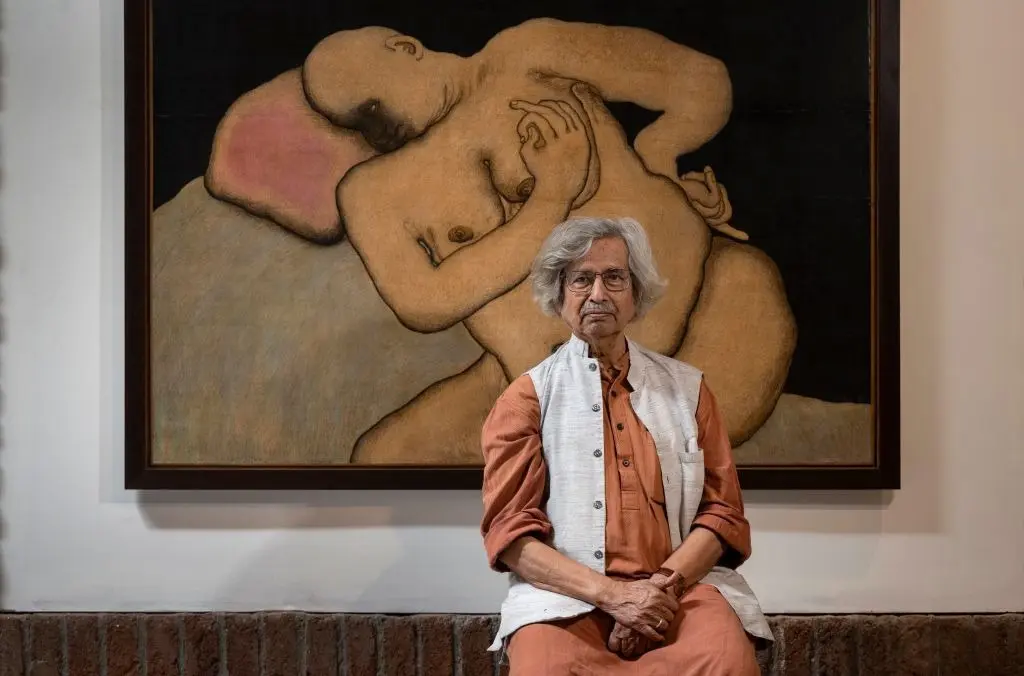
Jogen Chowdhury, a seminal figure in Indian modern art whose evocative, often haunting, depictions of the human condition defined a generation of aesthetic inquiry, passed away on October 25 at a hospital in Kolkata. He was 87. According to reports from Indian media, the artist had been battling a rare form of blood cancer for over a year, a struggle he faced with the same quiet dignity that characterized his decades-long career.
Widely regarded as one of India’s most influential modern painters, Chowdhury was celebrated for his unique ability to strip away the artifice of portraiture to reveal the raw, often distorted, psychic landscapes of his subjects. His death marks the loss of a titan whose work bridged the gap between traditional Indian sensibilities and the experimental rigors of global modernism.
A Legacy of Cultural Significance
The news of his passing has triggered an outpouring of grief across India, particularly within the artistic and intellectual circles of West Bengal, where he remained a central figure for decades. Tributes flooded social media platforms, reflecting the profound impact he had on the nation’s cultural identity.
Suvendu Adhikari, the leader of the opposition in the West Bengal Legislative Assembly, took to the social media platform X to honor the late artist. In his tribute, Adhikari described Chowdhury as a "towering pillar of our cultural world," asserting that his artistic legacy would remain "immortal through the ages." Similarly, noted Kolkata-based painter Samir Aich expressed deep personal sorrow, framing the loss as the closing of a significant chapter in the history of the Bengal School of Art. For many, Chowdhury represented a vital link to the foundational movements that defined Indian art during the 20th century—a tradition rooted in the artistic upheaval of the British Raj and the subsequent flowering of creative expression during the Indian Independence Movement.
Artistic Roots and Philosophical Shifts
To understand the trajectory of Jogen Chowdhury’s art, one must look to the historical currents of the Bengal School of Art. This movement emerged in Kolkata and Santiniketan as a direct response to the colonial dominance of Western academic realism. By rejecting the rigid constraints of European artistic traditions, proponents of the school sought to draw inspiration from the rich tapestry of Indian history, mythology, and pastoral life.
The aesthetic of the Bengal School was characterized by its synthesis of traditional Mughal miniatures, the fluid lines of Ajanta frescoes, and a deep, spiritual connection to the Indian landscape. Chowdhury, who maintained a home in the red-earth terrain of Santiniketan—the cultural epicenter established by Rabindranath Tagore—found constant inspiration in its unique light and textures.
However, Chowdhury was never a mere traditionalist. His work incorporated elements of Cubism and the refined sensibilities of Japanese modernism, reflecting a era of intense cultural exchange between India, Europe, and Japan. This fusion allowed him to cultivate a style that was at once deeply rooted in his heritage and radically forward-looking.
The Anatomy of the Psyche: Chowdhury’s Unique Technique
Chowdhury is perhaps best remembered for his singular approach to line work. He possessed an uncanny ability to imbue his figures with a tactile, expressionistic quality that was entirely his own. Utilizing a signature cross-hatching technique, he delicately distorted the human form. For Chowdhury, this distortion was never intended as a mockery or a caricature in the derogatory sense. Instead, it was a precise tool—a means of visualizing the "psychic interior."
His figures often appear slumped, corpulent, or strangely elongated, their features sagging under the weight of unspoken anxieties, desires, or the banalities of daily existence. As the renowned Indian art critic R. Siva Kumar once observed, Chowdhury’s figures are "wrought by a combination of decorative wilfulness and expressive distortion and are imbued with an effusive sensuality."
Kumar’s assessment highlights the difficulty of pinning down the artist’s work. "Chowdhury’s art is rich in suggestions," Kumar noted. "It is to be apprehended without bracketing our fund of knowledge, experience or memories, but also cannot be narrativised without trivialising it, without depleting its sensory particularities." This quality of "suggestiveness" invited viewers to engage with the paintings not as static objects, but as mirrors for their own internal realities.
Formative Years and Academic Training
Born on February 16, 1939, in Daharpara village in the Faridpur district of undivided Bengal, Chowdhury’s entry into the world was marked by the shifting tides of history. His early life was set against the backdrop of a region defined by its complex colonial history, including the religious partitions that occurred during the British occupation.
Despite the turbulence of the era, Chowdhury’s upbringing was nurtured by a creative and aristocratic environment. His family played a pivotal role in shaping his early aesthetic sensibilities: his mother was celebrated for her intricate skill in Alpana—the traditional folk art of painting decorative patterns on floors—and his father was an accomplished painter and sculptor. This early exposure to the marriage of folk tradition and fine art provided the bedrock for his future endeavors.
In 1955, he began his formal artistic education at the Government College of Art & Craft in Kolkata, where he studied until 1960. Seeking to broaden his horizons and engage with the global avant-garde, he later traveled to Paris, training at the prestigious École Nationale Supérieure des Beaux-Arts throughout the 1960s. His return to India in 1968 signaled a synthesis of his global experience with his native roots, a period that saw the full maturation of his iconic style.
A Life of Public Service and Recognition
Chowdhury’s influence extended far beyond the studio. In 1972, he assumed the role of curator at the Art Gallery of the Rashtrapati Bhavan, the official residence of the President of India, where he helped shape the collection and institutional memory of the nation’s highest office.
In a surprising turn toward the political, Chowdhury entered the public sphere in April 2014, winning an election to the Rajya Sabha—the upper house of the Indian Parliament—as a representative for the Trinamool Congress in West Bengal. During his tenure, which lasted until April 2020, he brought the sensibilities of an artist to the legislative arena, advocating for the intersection of culture and policy.
Throughout his prolific career, Chowdhury garnered numerous accolades that cemented his standing as a master. In 1966, he was honored with the Prix de la Jeune Peinture in Paris, and his work gained international attention at the Second Havana Biennial in Cuba in 1986. Within India, his contributions were recognized with the Kalidas Samman by the government of Madhya Pradesh in 2001, and in 2012, he was awarded the Banga Bibhushan, the highest civilian honor bestowed by the government of West Bengal.
As the art world mourns the loss of Jogen Chowdhury, his work remains a testament to the power of the line to capture the complexities of human existence. From his early days in Faridpur to his final years in Kolkata, he remained a steadfast observer of the human condition, leaving behind a body of work that continues to challenge, haunt, and inspire.