
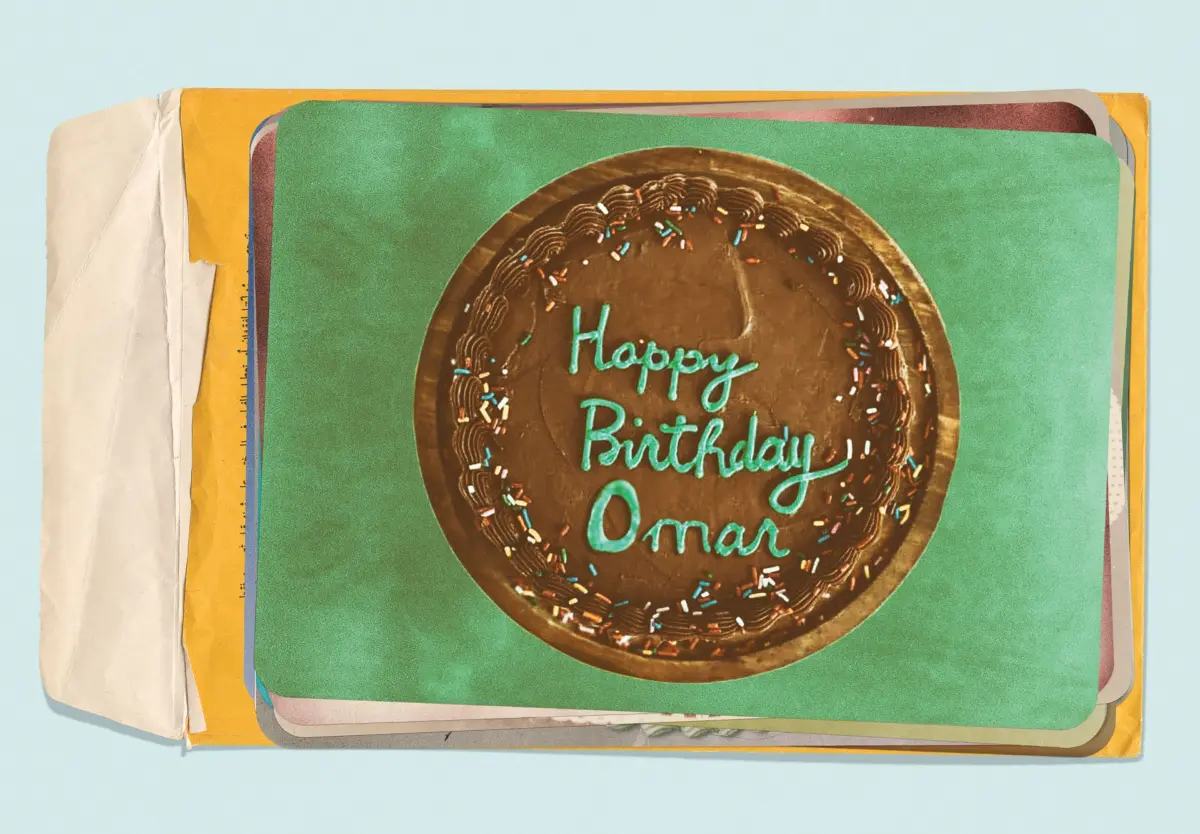
As a teenager in Beirut, Walid Raad walked the streets of his war-torn hometown with a camera, attempting to navigate a reality that defied simple documentation. His black-and-white photographs from that era, at first glance, appear as cool, detached observations of a city in collapse. Yet, he soon discovered that the chaos of the Lebanese Civil War resisted any straightforward attempt at sense-making. One afternoon, while passing a local bakery, he snapped a picture of a cake sitting in the display window. It was a mundane image, decorated with celebratory birthday wishes for someone named Hassan.
Only later, while developing the film in the makeshift darkroom his father had built in their bathroom, did the significance of the date and the name crystallize. The cake was intended for Hassan Nasrallah, then a rising figure in the Lebanese militia scene. Raad recalls experiencing a fleeting, dark fantasy of poisoning the confection. “But I was 15,” he told me, laughing at the absurdity of the memory. “I was a coward.”
Decades later, armed with a PhD and a prestigious MoMA retrospective, Raad returned to that image, transforming it into a series of digitally fabricated birthday cakes. These works are addressed to political leaders who are often difficult to celebrate: happy birthday to Ali, Kamal, Tony, Walid; joyeux anniversaire to Yasser, Elias, Nabih, Amine. By the time these works were realized, Nasrallah had become the leader of Hezbollah, and his 2024 death in an Israeli airstrike marked a grim finality to that chapter of history. Raad’s colorful cakes exist in a state of tension—at once cheerful and chilling, a trademark of his ability to blend the tragic and the comic, the fictional and the factual. In these cakes, as in the breadth of his practice, grand, violent political events are folded into an intimate, human scale.

This project, which effectively began when Raad was a teenager, encapsulates his signature methodology: he starts with a foundational truth—a document or a scrap of memory—and extrapolates its underlying logic to create something fictional, or perhaps, something fantastical. This method has sustained a nearly 40-year career, consistently challenging how we perceive the intersection of history and art.
The Speculative Archive
Raad’s work is currently a standout feature of the 61st Venice Biennale. His installations, comprising paintings, drawings, and photographs of seemingly mundane beds, take on a haunting quality when accompanied by wall text claiming they were slept in by Yasser Arafat. The text notes that the PLO leader “is said to have never slept in the same bed two nights in a row.” Having survived over 40 assassination attempts, Arafat lived and slept in a state of constant, necessary movement. Raad claims to have spent 30 years searching for the beds Arafat actually occupied, producing sketches of mattresses and duvets that remain perpetually unfinished.
Whether in the beds or the cakes, the narrative is delivered along the margins. The bed paintings are incomplete, bordered by tape and unfinished brushstrokes, while the birthday cakes appear to be pulled from manila envelopes, as if they are evidence being processed for a trial. Raad describes his objective as “creating the documents I wished already existed.”

Singling out Raad’s Arafat series at the Biennale, scholar Saidiya Hartman described his “belief in the imaginative and the speculative” as “critical.” Hartman, whose own work focuses on “critical fabulation”—a method of imagining the lives of oppressed people who left limited traces in the archives—finds common ground with Raad. Both artists engage with those whose voices were silenced, recorded only under coercion, or forced to live clandestine lives.
A Language for the Information Age
Raad’s career-long exploration of the Arab world’s history, particularly the Lebanese Civil War (1975–1990), is deeply informed by his generation’s exposure to the "war of images." Khalil Joreige, another Lebanese artist exhibiting in Venice this year, notes that during the war, every militia operated its own media station, television, or radio. “There was a real war of images,” Joreige explains, noting how that environment fostered a sophisticated, if skeptical, relationship to visual culture.
Harvard art historian Carrie Lambert-Beatty has characterized Raad’s work as an exemplar of “parafiction,” noting that the power of his art lies in its ability to force viewers to experience a scenario as having been true, while simultaneously reminding them that other worlds are possible. Claire Bishop, in her recent study on artistic research, praises Raad for providing a synthesis of narrative that avoids the trap of the authoritative master narrative. In my own book, Fables & Forensics, I describe Raad’s work as a form of surrealism for the information age, one that gives playful, structured form to the glut of misinformation without ever succumbing to the reproduction of "fake news."

The Atlas Group and the Instability of Fact
Raad is perhaps best known for his work with the fictional collective, the Atlas Group. This project interrogated photography’s fraught relationship with truth. In Hostage: The Bachar tapes (#17 and #31), attributed to the year 2000, a man named Souheil Bachar narrates his time held hostage in Lebanon alongside five Western men. The video, which features Bachar against a white wall, is clearly manipulated with green-screened footage of Ronald Reagan. The manipulation is a deliberate clue, as are the discrepancies between the Arabic audio and the English subtitles.
The Atlas Group, which Raad claims operated from 1989 to 2004, is defined by its fluid relationship with history. Dates are treated as a malleable medium; institutional records trace the group’s origins to 1967, 1948, or 1945, depending on the source. Even major institutions like the Tate and MoMA hold editions of his work with conflicting date ranges. While Raad asserts the Atlas Group ended in 2004, its presence in the 2026 Venice Biennale catalog—with a date of “printed 2023”—keeps the group’s status in a state of perpetual, intentional ambiguity.
Withdrawal and the "Vampire" Archive
Over the last two decades, Raad’s work has grown increasingly enigmatic. While the Atlas Group primed audiences to read his documents as unstable, his later works engage with shrunken objects, resurrected paintings, and the presence of "vampires" in the archive.

In a restored 19th-century barn in upstate New York, Raad maintains a meticulous archive of his own ephemera—wall labels, dinner name cards, and juvenilia. His childhood in Boston, where he learned to approximate the styles of photographers like Cindy Sherman and Henri Cartier-Bresson, taught him the power of inhabiting a persona. After switching from medicine to photography at the Rochester Institute of Technology, he fell under the influence of a "holy trinity" of theory: psychoanalysis, linguistics, and Marxism.
Yet, it was his encounter with Lebanese writer Jalal Toufic in the early 1990s that fundamentally altered his trajectory. Toufic’s concept of "withdrawal"—the idea that major cultural disasters can cause rituals and forms to become unavailable—became a cornerstone of Raad’s practice. Toufic argued that when a tradition is resurrected after a disaster, it is not truly alive but "undead." The artist’s task is to make this absence palpable.
This concept explains the "shrunken" artworks Raad presented at the Sfeir-Semler Gallery in 2008, where his Atlas Group materials appeared at 1/100th of their original size. For Raad, this was not a metaphor or a quantum trick; it was a physical manifestation of "withdrawal."

Looking Ahead
Raad’s recent work continues to push the boundaries of reality. In his collaboration with graphic designer Pierre Huyghebaert, I thought I’d escape my fate (again), he displays quotes from individuals whose exhibitions were canceled due to their solidarity with Palestine. The quotes are placed low on the gallery floor, forcing the viewer to crouch to read them, while colored tape marks the spaces where the art should have hung—a testament to the power of absence.
As he prepares for a spring exhibition at the Paula Cooper Gallery, Raad plans to display a vintage VW Beetle on its back, a reference to the "flying Volkswagens"—the term US soldiers used for the artillery shells fired on Beirut in the 1980s. Surrounding the installation will be reproductions of handwritten messages found on bombs by soldiers, shared on platforms like Reddit. In this instance, Raad does not need to resort to fiction; as he suggests, sometimes the facts themselves are strange enough. Through it all, Raad remains a master of the archive, proving that in a world of misinformation, the most honest way to document the truth may be to acknowledge everything that has been lost.