
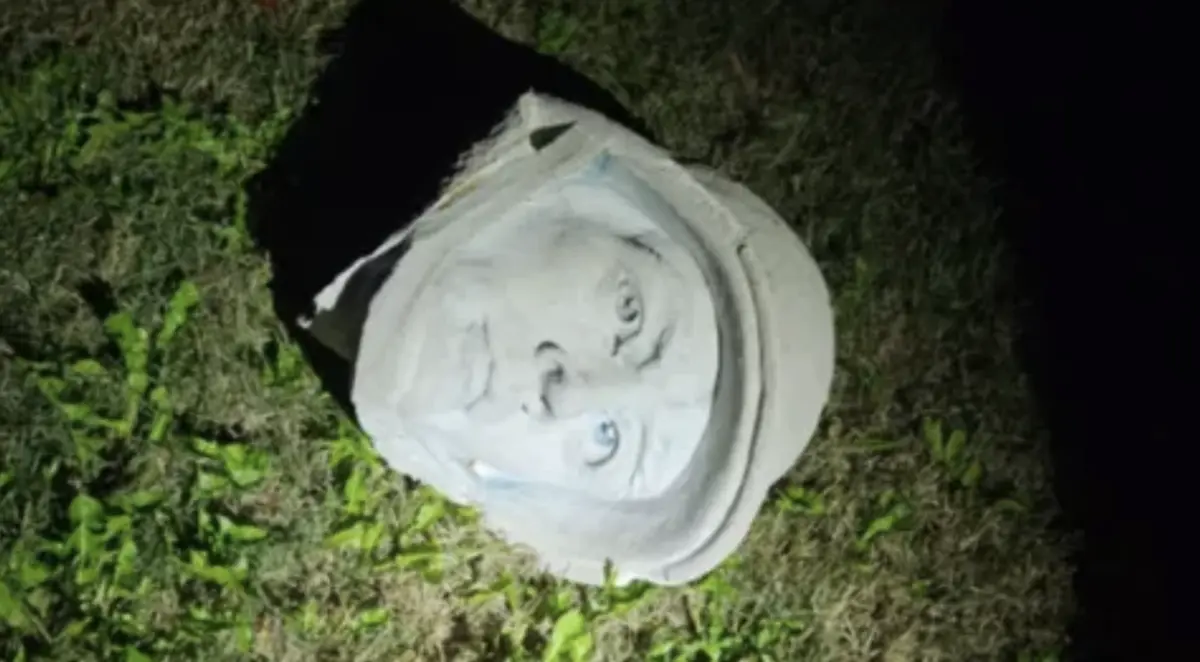
A 27-year-old Stafford, Virginia, man remains in custody without bond after allegedly embarking on a destructive rampage at a revered military landmark near the Quantico Marine base. Authorities say Miguel Alonso Maldonado Soriano was apprehended by Prince William County police late Wednesday night while in the midst of actively dismantling a prominent monument dedicated to the Marines who fought in the Battle of Iwo Jima.
The incident, which has left the local veteran community and military officials reeling, resulted in extensive damage to the site. Preliminary estimates from law enforcement suggest the cost to repair the historic structure could reach into the hundreds of thousands of dollars. The monument serves as a smaller-scale tribute to the iconic Marine Corps War Memorial located in Arlington, an site that holds deep emotional and historical significance for the United States military and the American public.
According to the official incident report, Prince William County police officers were dispatched to the site following reports of suspicious activity. Upon arrival, they discovered Maldonado Soriano in the act of striking the memorial with a sledgehammer. The scene that greeted officers was one of profound desecration: one of the six bronze figures depicted in the statue had been decapitated. Further inspection of the monument revealed that a second figure had sustained significant damage, with its helmet and facial features described as “chipped and gouged.” Additionally, the stone bayonet attached to the rifle carried by a third figure had been snapped off and was missing from the scene.
Maldonado Soriano, a resident of Stafford, was taken into custody at the scene without further incident. He now faces serious legal repercussions for his alleged actions. The Prince William County Commonwealth’s Attorney’s office has charged him with two felony counts: injury to a monument and destruction of property. He is also facing a misdemeanor charge of trespassing with the intent to damage property.
As of the time of this report, a representative for the attorney assigned to represent Maldonado Soriano in the proceedings declined to provide a comment regarding the pending charges. The suspect is currently being held without bond at a local detention facility, awaiting a future court appearance to answer to the allegations.
The Historical Significance of the Memorial
The vandalized statue is a replica of the famous Marine Corps War Memorial, a site that serves as a tangible link to one of the most pivotal moments in 20th-century history. The original memorial in Arlington is based on the Pulitzer Prize-winning photograph captured by Associated Press photographer Joe Rosenthal on February 23, 1945.
The photograph depicts six U.S. Marines raising the American flag atop Mount Suribachi during the brutal Battle of Iwo Jima. The image became an instant symbol of American resolve and sacrifice, eventually serving as the inspiration for the colossal bronze memorial that now stands in Arlington. Over the decades, the photograph has become one of the most recognizable images in American history, representing the grit and determination of the United States Marine Corps.
However, the history of the photograph itself is not without its own complexities. For many years, there was intense public and journalistic debate regarding whether the scene had been staged. Critics argued that the image was not an authentic snapshot of the initial flag-raising, but rather a posed recreation for the cameras. Rosenthal, who was the subject of much of this scrutiny, steadfastly denied the accusations throughout his life, maintaining that the image captured a genuine moment of victory. History eventually confirmed that Rosenthal had captured the second flag-raising on the mountaintop—a larger flag brought up to replace the first, smaller one—which helped resolve much of the controversy regarding the image’s legitimacy.
A Legacy of Sacrifice
The battle that the monument commemorates remains one of the most intense and costly engagements in the history of the United States military. The fight for Iwo Jima was a pivotal campaign in the Pacific Theater of World War II. The island, a tiny volcanic rock, was of immense strategic value. Its capture would provide American forces with an essential base for long-range bombers and escort fighters, and it would represent the first time in the war that U.S. troops had successfully captured Japanese home territory.
The fighting was savage and unrelenting. The Japanese forces, deeply entrenched in an intricate network of tunnels and bunkers, fought with a ferocity that stunned the invading Marines. When the smoke finally cleared and the island was secured, the human toll was staggering. Of the six men captured in Rosenthal’s famous photograph, the personal cost was devastating: three of the Marines were killed in action within weeks of the image being taken, never living to see the end of the battle or the conclusion of the war. Only three of the men depicted in the iconic scene survived the conflict.
For many, the monument near the Quantico Marine base serves as a place of quiet reflection, a site where the public can contemplate the enormity of the sacrifice made by those who fought for freedom during World War II. The act of vandalism, which saw the systematic destruction of the figures representing these men, has been viewed by many as an affront to the memory of the fallen.
Law enforcement officials have not yet released information regarding a potential motive for the destruction. As the investigation continues, the focus for the local community and military personnel has shifted toward the daunting task of restoration. Given the specialized craftsmanship required to replicate the fine details of the bronze figures, the process of repairing the monument is expected to be a time-consuming and expensive endeavor.
The arrest of Maldonado Soriano concludes the immediate threat to the site, but the damage inflicted on the memorial leaves a visible scar. The incident serves as a stark reminder of the vulnerability of public monuments and the ongoing responsibility of the community to protect sites that hold such profound historical and emotional weight. As the case moves through the court system, the monument stands in its damaged state, awaiting the necessary professional attention to return it to its former dignity, honoring the legacy of the Marines whose bravery it was intended to immortalize.