

Climate scientists have already established through extensive meteorological data that Europe’s sweltering summer was the hottest on record. Now, new research reveals it was likely the deadliest as well, with sophisticated epidemiological and climate models showing that the extreme heat led to more than 50,000 excess deaths in urban areas alone across the continent.
The continent has endured five scorching heat waves since May, with record-shattering temperatures recorded in several countries. On the whole, temperatures across the region hovered about 5.2 degrees Fahrenheit, or 2.9 degrees Celsius, above the 1991 to 2020 climatological average. Some particularly intense days exceeded the historical norm by nearly 22 degrees Fahrenheit, or 12 degrees Celsius.
To understand the human toll of these anomalies, researchers modeled the impact of those weather extremes across 854 urban areas, representing roughly 40 percent of the total European population. The comprehensive data, released today, showed that this summer was by far the deadliest on record for urban populations on the continent.
“We’re seeing significantly higher modeled deaths,” said Clair Barnes, an extreme weather and climate change researcher at Imperial College London’s Centre for Environmental Policy. The next closest years in recent history were 2022 and 2003, which recorded approximately 29,000 and 28,000 excess deaths, respectively, during similarly troubled summers.
Climate change is making extreme heat more likely, frequent, and persistent across the globe, but its impacts are felt acutely in densely populated European cities. As the mercury climbs, conditions become increasingly dangerous, Barnes noted, with even fractions of a degree dramatically raising health risks for vulnerable populations. She and her colleagues attributed roughly two-thirds of the 50,000 deaths calculated in their study—which the journal Nature Health is scheduled to publish next week—directly to human-caused global warming.
“Any one of those heat waves would have been deadly, but we’ve had five,” Barnes said, contrasting the current season with typical years that might see only one or two significant heat events. “It’s not just summer. It’s been turbocharged by climate change and now it’s dangerous.”
The research team’s methodology for attributing extreme heat deaths to climate change is considered a standard scientific practice, according to Kai Chen, faculty director of the Yale Center on Climate Change and Health, who was not involved in the study. Researchers essentially model the specific temperatures and associated mortality levels Europe would have experienced in a counterfactual world without human-induced climate change, and then report the stark difference between the two scenarios.
“This tells people that climate change is not a distant threat anymore,” said Chen, who was particularly struck by how quickly the analysis was completed and released to the public. “That is critical information to communicate in near-real time.”
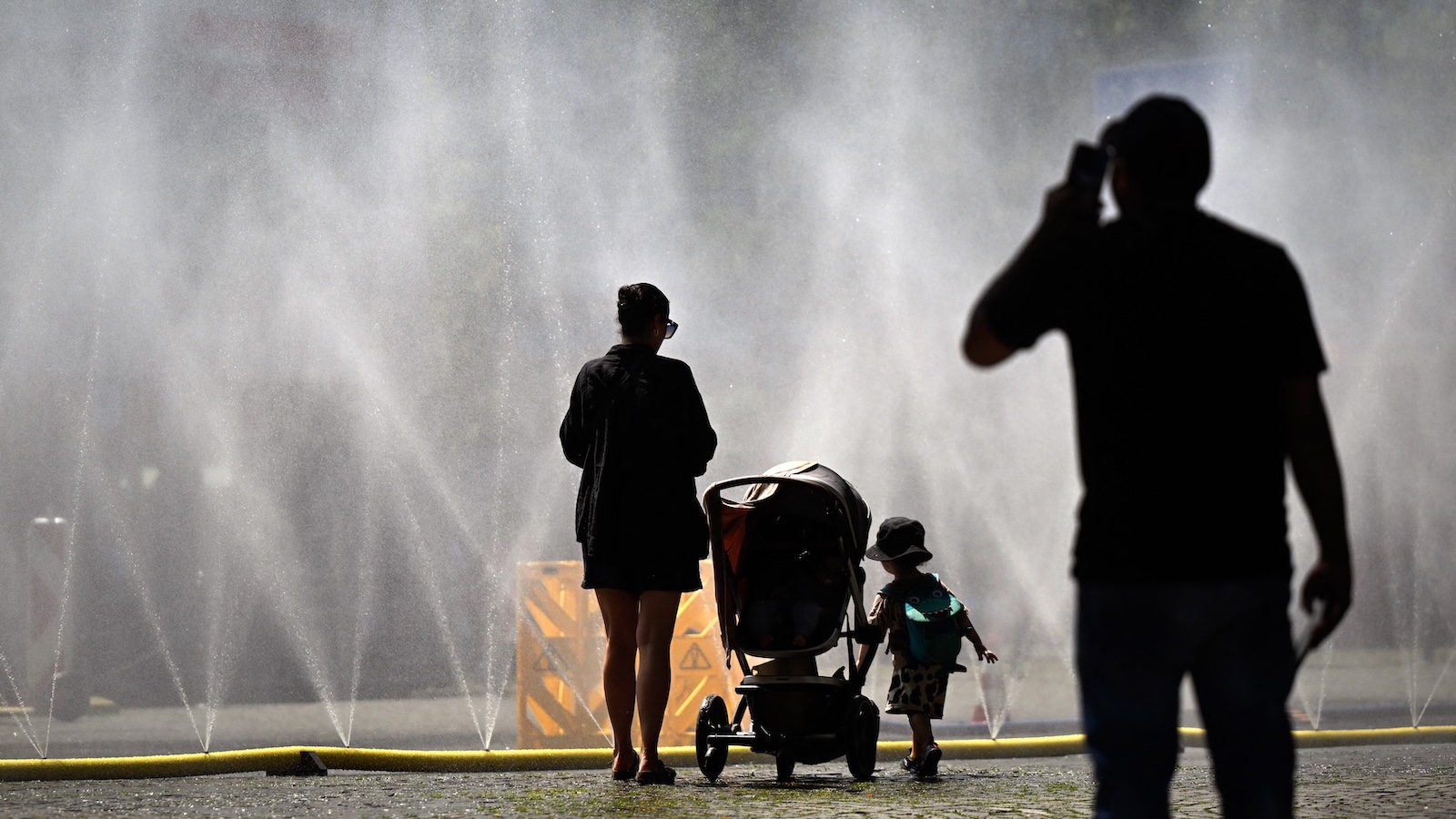
The summer of 2026 was punctuated by an especially searing stretch from June 17 to July 1, when daily average temperatures across the entire European region soared to more than 9 degrees Fahrenheit, or 5 degrees Celsius, above the standard 30-year average. The consequences of this prolonged thermal stress rippled across society. Schools were forced to close early as classrooms became stifling, public transit networks shuttered due to buckled rails and heat-stressed infrastructure, widespread wildfires erupted across parched landscapes, and emergency preparedness plans were tested to their absolute limits. The unrelenting heat even disrupted cultural mainstays, notably affecting the Tour de France as cyclists and spectators battled dangerous thermal conditions.
Overall, southern and western Europe bore the brunt of this summer’s heat impacts, with Italy seeing the greatest number of modeled excess deaths at 13,303, followed closely by France at 7,268. One primary reason Europeans remain exceptionally vulnerable to heat-related mortality, Chen explained, is that air conditioning is considerably less prevalent than in the United States. His own research demonstrates that widespread access to air conditioning can cut heat-related fatalities by more than half.
The elderly population faces a particularly elevated risk during such extreme weather events, as high ambient temperatures can rapidly exacerbate underlying cardiovascular, respiratory, and renal conditions. The latest modeling reflected this grim reality, with all but about 6,000 of the excess deaths occurring among individuals over the age of 65.
“People don’t realize how dangerous extreme heat can be,” Barnes said. “It’s really important to bring home those risks.”
The World Health Organization has described 2026 as a “dress rehearsal” for the severe climate impacts yet to come. Barnes believes that robust, timely research of this nature can help raise public awareness regarding the vital importance of preparing for extreme heat and accelerating efforts to mitigate global greenhouse gas emissions. Furthermore, Barnes noted that these predictive models can be utilized to project health dangers ahead of incoming heat waves, giving local authorities crucial lead time to plan emergency responses.
“There’s no reason,” she said, “that the model couldn’t be run on forecast temperatures.”
Looking ahead, Barnes hopes to expand her analytical framework to include other parts of the world, particularly historically marginalized regions such as Africa, where populations frequently feel the devastating health effects of extreme heat but may lack the resources to formally attribute them to broader climate trends. Limited data availability could impede those efforts in certain areas, she cautioned.
However, robust health and meteorological data mostly exist for the United States, where Chen is among the researchers working to implement this precise type of real-time health impact analysis.
“That will be very important for the U.S. conversation too,” he said. “It can raise awareness and motivate policy action.”