
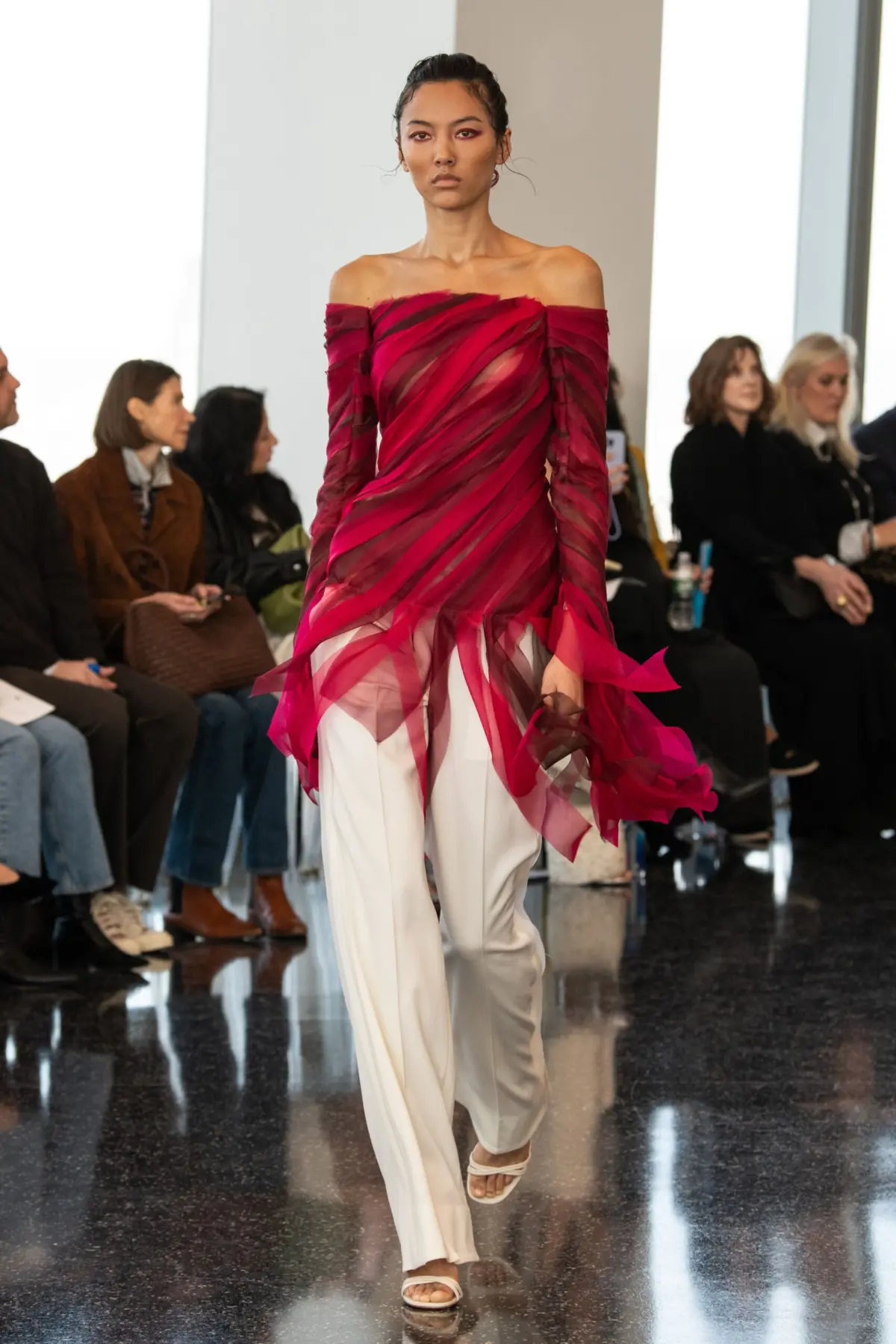
The atmosphere at the 102nd floor of One World Trade Center yesterday was, quite literally, elevated. As the site for J. Mendel’s latest runway show—the brand’s first collection reviewed by Vogue Runway since 2022—the choice of venue underscored a deliberate attempt to marry the label’s storied, high-altitude glamour with the gritty, modern pulse of downtown New York City. The event served as a formal introduction for the brand’s new resident creative director, Jonathan Cohen, marking a pivotal moment of transition for a house that has spent much of the last decade searching for its footing in a rapidly changing fashion landscape.
For a legacy brand like J. Mendel, the challenge of the venue was twofold. While the soaring views of the city skyline provided a backdrop of unmatched grandeur, they also served as a stark mirror to the label’s current identity. The collection, presented against the backdrop of the clouds, highlighted the tension between a company that has long felt "caught in amber" and the necessity of finding a contemporary voice that resonates with a modern audience.
A Legacy of Fur and Socialite Splendor
To understand the weight of the task facing Cohen, one must look back at the brand’s deep-rooted history. Founded in 1870 in St. Petersburg, Russia, the house began as a prestigious purveyor of furs. For over a century, the Mendel name became synonymous with artisanal luxury and opulence. When the brand eventually transitioned to Paris and later, in 1981, established a permanent foothold in New York City under Gilles Mendel, it maintained that reputation for high-end, tactile decadence.
However, the fashion world of the early 2000s—the era that truly defined the modern iteration of J. Mendel—was a different beast entirely. It was the golden age of the New York socialite, a time when names like Tinsley Mortimer, Byrdie Bell, and Muffie Potter Aston were fixtures of the city’s most exclusive galas. J. Mendel became the go-to label for these figures, providing the feathered, embroidered, and fur-trimmed dresses that defined the aesthetic of events like the Frick Young Fellows Ball.
This era of romance and exclusivity was epitomized in January 2011, when Natalie Portman graced the cover of Vogue wearing a pale pink, hand-pleated silk chiffon gown from the label. It is a moment that remains etched in the collective memory of the brand’s enthusiasts, including Cohen himself. Reflecting on that iconic look, Cohen noted, "I just always remember that dress being so beautiful and I loved how easy it looked."
Yet, the fashion industry has moved on significantly since 2011. The decline of fur as a primary driver of luxury sales, coupled with the departure of Gilles Mendel in 2018, left the brand in a state of flux. The challenge for Cohen is not just to revive the brand’s signature, but to translate that "easy" beauty into a language that feels relevant to a generation that prizes practicality as much as it does prestige.
Cohen’s Vision: Bridging Day and Night
Jonathan Cohen’s primary directive is a daunting one: to pivot the label away from being exclusively a provider of eveningwear and toward a more versatile, "day-ish" wardrobe. This evolution is central to his debut collection. The opening look—a set of slim-fitting trousers paired with a flowy, bias-cut chiffon top made of individual strips—offered a glimpse into this strategy. The design was inspired by the meticulous inner finishing of garments within the atelier, turning the hidden craft of couture into a visible, wearable feature. It was a piece clearly intended for a dressy lunch or a cocktail hour, signaling that J. Mendel is attempting to broaden its utility.
However, the collection’s success was uneven. While the move toward lighter, flowy pieces in printed, pleated chiffon felt like a step in the right direction, other elements struggled to find their place. The fur-paneled separates, for instance, felt heavy—a lingering echo of the brand’s history that didn’t quite harmonize with the modern, airy silhouette Cohen seems to be striving for.
Perhaps the most compelling evidence of where the brand could go appeared in a leather jacket featuring delicately puckered pockets. This piece was a triumph of technical innovation, created using a fur machine. By using specialized machinery to fuse the seams, the atelier was able to eliminate seam allowances entirely, resulting in a garment that was as weightless as it was structured. It was this specific intersection of old-world furrier’s artisanship and new-world fabrication that provided the collection’s most forward-looking, exciting moments.
Navigating the Weight of History
Despite these sparks of innovation, the collection was noticeably burdened by a sense of the past. Some of the silhouettes felt overly constrained by a too-tight fit, hindering the fluidity that Cohen clearly aims to achieve. The presentation struggled to fully reconcile the "champagne wishes and caviar dreams" identity of the brand with the reality of the contemporary, fast-paced world.
In his own personal design work, Cohen has often demonstrated a penchant for the playful and the provocative—as seen in look 15 of this collection, an ultra-short, skin-baring pink dress that he admitted was inspired by the pop-culture influence of Britney Spears. It was a jarring, yet intentional, contrast to the more traditional evening wear that has historically defined the house.
The question remains: can J. Mendel, a brand so deeply tethered to the elite socialite culture of the early 2000s, successfully pivot to meet the raw, concrete energy of today’s New York City?
Cohen certainly possesses the tools. His access to a highly skilled, specialized atelier is a rarity in modern fashion, providing him with capabilities that few other designers have at their disposal. The key to the brand’s future relevance likely lies in his ability to direct that artisanal talent away from the traditional, heavy aesthetics of the past and toward a new kind of "grounded" luxury.
To succeed, the label must stop looking at its archives as a blueprint and start using them as a foundation. By taking the meticulous techniques perfected over a century—the pleating, the finishing, and the precision—and applying them to the functional, daily needs of the modern consumer, Cohen has the potential to transform J. Mendel from a relic of an era of socialites into a powerhouse of modern, artisanal wear.
As the show concluded and the audience looked out over the city from their vantage point in the clouds, the message was clear: J. Mendel is ready for a new act. Whether it can successfully descend from the heights of its past to connect with the ground-level realities of current fashion, however, will be the true test of Jonathan Cohen’s tenure. The debut was a bold first step, but the path forward will require a delicate balance of honoring the label’s history while embracing the unpolished, raw reality of the city that serves as its home.