
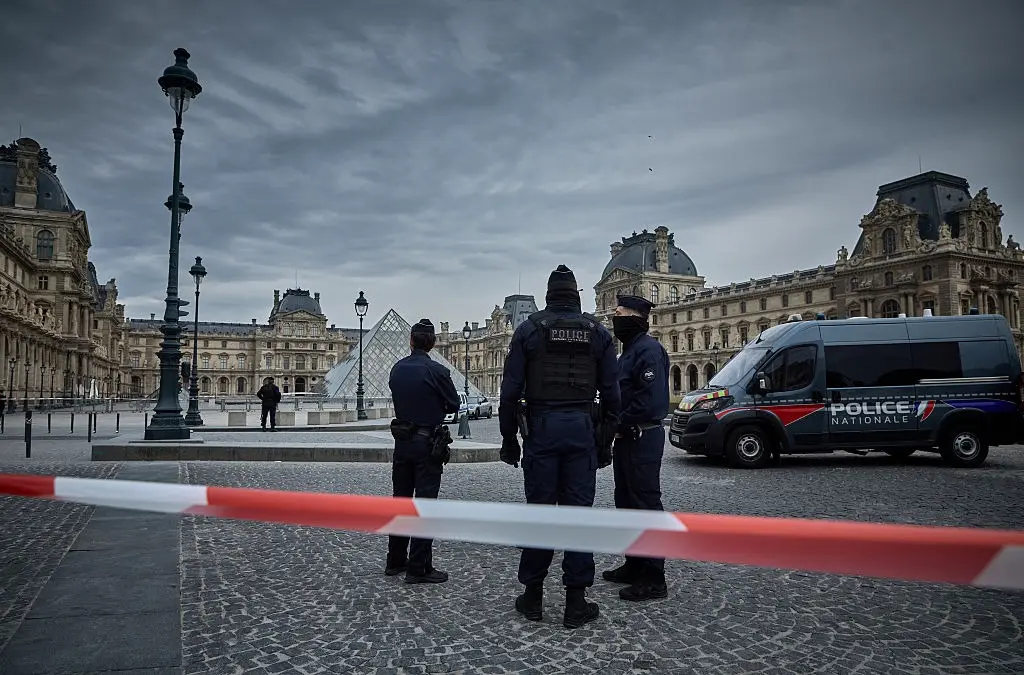
The Paris Court of Appeal delivered a significant procedural ruling this past Wednesday, denying a request for release submitted by Rachid H., an alleged member of the four-person criminal team responsible for one of the most audacious art heists in modern history. The 40-year-old suspect, who has been held in pre-trial detention since November 2025, will remain incarcerated as the investigation into the October 2025 theft of crown jewels from the Louvre continues to unfold. The ruling underscores the gravity with which the French judiciary views the incident, which saw approximately $100 million worth of historical artifacts vanish from the world’s most famous museum in a matter of minutes.
A Precision Strike at the Apollo Gallery
The heist, which took place on the morning of Sunday, October 19, 2025, was characterized by its rapid execution and tactical precision. According to investigators, the perpetrators utilized a truck-mounted motorized ladder to gain access to the Louvre’s prestigious Apollo Gallery. By bypassing traditional ground-level security, the group entered through a second-floor window, effectively circumventing the museum’s primary entry points.
Once inside the gallery, the thieves moved with clinical speed. Within an estimated seven-minute window, they smashed two high-security display cases and seized eight separate pieces of jewelry. The haste of the operation, however, resulted in at least one notable recovery—or near-loss. During their rapid retreat, the suspects reportedly dropped a crown previously owned by Empress Eugénie. Despite the sound of alarms triggering throughout the facility, the group managed to exit the building and make their escape on two motorized scooters, disappearing into the Parisian cityscape before responding law enforcement could intercept them.
The stolen artifacts remain missing to this day, leaving authorities in a race against time to track down the jewels before they can be dismantled or sold on the illicit international black market. The cultural and financial loss is considered immeasurable, as the pieces represent significant chapters in French history.
Piecing Together a Complex Criminal Network
While the physical jewels remain unrecovered, the French police have achieved moderate success in identifying and apprehending those they believe were involved in the operation. Within a month of the heist, authorities arrested the first two suspects: Abdoulaye N., 40, and Ghelamallah A., 36.
The backgrounds of these initial suspects have provided investigators with a window into the nature of the criminal network behind the robbery. Abdoulaye N., an unlicensed taxi driver, was already known to law enforcement due to prior robbery convictions and had gained a measure of notoriety online for his daring motocross stunts—a skill set that may have been instrumental in the group’s high-speed scooter getaway. Ghelamallah A., an Algerian national, was unemployed at the time of his arrest.
Both men have admitted to their roles in the heist, yet their cooperation with investigators has proven to be a double-edged sword. Their testimony, rather than providing a clear path to the recovery of the jewels, has introduced layers of complexity and contradictory narratives. In June, the two men claimed that they were recruited for the job by an unnamed sponsor just days before the October 19 operation. According to their accounts, they were merely foot soldiers following orders from a "principal accomplice" who remains at large.
Furthermore, the two suspects have attempted to distance themselves from later arrests, including that of Rachid H. They explicitly stated to investigators that individuals arrested after them—including Rachid H.—had no involvement in the actual crime. They went so far as to claim that the true mastermind of the operation was someone who physically entered the Louvre alongside them during the heist, a figure who has yet to be identified or apprehended by police.
The Case Against Rachid H.
The detention of Rachid H. centers on a specific, logistical link to the crime: his alleged role in providing the logistical infrastructure for the getaway. Investigators believe that Rachid H. provided the robbers with the keys to a parking facility located in the suburb of Aubervilliers.
In January, reports from Agence France-Presse (AFP) indicated that Rachid H. did admit to "passing" the keys to two individuals. However, he has consistently maintained his innocence regarding the broader scope of the robbery, asserting that he was unaware of the intended use of the facility and had no knowledge of the museum heist. His legal defense team has leaned heavily on the lack of direct forensic evidence linking their client to the scene of the crime.
Specifically, defense counsel has pointed out that Rachid H.’s fingerprints were absent from the truck utilized for the break-in. Furthermore, investigators have not recovered his fingerprints at the Aubervilliers parking lot, where the robbers are suspected of having handed off the stolen jewels to an unidentified third party. By challenging the prosecution’s reliance on circumstantial evidence and the conflicting statements of the co-conspirators, his lawyers have argued that there is insufficient grounds for continued detention.
A Lingering Mystery
The Paris Court of Appeal’s decision to keep Rachid H. in custody suggests that the judiciary is not yet convinced by these arguments or is prioritizing the need to prevent potential interference with the ongoing investigation. The case remains a high-priority matter for French authorities, who are under immense pressure to recover the stolen crown jewels and identify the "mastermind" described by the other detainees.
As the investigation enters its second year, the case continues to highlight the vulnerabilities of even the most well-guarded institutions. The audacity of the seven-minute heist, coupled with the elusive nature of the stolen goods and the shadowy figures who allegedly orchestrated the event, has kept the case at the forefront of public and legal attention in France. For now, the legal proceedings against Rachid H. and his co-defendants serve as the primary focus for prosecutors, as they attempt to reconcile the conflicting testimonies and hunt for the missing pieces of France’s royal history. With the court ruling firm, the state maintains that continued detention is necessary to unravel the full extent of the conspiracy and to ensure that all parties involved in the theft are brought to justice.