
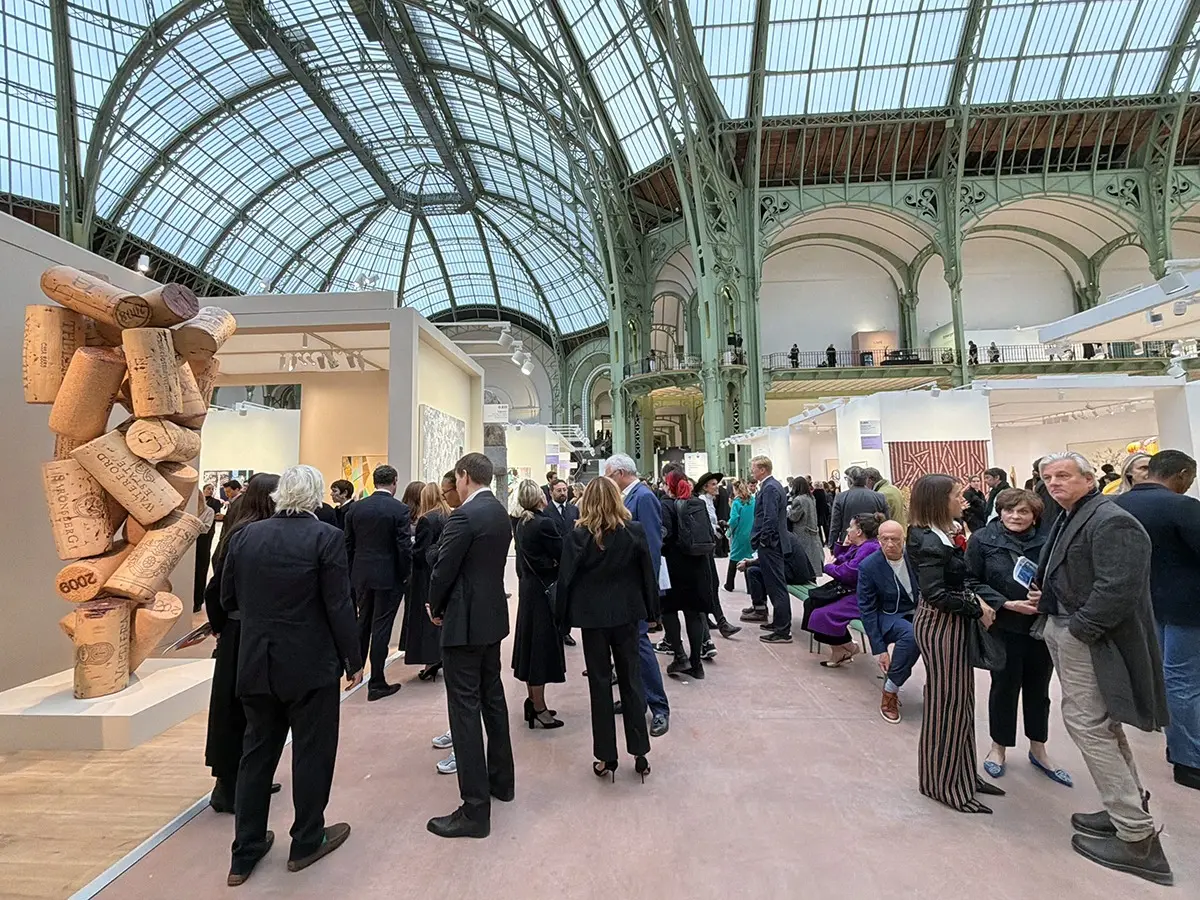
The atmosphere in Paris this week is a study in contrasts. While the remnants of weekend protests remain visible in several arrondissements, a different kind of intensity has taken hold within the art world. Despite the societal unrest playing out on the streets, the international art community has descended upon the city, proceeding with business as usual for the highly anticipated opening of Art Basel Paris. On Monday night and Tuesday, the city’s cultural calendar remained packed with events and private viewings, all serving as a prelude to the main event: the Avant Première preview, which kicked off at 3 p.m. on Tuesday at the iconic Grand Palais.
The Grand Palais, an architectural marvel that serves as the fair’s French home, hosted a slightly different scene than its debut last year. Roughly ten minutes before the doors opened for the ultra-VIP preview—the exclusive tier that precedes the fair’s general opening—the queue was notably shorter than in previous years. This initial observation set the tone for the afternoon. While the aisles were certainly bustling, they remained remarkably navigable, lacking the claustrophobic density often associated with major art fair openings. Rather than a sign of waning interest, however, observers noted that the fair and participating galleries had seemingly refined their guest lists, curating a crowd of the most serious, high-net-worth collectors in the world.
There had been whispered concerns among some dealers and advisers that the ongoing protests in Paris might deter international visitors, particularly those from the United States. While some industry insiders acknowledged that certain collectors had indeed opted to cancel their travel plans, these fears proved largely unfounded once the preview began. The floor was filled with heavy hitters, including prominent collectors such as Allison Berg, Glenn Fuhrman, Pamela Joyner, Nancy A. Nasher, Bob Clark, and Jason and Michelle Rubell. They were joined by a cohort of influential figures including Anne-Cecilie Speyer, Jessica Seinfeld, and Adam Lindemann.
The presence of major institutional leadership further underscored the fair’s prestige. Directors and curators from the world’s most significant museums were out in force, including Michael Govan of the Los Angeles County Museum of Art, Massimiliano Gioni of the New Museum, Ruba Katrib of MoMA PS1, Giampaolo Bianconi of the Art Institute of Chicago, and the Metropolitan Museum of Art’s Max Hollein and David Breslin. The Met, in particular, maintained a strong presence, hosting a large group of trustees throughout the day. Beyond the art world regulars, the star power was palpable, with actresses Katie Holmes and Natalie Portman also spotted navigating the aisles.

For those in attendance, the setting remained as captivating as ever. Art adviser Ana Sokoloff remarked on the quality of the presentations, noting that the booths felt "especially curated and well thought out." Reflecting on the venue, she added, "This place is magical," a sentiment shared by many who found the Grand Palais an indispensable part of the fair’s allure.
A Steady Rhythm of Sales Amidst Competitive Distractions
When asked to characterize the mood of the opening, dealers were nearly unanimous in their reports of "good energy." Mathieu Templon, of the Paris-based gallery Templon, was optimistic just over an hour into the event. "We’re off to a great start—we’re at home," he said. The gallery confirmed the sale of Bilal Hamdad’s L’envers du soir (2026) for €65,000, noting that demand for the artist—who held a solo show at the Petit Palais during last year’s fair—remains exceptionally high ahead of his upcoming March exhibition.
Because the Avant Première is a condensed, high-intensity event, the typical flurry of sales reports was more measured than what one might expect from the closing hours of a multi-day fair like Frieze London, which concluded just last week. Yet, the quality of transactions remained sky-high. Collectors like Will Paley, who divides his time between New York and São Paulo, noted that the current landscape of fairs is "complementary." He characterized Frieze as an environment for "young galleries, young artists, and young collectors with a more adventurous tone," while identifying Art Basel Paris as a space with a "higher price point."
This sentiment was echoed by major dealers, though they acknowledged the unique challenge of operating in a city as vibrant as Paris. Hauser & Wirth president Marc Payot noted that while top-tier attendance remains the fair’s greatest strength, "the problematic side is that you get distracted by the city. People come here to see a thousand things." Thaddaeus Ropac agreed, observing that collectors are making decisions with increased speed because the fair is essentially competing for their time against a wealth of museum exhibitions and Parisian cultural offerings. "Collectors make decisions fast in Paris," Ropac said, noting that while some clients planned to return for the official VIP opening on Wednesday, others were opting to skip it entirely to prioritize sightseeing and shopping.

Despite this, the caliber of works brought to the fair was significant. Ropac reported 15 sales on Tuesday, including four Picassos spanning from 1906 to 1938, a 1953 Lucio Fontana for €1.8 million, and a 2019 Georg Baselitz for €800,000. "We’re doing very well—but it was expected, to be honest," Ropac remarked.
High-Value Transactions and Market Shifts
The speed of transactions at the fair serves as a barometer for the current market. Payot noted that while the pace of closing deals has slowed compared to the frenzied climate of five years ago, the most exceptional works continue to find homes. Hauser & Wirth’s performance on Tuesday was a testament to this, with a series of major sales including Gerhard Richter’s 1965 Rokokotisch (Rococo Table) for approximately $10 million—a piece that had not been included in initial previews. The gallery also moved a 1965 Georg Baselitz, Der Hirte (The Shepherd), for roughly $10 million, along with a $2.9 million George Condo, a $1.9 million Lucio Fontana, and a $1.5 million Philip Guston.
The fair also saw the unveiling of what is widely considered its most expensive work: Amedeo Modigliani’s 1917 painting, Nu étendu (Lolotte). Presented by Pace Di Donna Schrader, the work is valued at over $100 million. The painting, which hasn’t been seen in public for roughly a century, carries significant historical weight, having been part of the artist’s only lifetime solo exhibition at Galerie Berthe Weill—a show that famously caused a scandal for its perceived indecency. Emmanuel Di Donna described the fair’s start as "hugely successful," likening the intensity of the sales activity to "drinking from a fire hose."
Other galleries reported similarly robust results. Gagosian confirmed the sale of a 1987 Willem de Kooning for an eight-figure sum, as well as a work by Peter Doig. White Cube reported 16 sales, including two paintings by Julie Mehretu for $7.85 million each. Gladstone sold a Victor Man painting for $1.3 million and two collages by Wangechi Mutu for $325,000 apiece, while Kurimanzutto placed a sculpture by Haegue Yang for $110,000.

Xavier Hufkens, the Brussels-based dealer, reported 10 sales, with a Charline von Heyl painting leading the group at $475,000. Reflecting on the week’s events, Hufkens observed that despite the "turbulent weekend," there remained a "genuine enthusiasm for art." He invoked the city’s motto, Fluctuat nec mergitur (She is tossed by the waves but does not sink), as a fitting description for the art market’s resilience in Paris.
The fair also saw a record number of shared booths this year, with 12 collaborations representing 24 galleries. A standout was the joint presentation by Layr and Kraupa-Tuskany Zeidler, which featured works like Franz West’s 1983/1984 Passstück and Anna Uddenberg’s 2026 sculpture White Noise (Soft Skills). Amadeo Kraupa-Tuskany noted that the collaboration allowed them to place works in prominent European collections, while Emanuel Layr confirmed interest from American collectors as well.
As art adviser Nicolas Nahab noted, these collaborative efforts reflect a broader "period of adjustment" within the market. Collectors are increasingly skeptical of pricing and demand more research and transparency before committing to a purchase. "Collectors today don’t trust prices like they used to," Nahab explained. "They need reassurance, research, and a global understanding of an artist’s practice and market before making a decision, which is why the decision-making is so slow. If trust is there, then the decision is easy for collectors."
For now, the balance of high-stakes commerce and the unique, undeniable gravity of the Parisian art scene continues to draw the world’s most serious collectors to the Grand Palais, ensuring that even in turbulent times, the market for the world’s most significant art remains resilient.