
In the lexicon of classical music, an étude—a French term meaning "study"—is far more than a simple exercise. It is a technically rigorous, often punishing composition designed to force a musician to transcend their perceived physical and mental limitations. It is a test of endurance, precision, and raw capability. It is through this lens that one must view CLOSING ÉTUDE, the impending finale of Florentina Holzinger’s sprawling, provocative performance piece SEAWORLD VENICE. As the seven-month residency at the Austrian Pavilion at the Venice Biennale nears its conclusion, the title suggests that the artist is not merely winding down, but rather ramping up toward a final, exhaustive feat of performance art.
Since its opening in May, SEAWORLD VENICE has been described as a "propriety-imploding, waste-wonderland." It is a hybrid work that blurs the lines between static installation and live performance, confronting visitors with the uncomfortable reality of human presence and environmental decay. The pavilion’s atmosphere has been defined by the piercing, rhythmic peal of a colossal bell, a relic salvaged from the depths of the Venice Lagoon. In a manifestation of Holzinger’s signature "body-first" philosophy, the piece began with the artist herself serving as the human clapper, striking the bell with her own body. While the physical presence of the artist has evolved, the bell remains as the heartbeat of the project, ringing out every hour—a haunting, industrial metronome marking the passage of time and serving as a grotesque, sonic altar to the ongoing ecological apocalypse of the Venetian landscape.
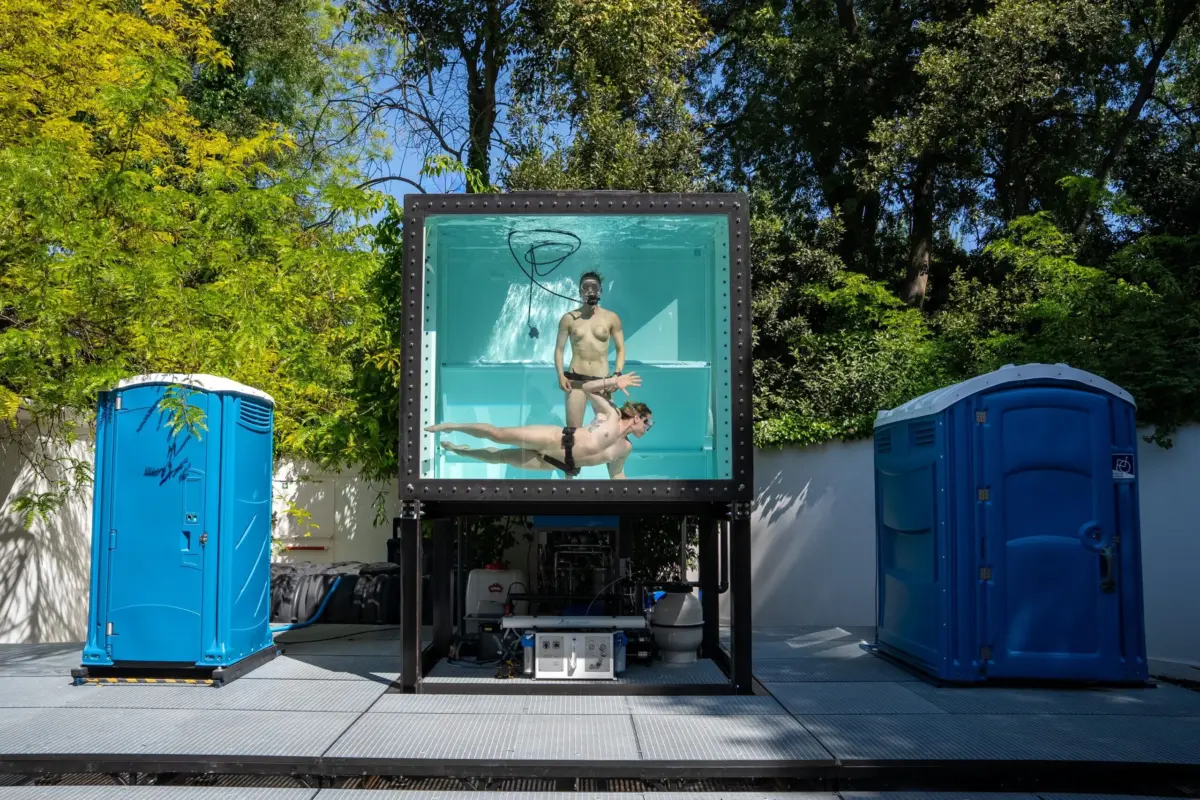
The installation itself is composed of materials that blur the distinction between artistic medium and environmental refuse. Human waste, sourced directly from the site’s visitors, is integrated into the work alongside debris washed up by the tides of the lagoon. The pavilion was equipped with portable toilets, the contents of which were filtered and redirected into a central dunk tank. This cycle of consumption and waste has turned the Austrian Pavilion into a closed-loop system of visceral art, forcing the audience to engage with their own biological footprint in a space traditionally reserved for refined contemplation.
A Ceremonial Transition to the Scuola Grande della Misericordia
As the Biennale prepares to shutter, the project is entering its final movement. For CLOSING ÉTUDE, the bell—the singular, resonant anchor of the installation—will be removed from the pavilion and transported in a ceremonial, somber procession through the streets of Venice. Its destination is the Scuola Grande della Misericordia, a historic structure in the Cannaregio district. Founded in the Middle Ages as a powerful guild, the building has a storied history, having been repurposed as an exhibition space following an extensive architectural restoration in 2015.
The choice of venue is deliberate. The Scuola Grande features a cavernous, imposing interior and a soaring ceiling adorned with frescoes attributed to the school of the Renaissance master Paolo Veronese. This environment provides the perfect backdrop for the "sacred tone" Holzinger has cultivated throughout the project. The transition from the modernist, industrial aesthetics of the pavilion to the historical, ecclesiastical grandeur of the Scuola Grande elevates the bell from a mere prop to a relic. In this final chapter, Holzinger leans into religious iconography, framing CLOSING ÉTUDE as a "final dinner." It is a transformation of the profane—human waste and lagoon sludge—into something resembling a liturgical monument.
According to the official announcement regarding the finale, the project aims to trace a definitive "material transformation from solid to liquid, forging a relic." The distilled remains of the bodily waste collected from pavilion visitors over the past seven months will be presented as a monument for the future. This final installation is scheduled to be unveiled in front of the closed Austrian Pavilion on November 22. The project’s narrative arc will conclude only when the bell finally falls silent and the water, which has been circulating through the system, stops its movement, signaling the end of the "waste-wonderland."
The Future of the Waste-Wonderland: A Tour of Adaptation
While the Venetian iteration of the project is approaching its definitive end, the spirit of SEAWORLD VENICE is far from extinguished. The work is slated to be born anew, beginning with an adapted version of the performance set to debut at the Gropius Bau in Berlin next spring. The exhibition will continue its journey in the fall at the Kunsthalle Wien in Vienna, before reaching its final, long-term leg in March 2028 at Amant in Brooklyn.
The continuity of this ambitious project is being managed by Nora-Swantje Almes, the curator for live programs and outreach at Gropius Bau, who was also instrumental in organizing the original Venice presentation. The task of reconfiguring such a site-specific and volatile work for different institutional spaces presents a unique set of logistical and curatorial challenges. Because the work is deeply tethered to the geography of the Venice Lagoon and the specific infrastructure of the Austrian Pavilion, it cannot be simply "packed up" and moved.
In June, a spokesperson for Amant confirmed to ARTnews that while preliminary preparations for the Brooklyn iteration were already underway, the specific mechanics of the show remained in flux. The central question—whether the controversial and iconic elements such as the jet skis and the portable toilets will make the international journey—remains unanswered. The spokesperson emphasized the inherent site-responsiveness of Holzinger’s work, noting that Almes must first navigate the complexities of adapting the installation for the Gropius Bau in Berlin before the team in Brooklyn can finalize their own strategy.
"If you saw the show in Venice, you know it’s very site-responsive, so [Almes] needs to figure out how to adapt it for Berlin after the Biennale closes in Venice this fall," the spokesperson noted. "After that, we’ll have a better idea of how our own team can further adapt it for Brooklyn."
As SEAWORLD VENICE transitions from the historic, water-logged streets of Italy to the gallery spaces of Germany and eventually the urban landscape of New York, the question of what constitutes a "relic" in Holzinger’s work remains central. The project has successfully challenged the boundaries of performance art, demanding that the audience not only witness the spectacle but participate in the creation of its physical substance. Whether through the tolling of the bell or the processing of human refuse, the work remains an exercise in endurance—both for the artist, who pushes the limits of her body, and for the institution, which must find ways to host a piece of art that refuses to remain static or clean. As November 22 approaches, the focus turns to that final, silent monument, a distillation of seven months of human presence in the historic heart of Venice.