
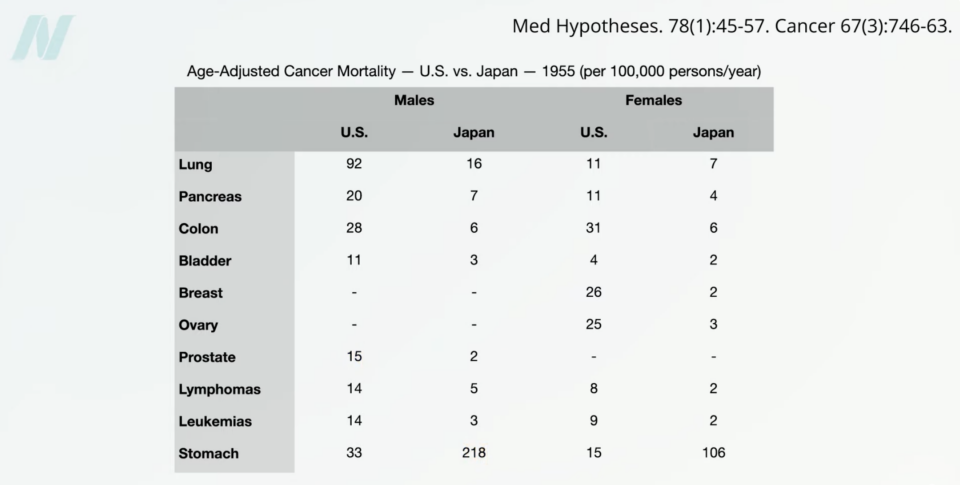
For decades, Japan has stood as a global paragon of longevity. With a healthcare system that manages to sustain the world’s longest life expectancy while consuming only a fraction of the budget required by other high-income nations, the country has long been a subject of intense scientific scrutiny. Much of this success has been attributed to traditional Japanese dietary patterns, which are widely credited with protecting the population from the scourge of coronary artery disease. Furthermore, historical data reveals that Japan has enjoyed some of the world’s lowest rates of colon, breast, ovarian, prostate, bladder, and blood cancers.
Yet, there is a glaring, persistent anomaly in this otherwise enviable public health profile: Japan records some of the highest rates of stomach cancer on the planet. This contrast is stark. For example, while Japanese men have historically faced a risk of prostate cancer that is seven times lower than their American counterparts, they simultaneously endure a rate of stomach cancer that is six times higher. This apparent "Achilles’ heel" in the Japanese diet has puzzled researchers for generations, sparking a decades-long investigation into why a population with such an exemplary health profile remains so vulnerable to gastric malignancies.
The Search for an Etiology: Beyond Genetics and Polish
When researchers first began to grapple with these high stomach cancer rates in the 1970s, the initial hypotheses focused on external environmental factors. One of the most prominent theories centered on the talc used to polish white rice, a process intended to give the grain a glossy, premium sheen. This was a reasonable suspicion at the time; similar concerns regarding talc had already been implicated in the development of ovarian cancer, a subject that has since resulted in significant legal consequences for manufacturers of baby powder. However, further investigation failed to link rice-polishing talc to the high incidence of stomach cancer in Japan.
With the "rice polish" theory debunked, scientists turned their attention to the role of genetics. Was the population simply predisposed to gastric issues? Evidence from migration studies quickly ruled this out. Data tracking Japanese individuals who relocated to the West demonstrated that as these migrants and their children adopted "Westernized" diets and lifestyles, their stomach cancer rates plummeted, aligning more closely with the populations of their new homes. This clear shift indicated that the problem was not rooted in the DNA of the Japanese people, but rather in the food they were consuming and the biological environment of their digestive systems.
The Role of H. Pylori and the Great Enigmas
The search for a primary culprit eventually led to the discovery of Helicobacter pylori (H. pylori), a bacterium that colonizes the lining of the stomach. H. pylori is now firmly established as the most significant risk factor for gastric cancer; it causes the chronic inflammation that can eventually transform healthy tissue into malignant tumors. Because of this, H. pylori is classified as a Group 1 carcinogen, representing the highest level of scientific certainty regarding its role in cancer development.
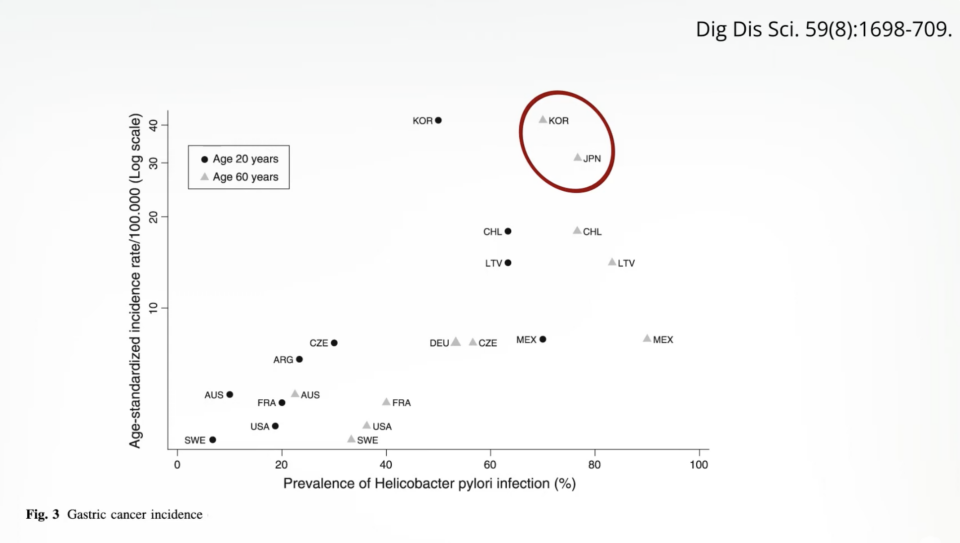
Indeed, both Japan and Korea possess some of the highest national rates of stomach cancer, and these nations also show among the highest incidences of H. pylori infection. For a time, this appeared to be the definitive answer. The "case closed" consensus, however, was shattered by the emergence of two confounding patterns: the "African enigma" and the "Indian enigma."
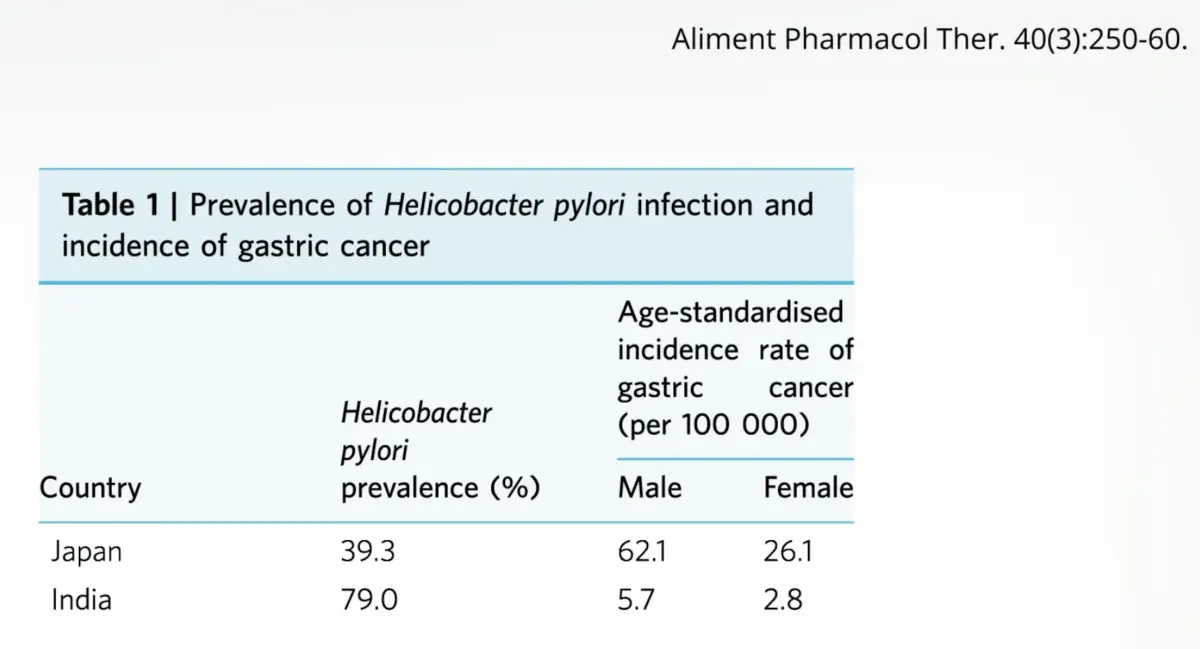
In countries like Nigeria, researchers found extremely high rates of H. pylori infection, yet the incidence of stomach cancer remained remarkably low—only a fraction of what is observed in Japan. Even more striking is the Indian enigma. In India, H. pylori is twice as prevalent as it is in Japan, yet the population experiences ten times less stomach cancer. These geographical discrepancies prove that H. pylori alone cannot explain the gastric cancer epidemic in East Asia.
While it is estimated that roughly half of the world’s adult population carries H. pylori, only a small minority of these individuals develop cancer. It appears that the bacteria acts as a catalyst, creating a state of chronic inflammation that sets the stage for disease, but it requires a co-factor—a secondary environmental trigger—to turn that inflammation into a full-blown malignancy. This realization redirected the focus back to the Japanese and Korean diets to determine what, specifically, might be working in tandem with the bacteria to promote cancer.
The Impact of Preservation and Salt
Scientific inquiry has increasingly pointed toward traditional food preservation methods as the missing link. Studies comparing Asian populations with similar H. pylori rates but vastly different cancer outcomes have identified salted, preserved foods—particularly fish and vegetables—as the primary suspects. Conversely, the consumption of fresh fruits and vegetables has been consistently associated with an 85% reduction in the risk of developing stomach cancer. Fresh fish, interestingly, does not show a strong correlation with cancer risk either way, suggesting that it is the process of preservation rather than the food itself that is at fault.
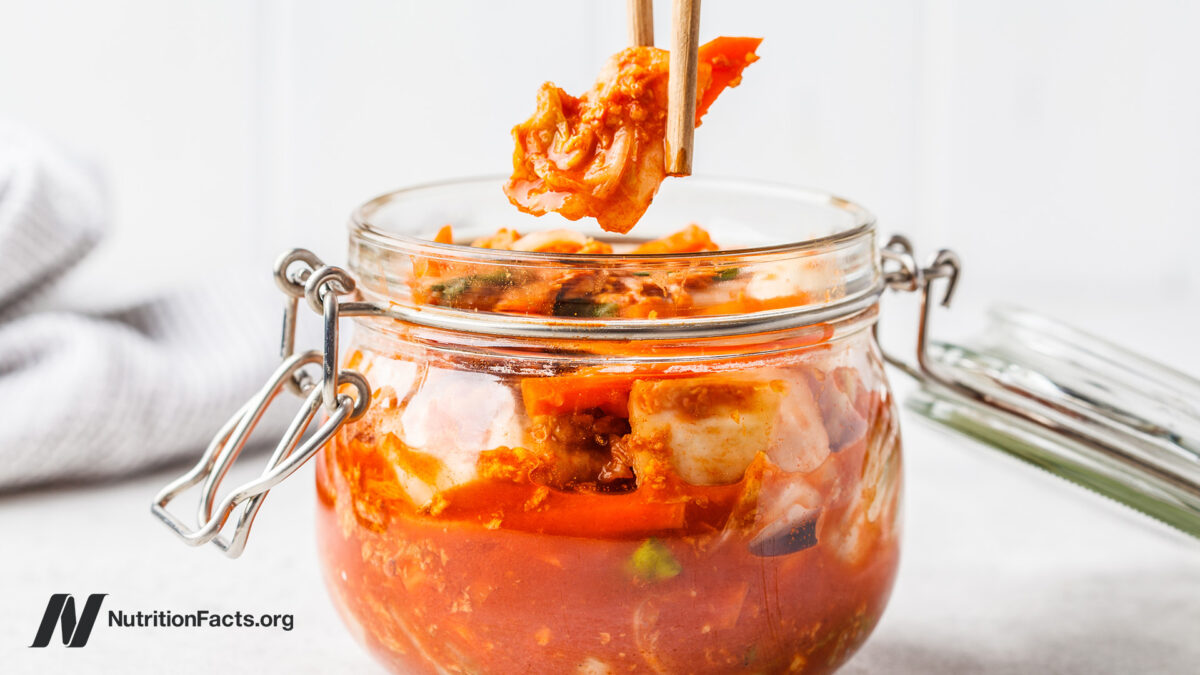
A comprehensive review of 60 studies confirmed that the consumption of pickled foods is linked to higher rates of stomach cancer. The correlation is particularly strong in Korea, where the per-capita consumption of salt-fermented vegetables, such as kimchi, is five to eight times higher than in Japan. To test this, researchers in Vancouver conducted a study where subjects were fed 30 ounces of fukujinzuke (vegetables pickled in soy sauce) or pickled cucumbers over a three-day period. Before the experiment, gastric biopsies were taken to establish a baseline of normal tissue. While subjects who ate fresh carrots or cucumbers showed no changes, those who consumed the pickled vegetables exhibited moderate to severe tissue abnormalities in just a few days, indicating significant stomach irritation.
The role of salt itself is also under scrutiny. While salt is not classified as a direct carcinogen, its secondary effects are profound. High salt intake can physically damage the stomach lining, thin the protective mucus barrier, enhance the colonization of H. pylori, and increase the permeability of the stomach wall to other potential carcinogens. Even in populations without high rates of cancer, moderately high salt intake is linked to an increased risk of gastric illness, though in Japan, this effect appears to be most severe in individuals already suffering from H. pylori-induced inflammation.
In contrast, non-fermented soy foods such as tofu, edamame, and soymilk have been linked to a lower risk of stomach cancer in Japan. Researchers believe the anti-inflammatory and antioxidant properties of isoflavones found in soybeans may provide a protective buffer against the damage caused by other dietary factors. Interestingly, this protective effect is not shared by highly salted, fermented soy products like miso, reinforcing the theory that the salt content remains a critical variable in gastric health.
As medical professionals continue to evaluate these findings, the focus remains on whether the H. pylori infection can be managed or eradicated through dietary intervention rather than relying solely on antibiotics. The interplay between traditional diets, environmental bacteria, and the resulting inflammatory response remains a vital field of study, highlighting the delicate balance required to maintain health in a changing nutritional landscape.