
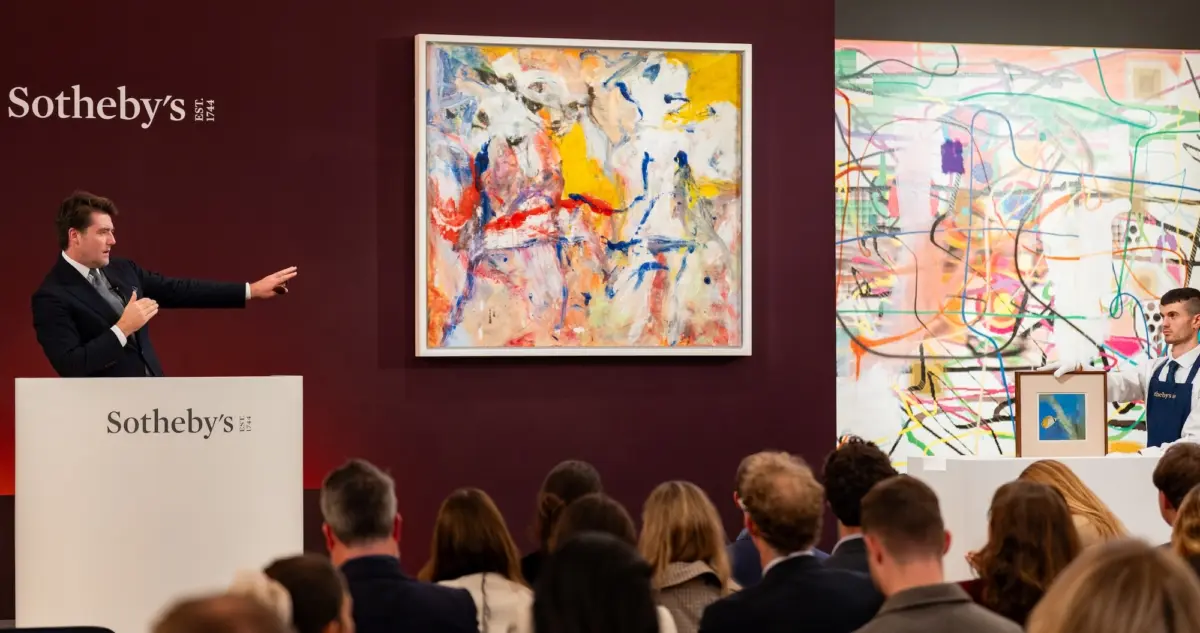
The atmosphere inside the Sotheby’s London saleroom on Thursday evening was thick with a palpable, almost clinical intensity. As the auction progressed, long stretches of silence punctuated by anxious, drawn-out pauses created an environment that felt less like a traditional commercial auction and more like the hushed, high-stakes proceedings of a courtroom. All eyes remained fixed on auctioneer Tom Eddison, who navigated the evening’s proceedings with a steady hand, presiding over a sale that, while slow, ultimately achieved a solid £46.1 million ($61.1 million).
The evening’s performance underscored the current mood of the international art market: one of profound caution and extreme selectivity. While the total fell within the evening’s pre-sale expectations—which had been set between £41.7 million and £58.6 million ($55.3 million to $77.8 million)—the hammer total of £36.9 million, excluding the house’s buyer’s premiums, landed just shy of the low end of the estimate. It was a trim, efficient affair, spanning just one hour and comprising 34 lots. Of those, ten were backed by third-party guarantees, a common mechanism used to mitigate risk in a volatile climate.
However, the event was not without its hurdles. Three significant works, by Damien Hirst, Anselm Kiefer, and Leon Kossoff, were withdrawn from the block prior to the start of the sale. Furthermore, several prominent names failed to find buyers, as works by Banksy, Georg Baselitz, Jadé Fadojutimi, Lucian Freud, Gerhard Richter, and Lynette Yiadom-Boakye were left on the table. When compared to the corresponding sale from the previous year, which totaled £47.6 million ($63.3 million) and was headlined by a Francis Bacon that fetched £13 million ($17.5 million), the results highlight a market that is currently searching for its footing.

A Backdrop of Market Uncertainty
The Sotheby’s sale arrived during the heart of London’s bustling art fair week, providing a direct point of comparison to the broader market sentiment. Just one night prior, Christie’s had held its own evening sales, which concluded with a total of £218.6 million ($289.4 million) across two sessions. That figure was more than double the total achieved at the same event the previous year, suggesting a degree of resilience despite the underlying nervousness. The auctions occurred against the backdrop of Frieze London, where the mood was markedly more vibrant. High-profile figures, including actress Tilda Swinton and fashion designer Raf Simons, were among the throngs of collectors and enthusiasts streaming into the fair, where many dealers reported robust, if deliberate, activity.
Yet, inside the Sotheby’s room, the mood was more contemplative. Ivana Miloradovic, an art historian and consultant who attended the auction, offered a blunt assessment of the evening’s proceedings. "I would say the market is very cautious," she remarked to ARTnews. "Most of the lots either underperformed or were at the lower end." Her sentiment reflected a prevailing view among market observers that collectors are becoming increasingly discerning, focusing their capital on blue-chip staples while showing hesitation toward works that lack impeccable provenance or immediate market heat.
The Headliners: Willem de Kooning and the Blue-Chip Standard
The evening was officially led by an untitled abstraction by Willem de Kooning, painted in 1977. Estimated at between £8 million and £12 million ($10.6 million to $15.9 million), the 5-foot-wide canvas served as a test for the strength of mid-century American masterworks. The painting performed respectably, selling within its estimate for a total of £9.8 million ($12.9 million) after hammering at £8.2 million. The work’s history is a microcosm of the fluctuating secondary market; it last appeared at auction at Sotheby’s New York in 2015, where it realized $6.1 million, marking a significant appreciation in value over the last decade despite the current climate of restraint.

Following the de Kooning was a commanding 8-foot-wide Abstraktes Bild (1992) by Gerhard Richter. Carried with an estimate of £6 million to £8 million ($7.9 million to $10.6 million), the work failed to ignite a bidding war, hammering below its low estimate at £5.4 million. With fees included, the final price came to £6.7 million ($8.9 million). The seller had acquired the piece at Christie’s London in 2011 for £3.6 million ($5.7 million at the time), representing a modest gain over 15 years, further illustrating the cooling of aggressive bidding for even the most established contemporary titans.
Rounding out the top tier was an untitled, dark-hued abstract by Mark Rothko from 1969. Estimated at £3 million to £4 million ($4 million to $5.3 million), it hammered at its low estimate, fetching £3.8 million ($5 million) with fees. The provenance of this particular work is striking; it last hit the open market in 1992 at Christie’s New York, where the current seller purchased it for a mere $264,000, underscoring the massive long-term growth of the Rothko market, even in a sale defined by its conservatism. The top 10 was rounded out by recurring appearances from Georg Baselitz, David Hockney, Albert Oehlen, and Andy Warhol.
The "Homey" Appeal of the School of London
Despite the general sense of caution, certain lots managed to capture the room’s attention, particularly those with strong British connections. Miloradovic noted that "British sales on British soil are always joyous," pointing to the spirited demand for David Hockney’s 10th–22nd June 2021, Water Lilies in the Pond with Pots of Flowers (2021) and Michael Andrews’s 1978 work Butterfly Fish. "Everybody knows the artist, the gossip, and the history. It was a homey atmosphere," she added.

The success of Michael Andrews’s Butterfly Fish was perhaps the most notable outlier of the night. Depicting the vibrant, titular creature, the work sparked an extended contest that pushed the price far beyond its high estimate of £120,000. It eventually hammered at £550,000, totaling £704,000 ($933,117) with fees—a new high for a work on paper by the artist. While Andrews is often overshadowed by his more famous contemporaries in the School of London, such as Francis Bacon or Lucian Freud, he remains a revered figure among collectors. The painter Frank Auerbach once famously praised him, noting that "Mike is so economical; he paints only masterpieces."
Ottilie Windsor, head of contemporary art at Sotheby’s London, provided additional insight into why such works continue to perform well. She explained that the limited supply of Andrews’s work is a primary driver of demand. "The paintings that he did make were often bought as they were being made by a group of collectors who followed his work really closely," she told ARTnews. "Those collectors have never really needed to sell, and so we get very, very low supply of his work to the market. When they do come up, they really do very well."
The Selective Path Forward
The evening concluded with a mixed bag for younger, high-growth artists. Works by the "under-50" set, such as Louis Fratino’s Kissing Couple (2019) and Adrian Ghenie’s The Wall (2019), achieved results squarely within their estimates—£320,000 ($424,144) and £640,000 ($848,288) respectively. These results are particularly notable given that Fratino currently has a sold-out exhibition at David Zwirner’s London showroom, indicating that while there is still money flowing, it is being deployed with surgical precision. Conversely, works by Jadé Fadojutimi and Lynette Yiadom-Boakye failed to find buyers, further highlighting the capricious nature of the current market.

For Sotheby’s, the bottom line remains a matter of perspective. Successfully selling 28 out of 34 lots is, by any professional standard, a respectable achievement. Windsor defended the evening’s performance, noting that "any dealer at the Frieze fair would be thrilled to sell nearly 30 secondary market lots." She concluded that the fundamental interest in art remains undiminished, even if the buyers have become more selective. "There is both interest and money in the market," Windsor observed, "but the market continues to be selective and continues to surprise us with what it is looking for." As the London art week continues, the trade will look to these results as a benchmark for the remaining months of the year, gauging whether this newfound caution is a temporary lull or a new, more measured reality for the global art trade.