
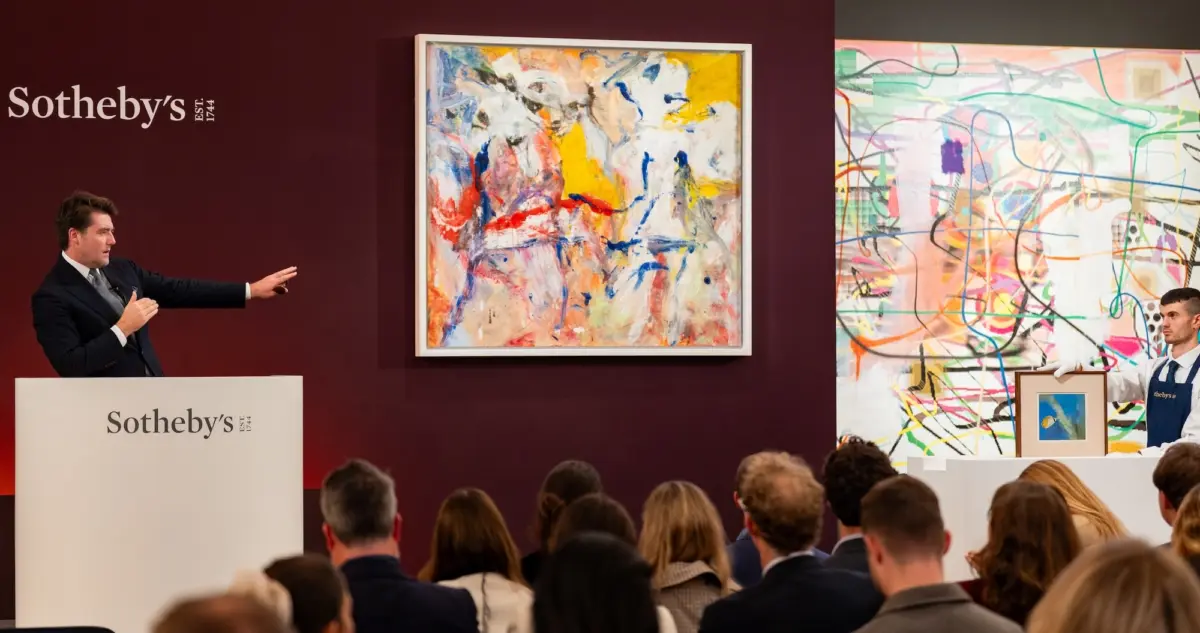
In a saleroom thick with the atmosphere of a high-stakes courtroom, London’s art world gathered on Thursday for a performance defined as much by its pregnant pauses and heavy silences as by the gavel strikes of auctioneer Tom Eddison. Sotheby’s London conducted a contemporary art sale that, while slow and methodical, ultimately achieved a steady £46.1 million ($61.1 million). The evening served as a barometer for a market that is currently operating under a cloud of deep deliberation, where collectors appear more concerned with precision than impulsivity.
The sale, which took place before a full house, featured a curated selection of 34 lots. The evening’s top lot—a sprawling, five-foot-wide untitled abstraction by Willem de Kooning, dating to 1977—anchored the auction with a final price of £9.8 million ($12.9 million). While the result sat comfortably within its estimate of £8 million to £12 million, it underscored the broader performance of the event. With an overall pre-sale estimate of £41.7 million to £58.6 million ($55.3 million to $77.8 million), the hammer total of £36.9 million (before the inclusion of house fees) fell just short of the low estimate, reflecting the cautious sentiment currently permeating the secondary market.
A Market Defined by Selectivity
The one-hour session was a trim, tightly managed affair. Of the 34 lots originally cataloged, ten carried financial guarantees—a testament to the auction house’s desire to secure inventory in an uncertain climate. However, the lead-up to the event was marked by the withdrawal of three significant works by Damien Hirst, Anselm Kiefer, and Leon Kossoff. Once the bidding commenced, the selective nature of the room became even more apparent; notable works by blue-chip names including Banksy, Georg Baselitz, Jadé Fadojutimi, Lucian Freud, Gerhard Richter, and Lynette Yiadom-Boakye failed to find buyers.

This performance stands in contrast to the same event held last year, which totaled £47.6 million ($63.3 million) and was buoyed by a Francis Bacon painting that fetched £13 million ($17.5 million). The current environment is, however, markedly different. Sotheby’s sale arrived on the heels of a more robust evening at Christie’s, which took place just one night earlier. That sale, spanning two sessions, totaled a healthy £218.6 million ($289.4 million), more than double its previous year’s performance.
The disparity between the two houses and the general atmosphere in the room prompted immediate analysis from industry experts. Ivana Miloradovic, an art historian and consultant who attended the Sotheby’s auction, described the mood as palpably guarded. “I would say the market is very cautious,” Miloradovic noted, observing that the majority of the lots presented either underperformed or hovered at the lower end of their expected valuation ranges.
Key Lots and Provenance
The evening’s primary focus remained the Willem de Kooning, an evocative abstract work that has seen a significant journey through the market. When it last appeared at auction at Sotheby’s New York in 2015, the painting realized $6.1 million. Its jump to $12.9 million nearly a decade later highlights the enduring, if measured, demand for established mid-century abstraction.

Following the de Kooning, the second highest price of the night was achieved by Gerhard Richter’s 1992 Abstraktes Bild. The eight-foot-wide canvas, estimated at £6 million to £8 million, hammered at £5.4 million, ultimately selling for £6.7 million ($8.9 million) with fees. The work’s history is a clear indicator of the market’s long-term volatility; the seller had acquired it at Christie’s London in 2011 for £3.6 million ($5.7 million at the time). While the sale represents a profit, it falls short of the explosive gains often associated with Richter’s work in the preceding decade.
Rounding out the top results was an untitled, dark-hued Mark Rothko abstraction from 1969. Estimated between £3 million and £4 million, it hammered at the low end of its estimate, reaching £3.8 million (just under $5 million) with fees. The provenance of the Rothko provided a stark reminder of how much the market has shifted over the last three decades; the seller had purchased the piece at Christie’s New York in 1992 for a mere $264,000. Other major names, including David Hockney, Albert Oehlen, and Andy Warhol, appeared twice in the top ten lists, providing a degree of stability to an otherwise fluctuating evening.
The "Homey" Appeal of the School of London
Despite the overall caution, certain segments of the sale felt distinctively energetic, particularly when works by British artists came under the hammer. Miloradovic pointed out that “British sales on British soil are always joyous,” citing the particular enthusiasm for David Hockney’s 10th–22nd June 2021, Water Lilies in the Pond with Pots of Flowers and Michael Andrews’s Butterfly Fish (1978).

The success of Butterfly Fish was perhaps the night’s most surprising narrative. The painting, which depicts the creature with a unique, minimalist sensibility, shattered its high estimate of £120,000 to hammer at £550,000. Including fees, the total reached £704,000 ($933,117), setting a new auction record for a work on paper by the artist. Andrews, who is often overshadowed by his School of London contemporaries like Bacon and Freud, was once famously described by Frank Auerbach as a master of economy, stating, “He paints only masterpieces.”
Ottilie Windsor, head of contemporary art at Sotheby’s London, provided insight into why such works continue to perform despite broader market trends. “The paintings that he did make were often bought as they were being made by a group of collectors who followed his work really closely,” Windsor explained. “Those collectors have never really needed to sell, and so we get very, very low supply of his work to the market. When they do come up, they really do very well.”
Navigating the Frieze Week Landscape
The Sotheby’s sale took place in the thick of London’s high-profile Frieze week, a time when the city typically swells with international collectors, curators, and celebrities. Only a day prior, figures such as Tilda Swinton and Raf Simons were spotted navigating the aisles of the Frieze fair, where many dealers reported that sales were moving forward with surprising robustness. This juxtaposition between the fair’s success and the auction room’s measured pace highlighted the nuanced behavior of today’s buyers.

Even among the "under-50" demographic of artists, the results were mixed. Louis Fratino’s Kissing Couple (2019) achieved a within-estimate price of £320,000 ($424,144), bolstered by the fact that the artist currently has a sold-out show at David Zwirner’s London showroom. Adrian Ghenie’s The Wall (2019) followed a similar trajectory, selling for £640,000 ($848,288). However, the failure to sell works by artists such as Fadojutimi and Yiadom-Boakye suggests that even the most hyped contemporary names are not immune to the market’s current mood of discernment.
Reflecting on the evening, Windsor maintained an optimistic outlook, framing the 28 sold lots out of 34 as a clear success. “Any dealer at the Frieze fair would be thrilled to sell nearly 30 secondary market lots,” she noted. While there is clearly still significant capital circulating in the art world, the current climate is defined by a heightened sense of selectivity. Collectors are no longer buying indiscriminately; they are waiting for the right moment, the right provenance, and the right price point. As the art market continues to evolve, the takeaway from this week’s events in London is that while the appetite for great art remains, the era of unbridled optimism has been replaced by a more calculated, careful, and deeply considered approach to acquisition.