
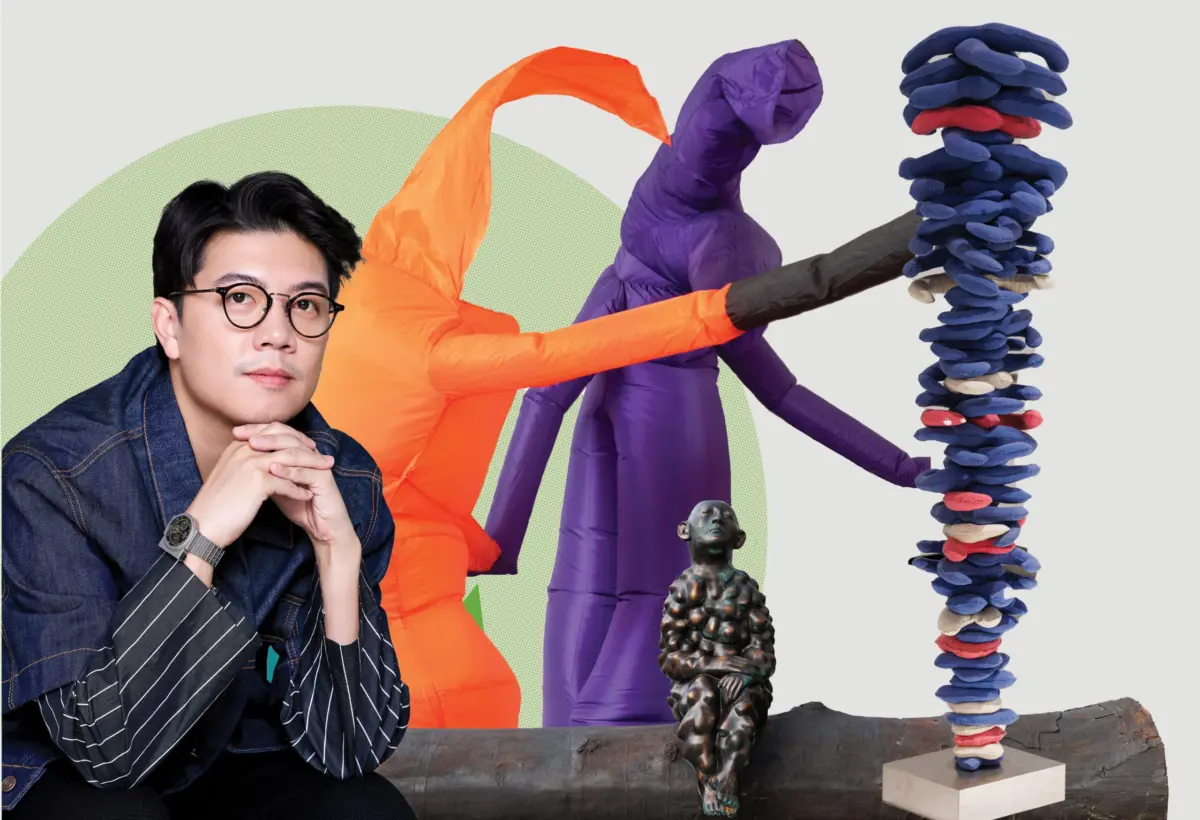
I hadn’t expected a talking frog to remind me of why I fell in love with contemporary art, and I certainly hadn’t expected to lose it before I ever had the chance to buy it.
In March, during a stretch of cool weather that reminds me why I still love Hong Kong—even when it no longer feels quite like the city I remember—I found myself navigating the labyrinthine aisles of Art Basel Hong Kong. It was there, at the Esther Schipper booth, that I encountered Ryan Gander’s 2025 sculpture, You Complete Me, or I see things you can’t see (A Frog’s Tale). The work is surreal, bordering on the uncanny: a hyperreal frog, perched nonchalantly in a potted plant, speaks in the voice of a young girl. Her dialogue flows through a stream of existential musing, at once innocent and eerily profound. It felt like stepping into a fairy tale that possessed a secret, fundamental truth about the human condition.
When I approached the gallerist, I was met with the specific, gentle regret reserved for a hopeful collector: the work was already spoken for. Someone else had claimed the frog. While I have long made peace with the competitive nature of the art market—the inevitable sting of losing a piece to another collection—this particular loss cut deeper than most.
Interrupting the Malaise
What the piece managed to do, in those few moments before I learned it was unavailable, was interrupt a pervasive fatigue I had begun to accept as ordinary. Call it art fair fatigue, or perhaps a low-key, systemic art world malaise; either diagnosis feels apt, and I suspect half the convention center that week was nursing the same undiagnosed condition. For those few minutes, I wasn’t thinking about price points, provenance, market cycles, or where the work sat within the artist’s broader career trajectory. I wasn’t evaluating, appraising, or calculating. I was simply looking, the way I did as a child. That giddy, unburdened feeling has stayed with me ever since.
As a small consolation, Gander is already represented in the collection of Dib Bangkok, the private museum that was my father’s lifelong dream and which we finally inaugurated at the end of 2025, two years after his passing. Ahead of the museum’s opening, we acquired Gander’s Untouched Idea Machines (2025). It is a wall-mounted brass dispenser that, at the press of a button, prints out one of roughly 2,000 unrealized ideas for artworks. We plan to showcase it in our second exhibition this fall. Under the circumstances, it felt only fitting to return home with an idea rather than a frog.
This has been one of the least traveled years I have experienced in quite some time. Business responsibilities carry their own gravity, and 2026 has kept me largely grounded in Bangkok, with only brief, tactical departures to Hong Kong, Shanghai, and Singapore—the latter for a panel discussion at Art SG regarding the modern responsibilities of building museums.

A trip to Shanghai in late April was ostensibly for a Monocle talk to a room of entrepreneurs, but the real draw was a private viewing room on Taicang Road, nestled in the old French Concession. There, I considered a series of works by Paul Chan for the Dib collection, most notably 2nd Light (2006). Part of Chan’s renowned “Seven Lights” series, this now two-decade-old installation features the shadows of trees, flags, and falling figures drifting across the floor through light alone. The room takes on the quality of a lucid dream, where beauty and fragility exist in perfect, uncomfortable harmony. It was a stark reminder that light can be as expressive as pigment or bronze, and this work demanded that I dwell in uncertainty—a space that felt both necessary and profound.
The Intersection of Depth and Accessibility
This experience brought me back to a guiding question for Dib Bangkok: Where does depth meet accessibility? Can a deeply considered, intellectual work remain rewarding while still speaking to someone encountering it for the very first time? I am increasingly convinced that those two worlds are not as far apart as the art establishment often assumes.
Watching thousands of first-time visitors move through the galleries at Dib this year has confirmed this suspicion. Experienced collectors do not necessarily see more than beginners; we simply know more, and those are two very different things. Children, for instance, rarely ask which art movement a piece belongs to. They ask why it feels alive, or why it seems strange. Expertise, if we aren’t careful, can overwhelm wonder. The challenge, then, is not to learn more about art, but to remember how to look at it. My personal inquiry over these past months has centered on how one maintains "fresh eyes" after years of conditioning.
While business kept me in Bangkok and forced me to forgo the Venice Biennale this year, our director, Miwako Tezuka, attended on behalf of the museum. She returned with vivid accounts of Lorna Simpson’s exhibition, "Third Person," at Punta della Dogana, one of the two exhibition spaces run by fellow collector François Pinault. Miwako was particularly struck by Stacked Stones/Vibrating Cycles (2020), an installation of stacked stones crowned with singing bowls that visitors are invited to sound themselves. The tones rising from the piece echoed the late Thai artist Montien Boonma’s philosophy of art as a practice rather than a spectacle, urging humility over hubris. Hearing her describe it, the sense of FOMO was palpable.
Miwako noted that the installation resonated with the spirit of our inaugural exhibition, “(In)visible Presence.” That show was rooted in memory: my late father, my grandfather, the work of Boonma, and the community that sustained the vision for Dib long before the walls were built. It was a somber exhibition that did not shy away from loss, but rather sought to embody the experience of it. It was an ode to spiritual reconciliation.
Our second exhibition, “Giving Life,” marks a pivot toward celebration. Featuring roughly 30 artists, including Alexander Calder, Rirkrit Tiravanija, and Izumi Kato, the show explores how artists breathe vitality into materials and objects. Many of the works feature items carrying their own heavy histories—spent bombshells, discarded machinery, living plants. These objects, forged by conflict or time, are transformed into something unexpectedly, vibrantly alive. These works were often created during periods of war, economic collapse, or political suppression, yet together they offer a quiet, undeniable case for the persistence of life. That feels like a cause worth celebrating, and perhaps this abundance of life is my own remedy for the malaise I carried home from the art fairs.

Market Cycles and Local Growth
Away from the museum floor, the art market has continued its own reckoning. While the apex of the auction world—and prices for historical, blue-chip names—remains resilient, the middle market has looked increasingly shaky. It is a natural, perhaps inevitable, cycle. To my great joy, the market has seen a surge in demand for René Magritte, proof that quality paired with scarcity will always command attention. In June, Sotheby’s London sold La Belle Promenade (1965) for $21.6 million, following the October 2025 sale of La Magie Noire (1934) in Paris for $12.3 million.
The subtle, painterly quality that draws me to Magritte also brings me back to the work of Prae Pupityastaporn, a Thai artist I have collected for nearly a decade. A visit in June to Nova Contemporary in Bangkok deepened my appreciation for her practice. Pupityastaporn takes mundane subjects—a window, a landscape—and suspends them in a real yet eerie, quietly humming dreamscape. There is a silent magic in her work that reminds me that even within our everyday lives, there exists something sublime.
We are currently witnessing a generational story unfolding. It is common to see the children of collectors reject their parents’ tastes, though I have never quite felt that rebellious instinct myself. It is, however, a reminder that the relationship between parent and child is often played out on the walls of the family home.
Nonetheless, I am feeling unusually optimistic about the cultural landscape in Thailand. A newer style of gallery, one built around community and a specific local vibe, is filling the gaps left by traditional institutions. Bangkok Kunsthalle is pushing boundaries in the Yaowarat district; the Jim Thompson Art Center continues to build on the momentum established by Gridthiya Gaweewong; and the upcoming deCentral, led by my old schoolmate Punn Chirakiti, promises a new chapter. A wave of new collectors and patrons is entering the scene, and they have kept me far more entertained close to home than any frog in the bustle of an international art fair ever could. It is a pleasure to watch this evolution unfold from the sidelines.
Being grounded in Bangkok has not been a hardship; it has been an invitation to sit still and reflect. Collecting has taught me much, but perhaps the most enduring lesson is the one I took from Gander’s frog: art is not something we are necessarily meant to fully explain. The works that remain with us, the ones that anchor our collections and our memories, are rarely the ones we can define with precision. They are the works that change how we see the world and, in those rare, transformative moments, remind us how to see it at all.