
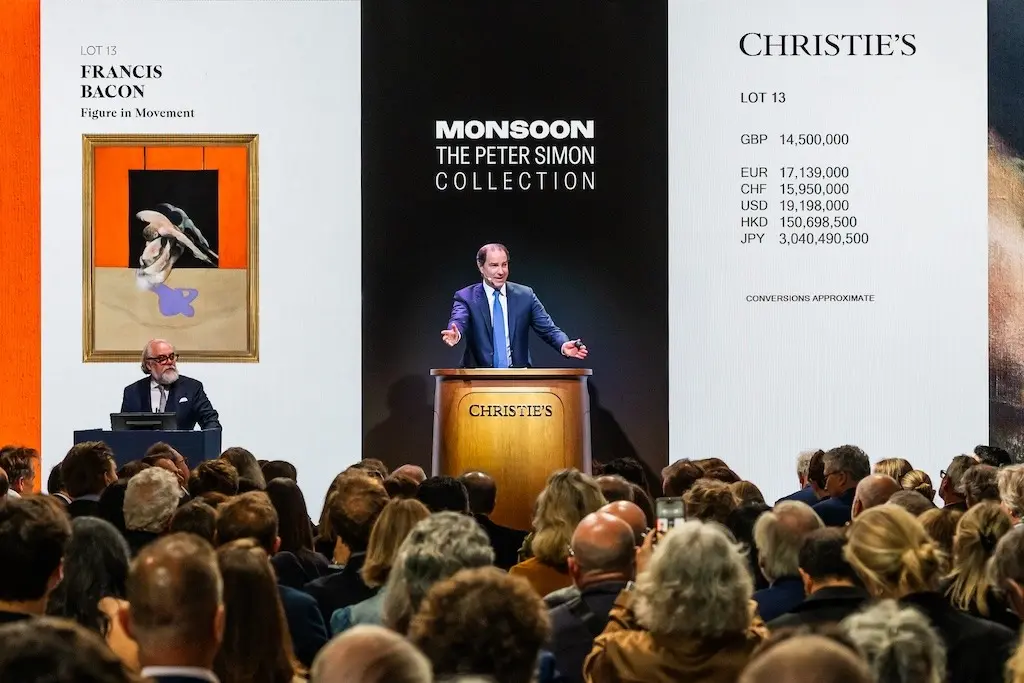
Christie’s London delivered a commanding performance this week, generating a combined total of £218.6 million ($289.4 million) across two back-to-back evening sales held on Wednesday. The robust results, which more than doubled the house’s total from the equivalent period last year, serve as a vital bellwether for the international art market as major players turn their attention toward the high-stakes November auctions in New York.
The evening was defined by a mixture of historical significance and modern energy, marked by the sale of the storied Peter Simon collection and a high-profile 20th- and 21st-century auction. Together, the events achieved a 91 percent sell-through rate by lot and 96 percent by value, offering a rare moment of optimism in what has been a cautious fiscal climate for the art world.
The Peter Simon Collection: A Record-Breaking Highlight
The focal point of the evening was undoubtedly "Monsoon: The Peter Simon Collection." Assembled by the founder of the British retail giant Monsoon—a prominent figure on the ARTnews Top 200 Collectors list since 2005—the collection proved to be the primary draw for global bidders. It accounted for £107.5 million ($142.3 million) of the night’s total, cementing its status as the highest-value single-owner collection ever presented at Christie’s London.
The collection’s performance was nothing short of surgical, boasting a 98 percent sell-through rate by lot and 99 percent by value, with only a single work out of 41 failing to find a buyer. The sale also served as a stage for fresh benchmarks, yielding five new auction records. Among the standout results was Francis Bacon’s Figure in Movement, which fetched £17.19 million ($22.8 million) after an intense contest, ultimately selling to a bidder present in the room. Piet Mondrian’s Composition A, with Double Line and Yellow also performed strongly, bringing in £9.71 million ($12.86 million), while Joan Miró’s Peinture (Les amants – Adam et Eve) realized £8.56 million ($11.33 million).
Perhaps the most surprising outcome of the session was the performance of Hurvin Anderson’s Last House. Offered with a modest estimate of £2 million to £3 million ($2.6 million–$3.9 million), the work ignited significant interest, eventually hammering down for £5.7 million ($7.5 million).
Market Dynamics and the "Guarantee" Factor
Despite the celebratory atmosphere, the evening was not without its administrative hiccups. A scheduling confusion regarding the start time of the Simon sale caused a ripple of anxiety among market professionals. While Christie’s had scheduled the event for 6 p.m., their live-auction website displayed a 7 p.m. start time in various regions. Several high-level advisers, managing global portfolios, were reportedly under the impression that the proceedings would begin later. While it remains unclear if this caused any specific bidder to miss their window, it highlighted the logistical pressures inherent in managing global, multi-time-zone auctions.

Beyond the clock, analysts were quick to contextualize the night’s success. Philip Hoffman, chairman and founder of the Fine Art Group, noted that while the results were encouraging, they should be viewed with a degree of nuance. A significant portion of the success in the Simon sale—29 of the 41 lots—was underpinned by third-party guarantees. This financial mechanism effectively offloads risk from the auction house to external parties before the first paddle is even raised.
"These auctions are staged, managed, and already pumped up to the max for the best guarantees they can get," Hoffman remarked to ARTnews. He suggested that while the results demonstrate a healthy appetite for blue-chip assets, the reliance on guarantees provides a safety net that may obscure the underlying volatility of the broader, non-guaranteed market.
A Tale of Two Auctions: 20th/21st Century Evening Sale
Following the conclusion of the Simon collection, the atmosphere shifted as the house transitioned into its 20th- and 21st-century evening sale. While the energy remained high, the results were more varied, culminating in an 85 percent sell-through rate by lot—a notable drop from the near-perfect performance of the preceding collection.
The second session was anchored by the sale of Wassily Kandinsky’s early masterpiece, Das bunte Leben. Long considered a centerpiece of the evening, the work proved to be the most successful lot of the night, fetching £31.6 million ($41.8 million). Auctioneer Adrien Meyer described it as the most significant early work by the artist ever to hit the auction block. The piece, which had been restituted to the heirs of Hedwig Lewenstein-Weyermann in 2023, sparked a fierce bidding war involving three separate Christie’s specialists, ultimately surpassing its £25 million high estimate.
Another highlight was the Russian avant-garde painter Liubov Popova, whose Painterly Architectonic shattered expectations. With nearly eight minutes of spirited bidding, the work realized £7.64 million ($10.1 million), more than tripling its £2.5 million high estimate and establishing a new auction record for the artist.
Other notable records included Bridget Riley’s Streak 2, which sold for £5.21 million ($6.9 million), and David Bomberg’s San Miguel, Toledo, Afternoon, which brought in £3.26 million ($4.32 million). The latter lot prompted a rare moment of excitement in the room, with the auctioneer pausing to allow for a closer inspection of the work as the price climbed. Further records were set for artists Portia Zvavahera and Barbara Hepworth, demonstrating continued interest in high-quality modern and contemporary works.

Shifting Energy and Future Outlook
As the evening wore on, the momentum began to fluctuate. During the later stages of the second sale, the room experienced a noticeable lull. Following the sale of Warhol’s Mona Lisa (Reversal Series) for £1.5 million ($1.98 million), the energy waned, and a sequence of works by heavyweights such as Cy Twombly, George Condo, Alberto Giacometti, and Lucian Freud failed to secure bids. By 8:52 p.m., the crowd—a collection of the industry’s most elite collectors and dealers—began to thin out.
Even attempts to inject philanthropic urgency struggled to reignite the room. Igshaan Adams’s The certainty of being a rose (ii), a complex sculpture of beads and textiles, sold for £96,000 ($127,000) for environmental charity, setting an artist record but failing to recapture the intensity of the earlier sessions.
For industry observers like Hoffman, the takeaway is one of cautious optimism. He remains focused on upcoming benchmarks, specifically the sale of the Antonio Homem Sonnabend collection. Expected to exceed $50 million and notably offered without the safety net of guarantees, that sale will provide a much more transparent reading of market sentiment.
For now, however, Christie’s can count the evening as a clear victory. By successfully placing high-value assets and securing strong prices for modern masters, the house has provided a stable foundation for the upcoming New York sales scheduled to begin on November 17. As the London art world moves on from Frieze week, the consensus remains that while the market is undeniably selective, the appetite for premier, high-provenance works remains as robust as ever.