
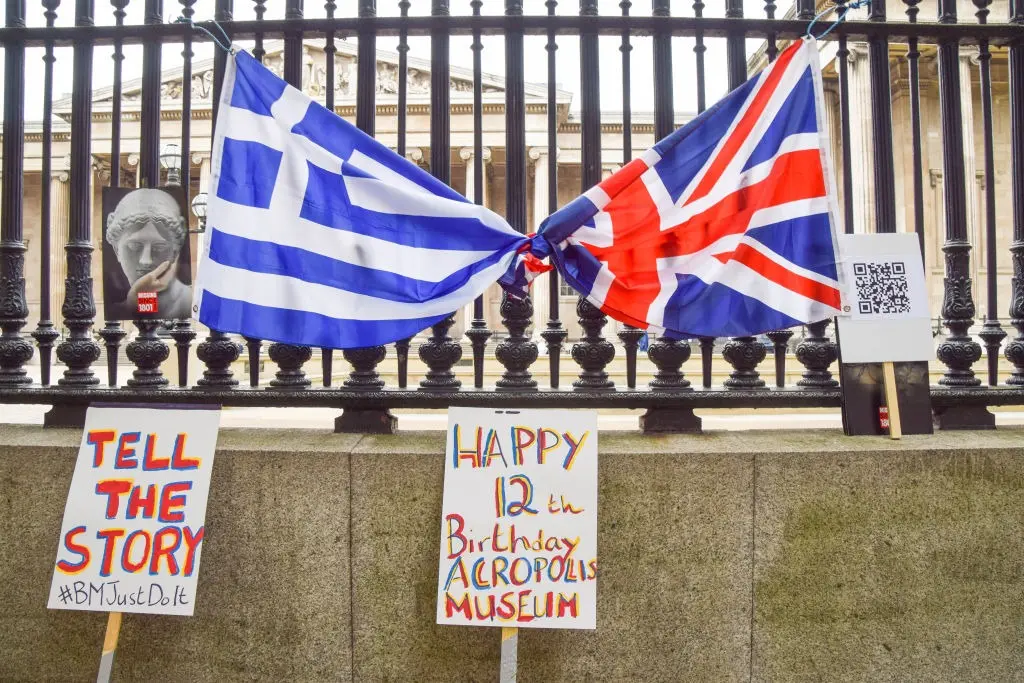
George Osborne, the chairman of the British Museum, has signaled a renewed sense of optimism regarding the long-standing diplomatic impasse over the Parthenon Marbles. Speaking to reporters in Athens this past Tuesday, the former British Chancellor of the Exchequer expressed his belief that a compromise—one that sidesteps the intractable dispute over legal ownership—remains within reach. As the two-centuries-old disagreement continues to color the cultural and political relations between London and Athens, Osborne’s comments suggest that a path forward may lie in a framework of shared custody rather than a definitive transfer of title.
“I’m still optimistic that we can reach an agreement,” Osborne told the press. “If everyone enters into it with the spirit of ‘we’re not going to get everything we want,’ as is always the case with a successful agreement, then there’s a deal to be done.”
A Legacy of Contention
The Parthenon Marbles, arguably the most famous and contested artifacts in the world, consist of a collection of marble relief panels, friezes, and sculptures created between 447 and 432 BCE by the legendary Greek sculptor Phidias. Originally designed to adorn the Parthenon temple on the Acropolis in Athens, these works are considered the pinnacle of Classical Greek art. Their journey to London began in 1801 when Lord Elgin, the Scottish nobleman then serving as the British ambassador to the Ottoman Empire, removed the sculptures from the Acropolis.
At the time of their removal, Greece was under the occupation of the Ottoman Empire, and the legality of Elgin’s actions has been the primary point of contention ever since. Following their acquisition, the British government purchased the marbles from Elgin, leading to their permanent housing within the British Museum. Greece has consistently demanded the return of the artifacts since the country gained its independence in 1832, arguing that the sculptures were taken without the consent of the Greek people and that the transaction lacked any legitimate legal basis.
For decades, the British government and the museum’s trustees have pointed to the British Museum Act of 1963 as a firm legislative barrier to the repatriation of the marbles. The Act imposes strict limitations on the museum’s ability to deaccession items from its collection, effectively barring the return of the sculptures to Greece. However, in recent years, the discourse has shifted. The opening of the state-of-the-art Acropolis Museum in Athens—designed specifically to house the collection in view of the original temple—has amplified calls for restitution. Furthermore, reports regarding the physical condition of the marbles and concerns over the British Museum’s internal gallery management have added pressure to the institution to reconsider its long-held stance.
The Search for a Middle Ground
Osborne’s recent visit to Athens highlighted his continued role as the primary interlocutor between the London institution and the Greek authorities. His proposal centers on a model of cooperation rather than confrontation.
“I very much hope we can come to some arrangement whereby the Parthenon sculptures that are in London can be seen in Athens, but they have to be shared,” Osborne stated. He acknowledged the complexity of the political climate in Greece, noting, “I know that’s not the position of everyone in Greece, and I understand that and respect that, but that is our position, and so if we want to make progress, it has to be in that spirit.”
This concept of "sharing" has been floated as a potential middle ground before. In 2023, the British Museum confirmed it had been engaged in delicate, high-level discussions with the Acropolis Museum. At that time, sources suggested that a deal involving the return of the sculptures to Greece on a rotating or long-term basis as part of a broader cultural exchange was being finalized. However, that agreement never materialized, largely due to the fundamental disagreement over ownership.
The Greek government, led by Minister of Culture Lina Mendoni, has been firm in its refusal to accept any arrangement that would inadvertently validate the United Kingdom’s claim to the marbles. Mendoni has consistently argued that the sculptures belong to Greece and that any deal must respect this fundamental reality, suggesting instead that a different form of cultural exchange—involving other major Greek treasures being displayed in London—would be a more appropriate way to facilitate a relationship.
A Clash of Philosophies
The diplomatic tension was further underscored in September by an op-ed published in the Guardian by Greek Prime Minister Kyriakos Mitsotakis. In the piece, Mitsotakis took direct aim at recent comments made by the new director of the British Museum, Nicholas Cullinan. Cullinan had previously likened the potential exchange of the Parthenon Marbles to the international partnership displayed when France loaned the Bayeux Tapestry to the United Kingdom, labeling it a “compelling example of international partnership.”
Mitsotakis rejected this comparison in no uncertain terms. “Nobody would seriously contemplate cutting what survives of the tapestry in two and displaying half in London and half in Bayeux, and claiming this was an adequate way to understand it,” the Prime Minister wrote. “Yet that is exactly what happened to the Parthenon sculptures.”
The Prime Minister’s critique touches on the core of the Greek argument: that the marbles are not merely a collection of isolated artifacts but an integral, inseparable part of the Parthenon’s architectural and historical narrative. To the Greek government, treating them as objects that can be swapped or shared like other museum loans fails to acknowledge the cultural trauma of their removal and the unique status they hold as national heritage.
The Broader Diplomatic Context
The dispute is now poised to move beyond the confines of the museum world and into the realm of international politics. With world leaders scheduled to convene at the EU-UK summit in Brussels next month, the Parthenon Marbles are expected to become a subject of broader diplomatic dialogue.
Speaking at a conference at the University of Athens on October 6, Prime Minister Mitsotakis hinted that the issue of the marbles would be integrated into the wider discussions regarding the future of EU-UK relations, particularly following the United Kingdom’s exit from the European Union in 2016. “The Parthenon sculptures will be part of this debate,” Mitsotakis said. “This is not just an issue for Greece, it’s an issue for Europe.”
This elevation of the dispute signifies that, for Greece, the return of the marbles is not merely a matter of cultural property, but a question of European identity and historical justice. As the British Museum and the Greek government prepare for these upcoming summits, the tension between the legal constraints of the British Museum Act and the moral and historical imperative felt by Greece continues to define the landscape of the negotiations.
For George Osborne, the challenge remains to find a phrasing or a framework that allows both sides to save face—to provide the Greek public with the access they demand while ensuring the British Museum remains within the bounds of its legal requirements. Whether a "spirit of compromise" is enough to bridge a two-century-old divide remains to be seen. As it stands, the marbles remain in London, the subject of one of the most enduring and complex cultural disputes in the modern era, awaiting a resolution that satisfies both the demands of history and the realities of modern diplomacy.