
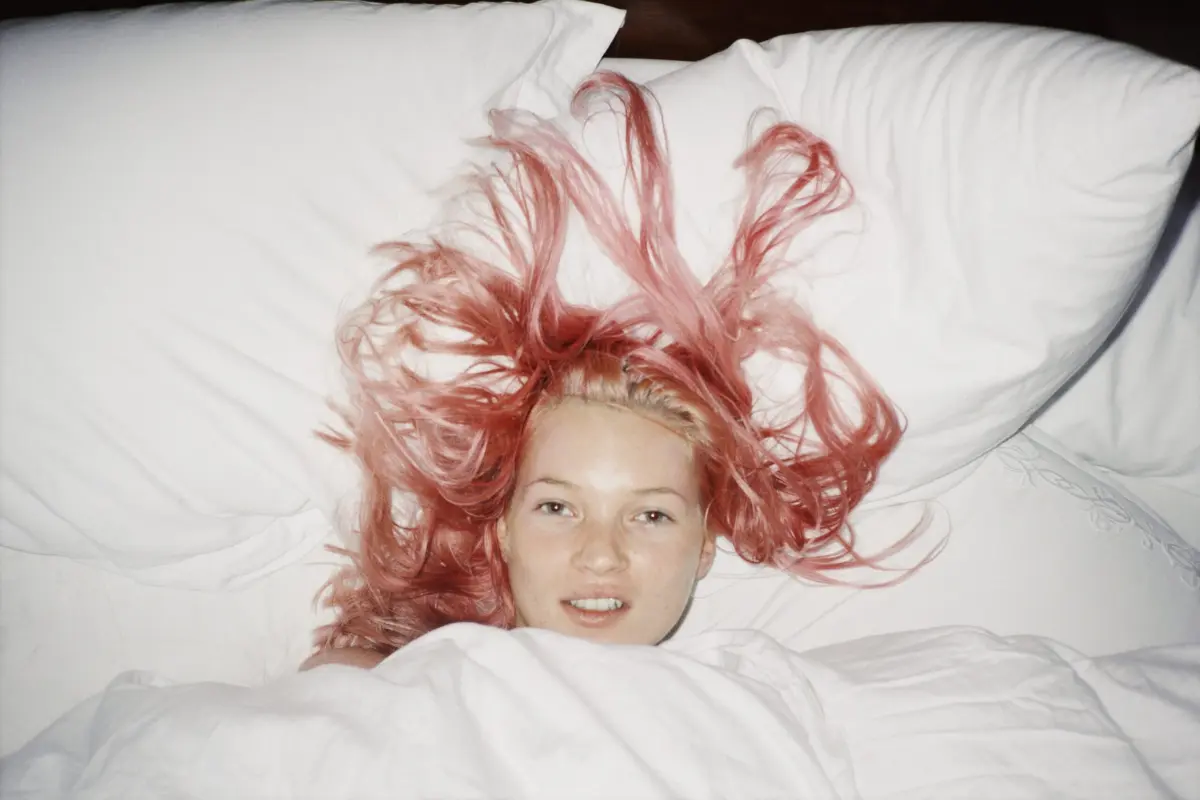
As the dust settled on the final presentations of Paris Fashion Week, the international creative community pivoted sharply to London for one of the most anticipated cultural events of the year. On Tuesday night, the doors of Tate Britain swung open for the premiere of “The 90s: Art and Fashion,” an ambitious exhibition that seeks to map the volatile, creative, and transformative intersection of two of Britain’s most influential industries.
The opening night was a spectacle of star power, underscoring the deep-seated connection between the high-stakes worlds of gallery art and global luxury. The guest list was a testament to the show’s cross-disciplinary reach: Donatella Versace, Sarah Burton of Givenchy, and Daniel Lee of Burberry were seen navigating the galleries alongside photographer Ellen von Unwerth and Nicholas Cullinan, the director of the British Museum.
The presence of such industry titans was perhaps inevitable, given the exhibition’s curatorial DNA. Edward Enninful, the former editor-in-chief of British Vogue—whose tenure from 2017 to 2024 is widely credited with revitalizing the publication’s cultural authority and glamour—served as a lead curator. Enninful collaborated with a team of seasoned Tate Britain curators, including Jessica Vaughan, Helen Little, Dominique Heyse-Moore, Alex Farquharson, and Celeste McEvoy, to assemble a show that attempts to capture the frenetic energy of a decade that redefined British identity.
A Polarized Reception from the Press
Despite the glitz of the launch, the exhibition has faced a starkly polarized reception from the British art establishment. The friction between the worlds of high fashion and fine art was laid bare in the pages of the UK’s leading newspapers, with some critics questioning whether the Tate’s approach was too superficial for such a complex decade.
Waldemar Januszczak, the chief art critic for The Times of London, did not mince his words, noting that while he had expected a grand celebration of the Nineties, he felt the result was a “fashion disaster.” The sentiment was echoed by Jonathan Jones of The Guardian, who offered a scathing one-star review. Jones dismissed the show as less of an art historical examination and more of a glorified magazine editorial. "I hoped what I’d seen was a prologue to more art, bigger art, with enough space to appreciate it," Jones wrote. "But no. That’s it. You leave as dissatisfied as you might after flicking through a 30-year-old copy of The Face in a dentist’s waiting room."

However, not all observers were so dismissive. Alastair Sooke, the chief art critic for The Daily Telegraph, gave the exhibition a glowing five-star review, admitting that the collection left him “buzzing.” Similarly, Stephen Armstrong of The Independent found a deeper resonance within the galleries, remarking that “the hope on the walls of this five-star exhibition is heartbreaking.”
The divide among critics highlights a broader tension regarding the marketing of the show. With the city of London plastered in posters of Kate Moss photographed by Juergen Teller, the exhibition’s visual identity has leaned heavily into the fashion-forward aesthetic that Enninful championed. For some, this marketing campaign has overshadowed the art, creating a perception that the exhibition is an extension of a glossy editorial spread rather than a rigorous historical survey.
Curatorial Intent: Beyond the YBAs
In an interview regarding the exhibition’s goals, Tate curator Jessica Vaughan sought to clarify the show’s mandate. She emphasized that the primary intention was to move beyond the well-trodden narrative of the Young British Artists (YBAs). While the movement—led by names like Damien Hirst and Tracey Emin—is central to the British art story of the 1990s, the curators felt that the historical focus had become too narrow, often excluding voices that did not fit the dominant, predominantly white, male-centric canon of the time.
"The story of the YBAs is really well-known and some of the criticism we’ve got so far is that we haven’t included those big names enough," Vaughan explained. "There are works by Tracey Emin and Damien Hirst there. We just wanted to spotlight other artists who we didn’t think got their dues, and Edward always did that in fashion."
To achieve this, the exhibition juxtaposes established YBA figures with artists whose contributions have historically been sidelined, such as Hamad Butt, Eileen Perrier, Yinka Shonibare, and Barbara Walker. The exhibition frames the 1990s as a moment of massive cultural growth, where the boundaries of contemporary art were being stretched by a generation of young creatives, many of whom were drawing inspiration from the fashion world’s rapid evolution.

Confronting History through Art
One of the most poignant aspects of the exhibition is its focus on queer themes and the struggles of the decade, particularly the AIDS crisis. A standout in this regard is Familiars (1992), a three-part sculptural installation by the queer South Asian artist Hamad Butt. The work is both haunting and dangerous; it features vacuum-sealed glass bulbs filled with toxic chemicals. When the piece was first exhibited at the Tate in the 1990s, a vial famously cracked, resulting in a gallery evacuation.
Vaughan describes the work’s enduring mythology: "It’s the idea that the thing that we’re most attracted to might be the thing that’s the most threatening to us." By placing such works alongside the more commercial imagery of the decade, the curators invite a dialogue about the precariousness of life during that era.
Similarly, Steve McQueen’s 1993 film Bear—a raw, homoerotic, and physically demanding portrayal of two Black men wrestling—serves as a stark reminder of the sophisticated work being produced in the shadows of the YBA mainstream. By highlighting artists like McQueen, the show argues for a more inclusive history of British contemporary art.
The Body, Politics, and Nostalgia
The exhibition also offers a critical look at the female experience in the 1990s. The curators have made a deliberate choice to include works that challenge the era’s dominant beauty standards, specifically the waif-like aesthetic epitomized by the Kate Moss images found elsewhere in the show. Sam Taylor-Johnson’s 1993 photograph Fuck, Suck, Spank, Wank, which features the artist in a graphic T-shirt with her jeans around her ankles, is presented as a counter-narrative to the fashion-led imagery of the decade. This theme is further explored in Sarah Lucas’s iconic 1997 photograph Chicken Knickers, where a raw chicken is placed against a woman’s underwear, subverting the sexualized tropes of the time.
"We wanted to capture what it was to be a young woman at that time and to counter the images of Kate Moss by Corrine Day and others," Vaughan said.

Perhaps the most prescient aspect of the exhibition is its reflection on the socio-political climate of the late 20th century, which feels increasingly relevant in today’s Britain. With the country navigating a complex political landscape—marked by the rise of right-wing influence and significant shifts in the economic environment—the exhibition’s focus on the post-Thatcher era carries a heavy weight.
The galleries dedicated to the decline of urban spaces and the shifting nature of British nightlife—from the peak of acid house and drum and bass to the subsequent closure of venues—provide a nostalgic yet biting commentary on the present. As London continues to grapple with the loss of its nightlife culture, with more than a quarter of its late-night venues shuttering between 2020 and 2025, the exhibition serves as both a memorial and a critique. Those who dismiss the show as a mere fashion exhibition may be missing the point: that a reevaluation of the past is often the most effective way to understand the vulnerabilities and anxieties of the present day.