
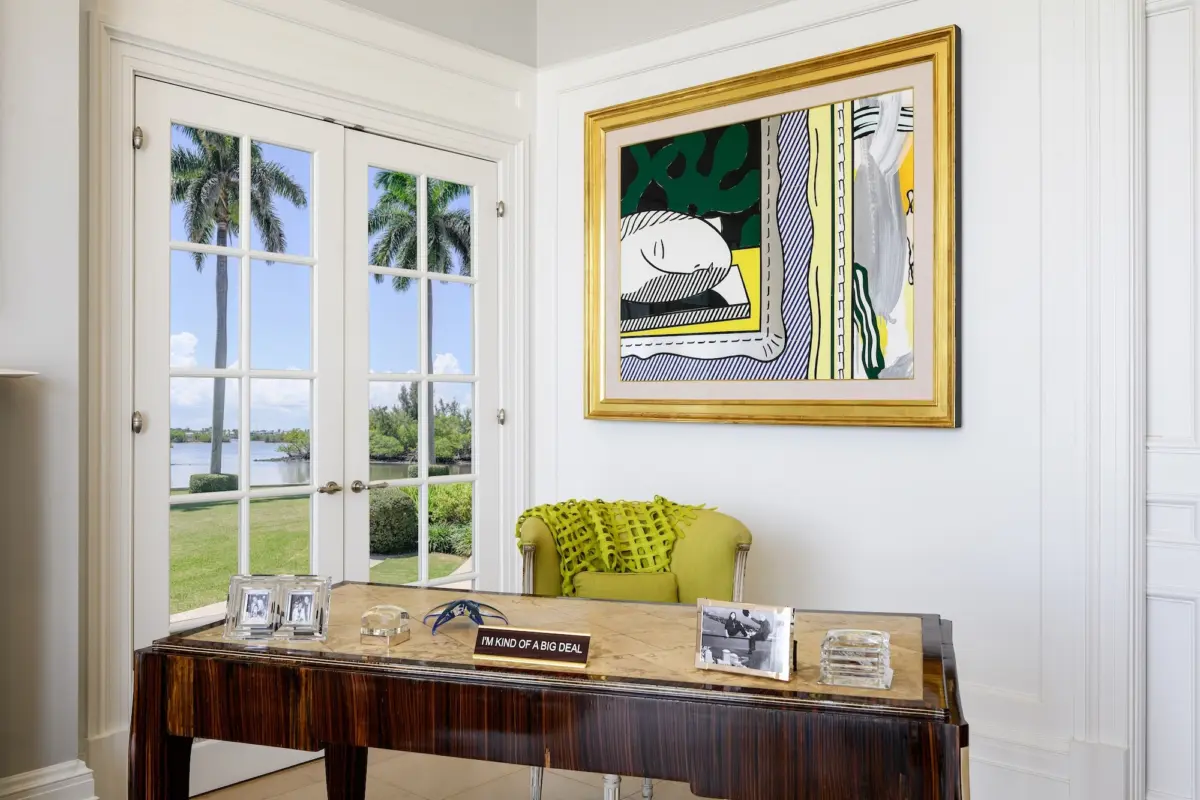
Sotheby’s has announced a landmark series of sales featuring the expansive private collection of the late cable television magnate Ted Baum and his wife, the interior designer Ruth Baum. The collection, which boasts more than 130 works, is expected to fetch in excess of $100 million when it hits the block later this year. The offering represents a significant moment for the secondary market, showcasing a meticulously curated assembly of masterworks that bridge the gap between American post-war abstraction and European avant-garde movements.
The collection is anchored by heavyweights of the art world, including Roy Lichtenstein, Joan Mitchell, Ed Ruscha, Mark Rothko, and Tom Wesselmann. Complementing these American titans are significant European figures whose works defined the mid-20th century, such as Alberto Burri, Lucio Fontana, Yves Klein, and Piero Manzoni.
A Curated Vision of Modernity
The marquee lots of the sale are led by a Rothko painting on paper and a signature work by Ed Ruscha, both of which carry estimates in the range of $10 million to $15 million. Other standout items include works by Burri, Fontana, and Andy Warhol, all of which are pegged at estimates between $4 million and $6 million. While these primary highlights have been assigned clear valuation ranges, the remainder of the 130-plus works will be revealed with their respective estimates as the auction dates approach.
The dispersal of the collection will be structured across multiple events. A dedicated evening auction is scheduled for November 16, where the first two dozen works will be offered to the highest bidders. A follow-up day sale is set for November 17, with the remaining pieces slated to appear in various auctions throughout the coming year. To build anticipation for these events, Sotheby’s plans to host public exhibitions of the highlights in major cultural hubs, including London, Hong Kong, Paris, Los Angeles, and New York.
Reflecting on the couple’s unique approach to collecting, their longtime advisor, Wendy Cromwell, remarked on the Baums’ relentless intellectual curiosity. "From Joan Mitchell to David Hammons, the Baums knew what they liked, were insatiably curious, and kept pushing their eye," Cromwell stated in recent press materials. "The result of their shared passion is a collection that gallops through time, countries, and genres. The Baums’ collection tells the story of what it means to collect contemporary art."
From Humble Beginnings to Artistic Stewardship
The story of the Baum collection is one of organic growth and deep personal connection. The couple’s journey began in the 1970s with a modest purchase—a sketch by American artist John Sloan acquired at a charity auction. That initial spark ignited a decades-long pursuit of excellence, leading them through the acquisition of modern drawings and watercolors by European masters such as Fernand Léger and Pablo Picasso.
However, the couple’s focus shifted toward the visceral power of contemporary art in 1983, a pivotal year that saw them acquire their first significant piece of contemporary work: a 1967 untitled red-and-orange painting on paper by Mark Rothko. For the Baums, this was not merely an acquisition; it was a transformative experience.

"The Rothko hit us," Ruth Baum once noted in press materials. "That was it. We were children of the ’60s, and the art of that period spoke to us."
This defining moment set the trajectory for their collecting habits over the next four decades. In the 1990s, they leaned heavily into the expressive power of Abstract Expressionism and Pop Art, acquiring pieces by Joan Mitchell, Sam Francis, Hans Hofmann, Roy Lichtenstein, and Tom Wesselmann. As they moved into the 2000s, their tastes continued to evolve, favoring conceptual rigor and clever subversion. A prime example of this is their acquisition of Ed Ruscha’s 1964 painting Dimple, in which a C-clamp appears to physically wrinkle the letter "e" at the end of the word—a piece that particularly appealed to Ted Baum’s documented love of wordplay.
Another notable acquisition from this era was Andy Warhol’s 1984 work The Scream (After Edvard Munch), which the couple purchased at Sotheby’s London in 2006 for £1.5 million. Adjusted for inflation, that purchase price of roughly $4.5 million highlights the astute nature of their market timing.
Bridging American and European Traditions
The breadth of the Baum collection lies in its ability to synthesize disparate artistic movements. Oliver Barker, Sotheby’s chairman for Europe, noted that the couple possessed a rare instinct for how different global traditions could exist in dialogue with one another.
"Ted and Ruth were among the most committed collectors of their generation," Barker said. "I was immediately struck by their inquisitiveness and the deep level of their research. No doubt they came to European abstraction via the touch points of post-war American abstraction. They instinctively understood that artists like Lucio Fontana and Yves Klein were vital to the history of 20th-century abstraction and could sit perfectly well situated in their beautiful interiors alongside Rothko, Mitchell, and others."
This vision was clearly realized in their acquisition of Lucio Fontana’s Concetto Spaziale, Attese (1960). Purchased at Sotheby’s London in 2000 for £333,500—an amount that would be nearly $1 million in today’s currency—the piece stands as a testament to their foresight in recognizing the enduring value of European spatialism.
A Legacy Beyond the Canvas
The Baums were as committed to the public sphere as they were to their private collection. During their lifetimes, they maintained residences in New York, New Jersey, Southampton, and Palm Beach, and they remained deeply active in the philanthropic landscapes of each community.

Following Ted Baum’s passing in 2021 and Ruth’s death earlier this year, the legacy of their support for the arts remains visible in major institutions. The Norton Museum of Art in West Palm Beach, Florida, honors their contributions with a gallery named in their honor. The couple were instrumental in funding the museum’s first contemporary art curator position and were generous donors of works by prominent artists such as Dale Chihuly and Leo Villareal. Ruth Baum’s commitment to the Norton was further cemented when she was elected a life trustee in 2020.
Their influence extended to other prestigious institutions as well, with the pair serving on various boards and committees at the Guggenheim Museum in New York and the Parrish Art Museum. Beyond the art world, Ruth Baum was a dedicated supporter of organizations ranging from the Palm Beach Zoo and Conservation Society to Planned Parenthood and local theater in Palm Beach.
A High-Stakes Auction Season
The announcement of the Baum collection arrives at a critical juncture in the global art market as major houses jostle for dominance in the upcoming November sales season. The competition for high-value consignments has been fierce, with market leaders aiming to re-energize collectors ahead of year-end closing.
Just days before the Baum announcement, Sotheby’s revealed that it would be handling 12 works from the collection of Argentinian collectors Carlos Pedro Blaquier and Nelly Arrieta de Blaquier. That sale is expected to reach a staggering $450 million, anchored by a Vincent van Gogh estimated at $180 million. Simultaneously, Sotheby’s main competitor, Christie’s, has made its own splash, announcing a $100 million sale of Old Masters and contemporary art from a "distinguished collector"—widely reported to be the artist Jeff Koons—which will feature a significant Picasso with an estimate of $40 million.
As these massive collections come to market, the Baum sale stands out not only for its financial scale but for the narrative of the collectors themselves. By offering a cohesive, 130-work assembly that spans the emotional depth of the 20th century, Sotheby’s is presenting a collection that is as much a historical document of mid-century taste as it is a portfolio of high-value investment assets. For those watching the market, the November sales will serve as a bellwether for the health of the high-end art trade, with the Baum collection providing a centerpiece of both historical significance and personal passion.