
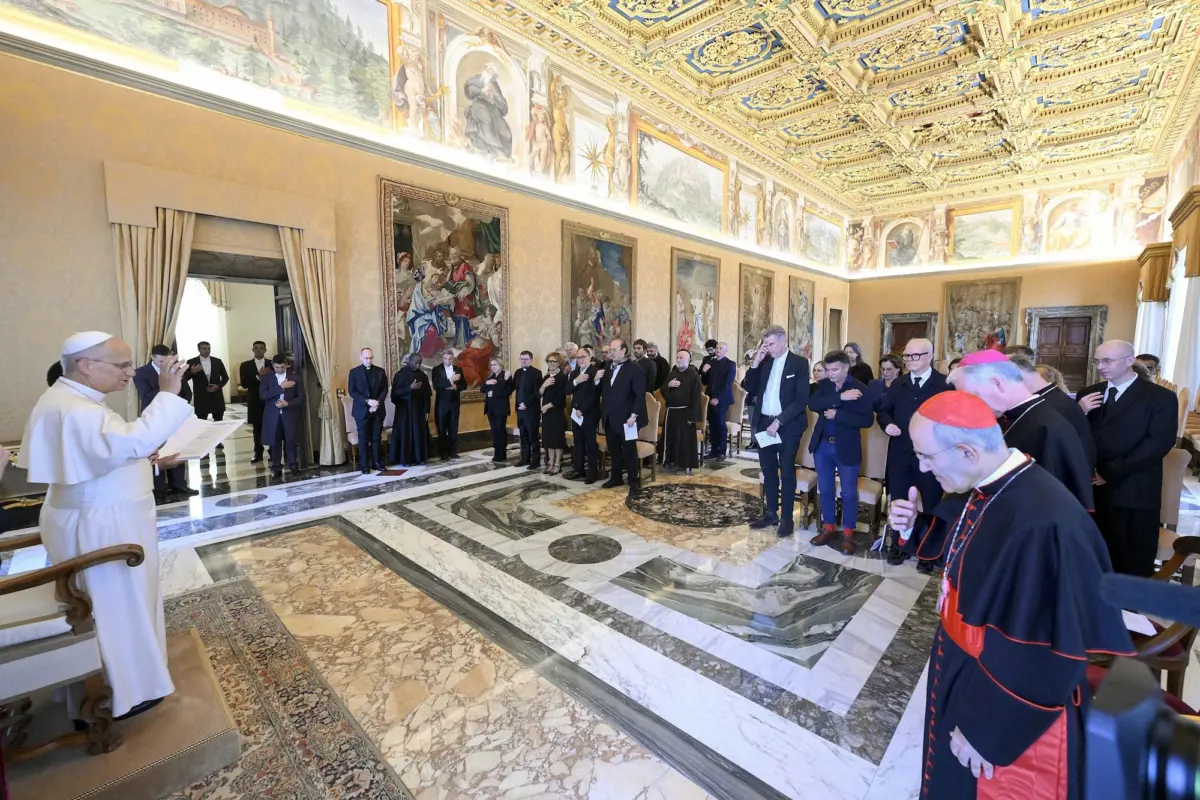
In a significant address delivered at the Vatican’s Apostolic Palace this past Friday, Pope Leo XIV issued a poignant call to action for the world’s artistic and curatorial communities. Speaking against the rapidly shifting backdrop of the digital age, the pontiff emphasized that the Church’s mission remains inextricably linked to the creative spirit, asserting that in an era defined by the rise of generative artificial intelligence, the role of the human artist has never been more critical.
The Pope’s remarks arrived at a moment of profound global anxiety regarding the trajectory of technology. His address came just three days after U.S. President Donald Trump convened a high-stakes summit at the White House, bringing together the architects of the world’s most powerful frontier AI models. That meeting, centered on the urgent need for self-regulation within the industry, took place as some leading experts continue to issue dire warnings that unchecked artificial intelligence could pose an existential threat to humanity within the next decade.
Against this tumultuous geopolitical and technological landscape, the Vatican hosted an exhibition titled “The Art of Possibility: Weaving Together,” organized by the Dicastery for Culture and Education. It was within this context that Pope Leo spoke directly to the assembled creators, framing the Church not merely as a patron of the arts, but as a sanctuary for the uniquely human spark that he argues is being threatened by algorithmic proliferation.
“This is especially true in this age of artificial intelligence, in which we urgently need to distinguish human art from what is produced by machines,” the pontiff stated.
The Ontological Distinction Between Creation and Calculation
Central to the Pope’s address was the philosophical argument that there exists a fundamental, non-negotiable divide between human creativity and the output of large-scale computational models. Drawing from his own encyclical released in May 2026, titled Magnifica Humanitas: On Safeguarding the Human Person in the Time of Artificial Intelligence, Pope Leo argued that the difference between an artist and a machine is not merely a matter of aesthetic preference, but one of existence itself.
“There is an ontological difference—even before an aesthetic one—between art and what a machine can generate through statistical calculation based on millions of images created by others,” the Pope explained.
He articulated a critique of the generative AI model, noting that while these systems can mimic the output of human history, they lack the internal experience that gives art its purpose. For the pontiff, the algorithms that power modern search engines and image generators are fueled by the labor of past human creators, yet they are devoid of the “spark” that defines a living culture. By contrast, he argued that authentic culture serves as a vessel for the human spirit, capturing nuances, suffering, joy, and inquiry that statistical probability can never replicate.
A Legacy of Dialogue Between Church and Art
The Pope’s plea for collaboration resonated with a long history of Vatican engagement with the creative community. To underscore the continuity of this mission, Leo invoked his predecessor, Pope Paul VI, who in 1964 famously declared to artists, “We need you.”
Pope Leo reiterated this sentiment, positioning the Church as a facilitator for the “world of the spirit.” He suggested that the vocation of the artist is to translate the invisible, abstract realities of the human condition into intelligible, accessible forms. “In this task, which translates the invisible world into accessible, intelligible forms, you are masters,” the Pope told his audience, reaffirming the Church’s reliance on their vision to communicate spiritual truths to a modern audience.
The urgency of his message was further amplified by a simultaneous post on X, the social media platform currently owned by Elon Musk. Interestingly, the timing of the Pope’s digital outreach coincided with the public discourse surrounding Musk’s own involvement in the White House summit on AI safety, highlighting the intersection of global technology leaders and the moral oversight that religious institutions are increasingly seeking to exert over the sector.
Beyond the Search Engine: A New Definition of Inquiry
Expanding on his critique of the digital landscape, the Pope contrasted the nature of modern technology with the nature of art. He observed that society has become accustomed to the instant gratification provided by contemporary search engines, which offer thousands of answers in a split second. However, he cautioned that these tools often reinforce existing biases and limitations.
“We live in the age of search engines that offer us thousands of instantaneous answers,” the Pope remarked. “Yet, no matter how powerful they may be, they merely return what already exists and tend to give us what we already want.”
In this view, the search engine is a passive tool, a mirror of the data it has already consumed. He offered a compelling alternative, characterizing art as a “different kind of search engine.” According to Leo, art does not function through indexing or the retrieval of existing data, but rather through a process of deep, intentional inquiry.
“It does not proceed by indexing but by inquiry,” he said. “Indeed, its inquiry is a focused attention that is not satisfied with the mere sum of facts, for it never ceases to dig deeper, seeking the thread that unites them.”
This distinction is essential to the pontiff’s view of human dignity. He argued that when art resists the homogenization favored by algorithms—when it forces the viewer to pause and engage with that which cannot be easily consumed or quantified—it performs a vital function of cultural and spiritual regeneration. In a world of rapid-fire content generation, the act of slowing down to witness a work of human art becomes an act of resistance against the dehumanization of the digital experience.
A Call for Shared Stewardship
The address concluded with a warm, personal appeal to those who define the visual and cultural landscape of the current era. Pope Leo expressed a desire for a partnership that transcends institutional boundaries, emphasizing that the Church is not an observer of this technological shift, but a participant in the effort to preserve human value.
“Dear artists, dear curators, know that the Church looks upon you with esteem, gratitude and hope; that she needs you, and that she wishes to walk alongside you, so that together we may safeguard the grandeur of humanity entrusted to us,” he said.
By framing the issue as a joint responsibility, the Pope invited artists to view their work through a moral lens, encouraging them to consider the spiritual implications of their contributions in an era of rapid technological change. As the debate over AI’s role in society continues to escalate in political and corporate circles, the Vatican has signaled its intention to remain a significant voice in the conversation, advocating for the protection of human agency.
With his final words, “May God bless all of you and your work!” the pontiff left his audience with a clear challenge: to maintain the sanctity of the human perspective, ensuring that as technology advances, the “spark” of human creativity remains the guiding light of cultural evolution. For the attendees at the Apostolic Palace, the message was clear—the future of art is not merely a technical challenge, but a spiritual one, requiring a vigilant defense of the very things that make humanity unique.