
Good morning. As the art world begins another week, a startling theft in France serves as a grim reminder of the vulnerabilities facing private cultural institutions, while the market for natural history continues to mirror the trends of the broader fine art auction landscape.
The Dalí Disappearing Act
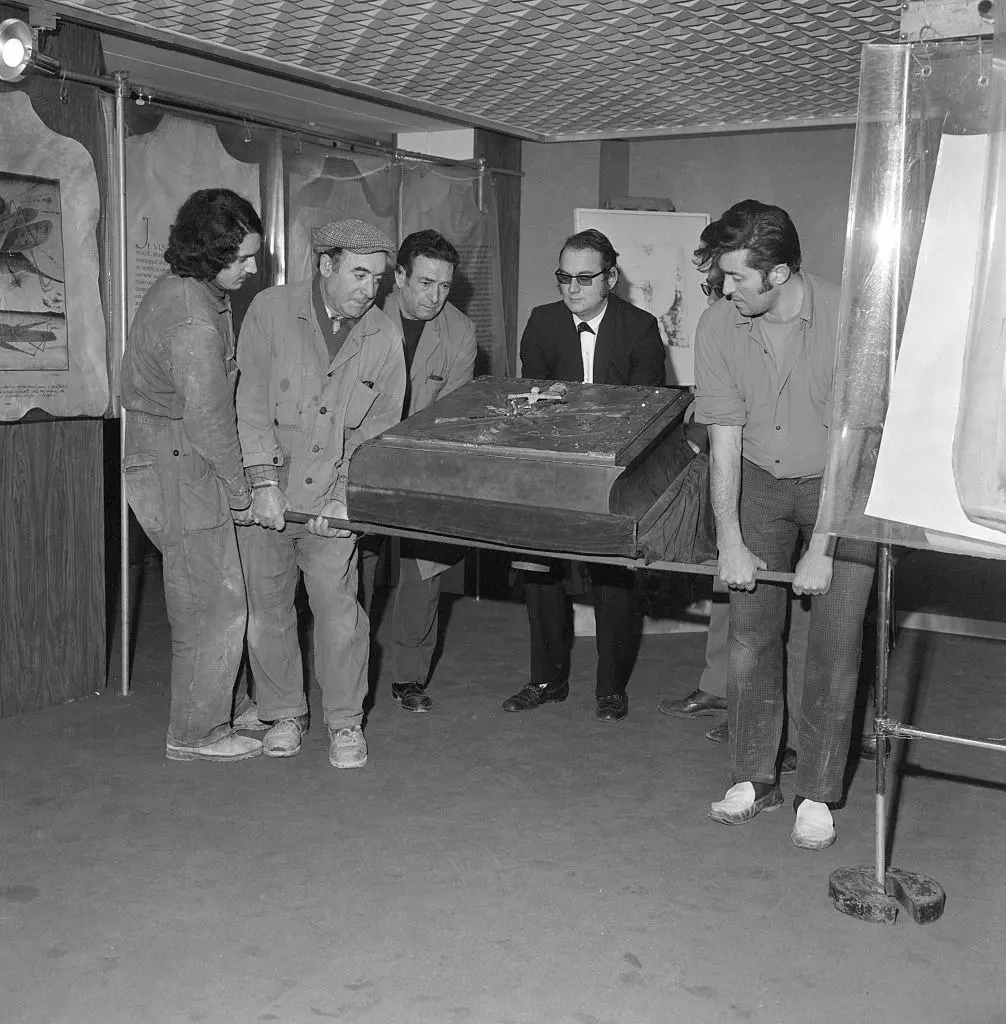
The French art community is reeling following the news of a brazen and sophisticated theft in the town of Issoire, located in the heart of France. Overnight on Sunday, a highly significant bronze book cover designed by the surrealist master Salvador Dalí was stolen from a small, private contemporary art museum. The piece, a heavy, 330-pound work of art, is far more than a simple binding; it is an ornate construction encrusted with precious stones, seashells, and—in true Dalí fashion—an array of cutlery.
Known as the Livre de l’Apocalypse (Book of Revelation), the object was originally conceived as a massive collaborative art project in 1958 by the French publisher Joseph Foret. The project was designed to be a monumental tribute to biblical themes, featuring contributions from a roster of 14 iconic modern artists and writers of the era, including Jean Cocteau, Bernard Buffet, and Jean Giono.
Local authorities are currently baffled by the mechanics of the heist, noting that there is currently no clear indication of how such a massive and unwieldy object was extracted from the museum without alerting security. The Mayor of Issoire, Bertrand Barraud, expressed the collective devastation of the community, labeling the piece “the work of a lifetime” and characterizing its loss as “inestimable.”
While the cover itself has vanished, the 150 large sheets of parchment intended for the interior of the book—which were stored separately—remain in safe keeping. The owner of the piece, Christian Karoutzos, spoke to local radio with palpable anguish, stating, “They assassinated France last night; they assassinated French heritage.” The incident highlights the precarious nature of security for smaller, private institutions that house world-class masterpieces, often lacking the state-of-the-art protection found in major national museums.
The Evolving Market for Prehistoric Relics
While the art world grapples with a high-profile theft, the auction market continues to find success in the unconventional realm of paleontology. Sotheby’s has announced that it will once again bring a significant fossilized specimen to the auction block. This time, the star of the show is "Jodi," a Nanotyrannus—a creature often described as a smaller, more agile cousin of the legendary Tyrannosaurus rex.
The fossil is estimated to fetch between $6 million and $9 million when it hits the block in New York on October 27. This is not Jodi’s first time in the spotlight; the specimen was previously presented at Frieze London in 2023. At that time, it was incorrectly identified as a juvenile T. rex and carried an ambitious price tag of $20 million. However, the market for dinosaur remains is notoriously sensitive to scientific classification. Following a year of intense debate among paleontologists, the specimen was officially identified as a separate species, leading to this revised valuation.
The move follows a highly successful summer for the auction house, which saw the sale of "Gus," a T. rex skeleton, for $50.1 million in July. Cassandra Hatton, the head of science and natural history at Sotheby’s, noted that the shifting identity of the Jodi specimen serves as a perfect case study for the field. “It’s a really good example of how paleontology is an evolving science and how specimens like this can answer questions about how things worked,” she observed. As the market for such items continues to grow, collectors are increasingly viewing these natural history specimens as significant cultural assets, comparable to fine art.
The Digest: Institutional Shifts and Global Developments
In other industry news, the London-based, Grenada-born painter Denzil Forrester has officially joined the prestigious Thaddaeus Ropac gallery. This move follows the closure of his long-standing former gallery, Stephen Friedman, marking a significant transition for the artist, whose vibrant, rhythmic works have gained increasing international acclaim.
Philanthropy remains a vital pillar for museum growth, as evidenced by a substantial $5 million donation from philanthropist Sukumar Nagendran. The funds are earmarked for the Phoenix Art Museum to expand its galleries dedicated to Sri Lankan and South Asian art. The gift will not only facilitate the physical expansion of the gallery space but will also support critical new acquisitions, ongoing research, and a robust slate of public programming, ensuring that these regions’ art histories receive the visibility they deserve.
The real estate market also continues to intersect with the art world. Renowned collector Beth Rudin De Woody has listed her 5,000-square-foot Upper East Side co-op for $12 million. The 1929 property, a fixture of the New York social and art scene, has been on the market before—this marks the second time she has listed the residence since 2018.
Looking toward the future of the global biennial circuit, the 2026 Lagos Biennial has unveiled the list of participating artists for its upcoming exhibition, "The Museum of Things Unseen." The roster features a diverse group of international practitioners, including Ade Adekola, Ala Praxis, Caitlyn Min-ji Au, CAMP, Ha Bik Chuen, Jacob Höfle, the Lagos Studio Archives, and Olukemi Lijadu, among others. The event promises to be a significant moment for the African contemporary art scene.
Meanwhile, on the West Coast, the San Francisco Arts Commission (SFAC) has announced a major injection of capital into the local cultural ecosystem. The commission is awarding $25.26 million in funding across 465 grants. These resources are distributed to a wide array of local artists, non-profit arts organizations, and cultural institutions, providing a much-needed lifeline to the region’s creative community.
The Kicker: Unlocking the Voynich Manuscript
In a final note that bridges the gap between historical mystery and academic rigor, new research suggests that the world’s most enigmatic document—the Voynich manuscript—has been fundamentally misunderstood for centuries. Produced in the Middle Ages between 1404 and 1438, the manuscript has long baffled historians with its strange botanical drawings, astronomical diagrams, and an indecipherable language that has prompted wild theories ranging from secret codes to work by Leonardo da Vinci.
However, a recent article in Digital Medievalist proposes a much simpler, structural explanation: the pages are currently bound in the wrong order. Researchers argue that the manuscript was never meant to be a standard book. Instead, it was likely a collection of booklets designed to be folded like cards. When stacked or nested incorrectly, the original sequence was lost, leading to the "mystery" that has occupied scholars for generations.
“There are a lot of people who wanted the Voynich to have been created by one mad genius working in their attic in medieval London,” said Lisa Fagin Davis, a co-author of the peer-reviewed study. “In fact, the evidence suggests we’re talking about a more communal object, perhaps a set of booklets through which information was passed down from one generation to the next—the ‘lone genius’ idea is kind of out the door.” By shifting the focus from a singular mystery to a communal, functional object, historians hope to finally begin the process of properly translating the text that has eluded them for so long.