
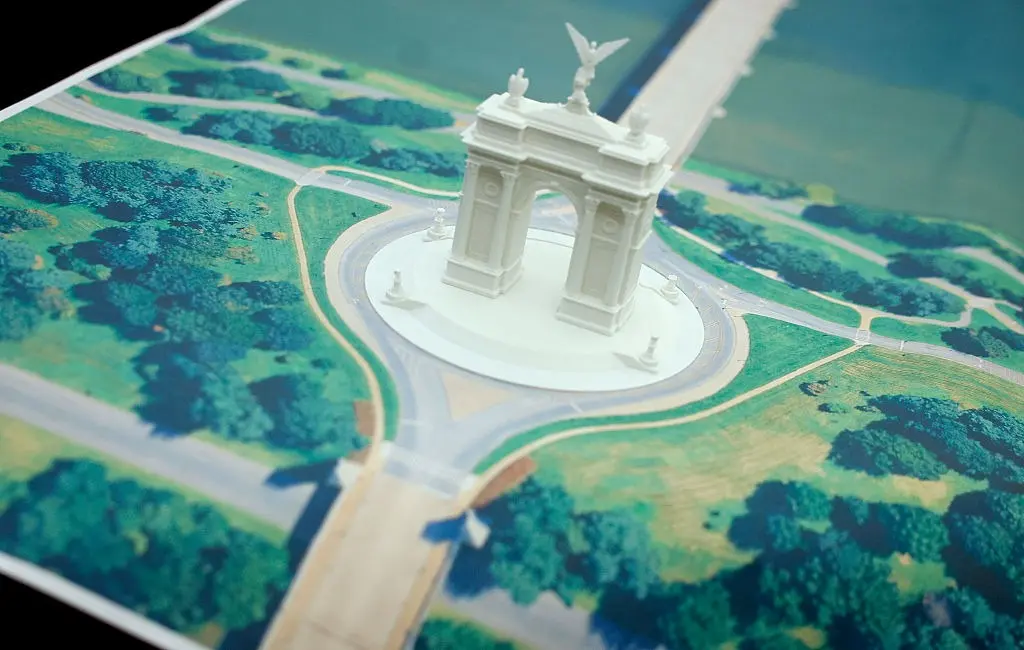
In a sharp rebuke of federal oversight procedures, the American Institute of Architects (AIA) issued a formal letter on September 29 to Jaime Loichinger, the director of the Advisory Council on Historic Preservation (ACHP). The correspondence serves as a stinging denunciation of the council’s recent decision to effectively resign from its oversight role regarding the controversial "triumphal arch" project championed by President Trump. The proposed 250-foot-tall structure, slated for construction at Memorial Circle near the hallowed grounds of Arlington National Cemetery, has become a focal point of intense national debate, pitting the administration’s aesthetic and symbolic ambitions against the established protocols of historic preservation.
The catalyst for the AIA’s intervention is the ACHP’s September 24 determination to bypass the established Section 106 review process. Under the National Historic Preservation Act, Section 106 serves as a critical regulatory safeguard, compelling federal agencies to evaluate the potential impact of their projects on historic properties, sites, and landscapes. By opting to sidestep this requirement, the ACHP has effectively signaled its withdrawal from a process designed to ensure transparency and public accountability. Instead of following the standard consultative path, the council has opted to engage in direct, non-public communication with U.S. Secretary of the Interior Doug Burgum, a staunch ally of the President, regarding the future of the massive monument.
The Erosion of Regulatory Oversight
The AIA’s letter underscores the professional community’s deepening alarm over the abandonment of established legal frameworks. By bypassing Section 106, the ACHP has dismantled a cornerstone of historic preservation, which traditionally mandates that federal agencies account for how their actions might compromise the integrity of the nation’s most significant sites. According to reports from The Architect’s Newspaper, the council’s decision to transition from a structured public review to an informal, high-level dialogue with Secretary Burgum leaves preservationists and architects without a clear avenue to contest the project’s design or site selection.
For the architectural community, the issue extends far beyond a single monument; it represents a fundamental challenge to the integrity of the National Historic Preservation Act itself. The AIA, representing thousands of design professionals, argues that the ACHP’s departure from its core mission undermines the very purpose of its existence. By shifting the decision-making process into a more insulated environment, the council has removed the essential checks and balances that prevent the unilateral alteration of historically sensitive areas like the environs of Arlington National Cemetery.
A Conflict of Landscape and Legacy
In their September 29 letter, the AIA does not mince words regarding the architectural and historical incompatibility of the proposed arch. The institute explicitly urges the ACHP to advise Secretary Burgum that the project, in its current iteration, "must not proceed." Furthermore, the AIA calls upon the National Park Service to fundamentally reconsider the location, the scope, and the design of the undertaking. The objections raised by the AIA are multifaceted, touching upon concerns ranging from the adverse physical impacts on nearby historic properties to the broader question of aesthetic harmony within the carefully curated landscape of Washington, D.C.’s monument core.
The AIA’s argument centers on the interconnected nature of the capital’s memorial landscape. "Washington’s monuments are not a collection of isolated objects," the letter asserts. The architects contend that a 250-foot-tall permanent structure positioned at the central hinge of this delicate landscape would irrevocably disrupt the area’s historic sequence. They emphasize that such an intrusion cannot coexist with the existing "reciprocal views, civic meaning, and solemn function" that define the region. By introducing a massive, triumphalist element into a space defined by quiet reflection and historic reverence, the project risks overshadowing and diminishing the symbolic gravity of the surrounding memorials.
The AIA also challenged the National Park Service’s rationale for the current proposal. The agency has previously maintained that shifting the location or altering the design would fundamentally change the nature of the project and prevent it from achieving its primary goals. The AIA dismisses this claim as premature and suggests that the agency has failed to conduct a genuine, exhaustive analysis of potential alternatives. The institute argues that the ACHP is uniquely positioned to advocate for less intrusive options—such as a smaller-scale monument or a design that respects existing sightlines and topography—yet the council’s withdrawal from the Section 106 process prevents these constructive alternatives from being fully explored.
A Growing Controversy and Legal Impasse
The proposal for the triumphal arch has been a source of contention since it was first unveiled by President Trump during a holiday gathering last December. Since that time, the project has moved through various stages of approval and legal challenge, often against a backdrop of public outcry. In May, the Commission of Fine Arts granted its approval to the plan, a decision that drew immediate and sharp criticism from both military veterans’ groups and historic preservation organizations.
The objections have been consistent and strident. Veterans have argued that the site—located in close proximity to Arlington National Cemetery—is inappropriate for a structure of this scale and nature, fearing it would detract from the sanctity of the cemetery. This sentiment was echoed by preservationists who argue that the arch imposes a modern political aesthetic onto a landscape that has historically been managed with the utmost sensitivity to its national importance.
The friction reached a critical point last month when veterans filed for a restraining order to halt construction, which was originally scheduled to commence in mid-September. The success of this legal maneuver brought the project to a temporary standstill, creating the opening for the current standoff between federal regulators and the broader architectural community. The court-ordered pause has provided a brief window for critics to amplify their concerns, yet the ACHP’s decision to bypass the Section 106 review suggests that the administration remains committed to proceeding with the original plans.
As the situation evolves, the AIA’s intervention serves as a significant escalation in the struggle over the project. By framing the dispute not merely as a matter of taste, but as a violation of established administrative law and professional standards, the architects have elevated the debate. The question remains whether the ACHP, now operating outside the traditional bounds of its statutory review process, will respond to these concerns or continue to coordinate directly with the Department of the Interior to push the project forward.
For now, the site at Memorial Circle remains a point of profound contention. The standoff reflects a deep-seated disagreement over the role of government in shaping the nation’s cultural identity and the limits of executive power when it comes to altering the built environment of the nation’s capital. With the legal system currently acting as the primary buffer against the commencement of construction, the future of the arch rests in a precarious position, subject to the pressures of both high-level federal policy and the vocal opposition of those who seek to protect the historic integrity of Washington’s most cherished landscapes. As the AIA continues to press for a more inclusive and thoughtful review process, the architectural and historic preservation communities remain watchful, awaiting further indication of whether the administration will acknowledge the concerns of those tasked with the stewardship of the nation’s heritage.