
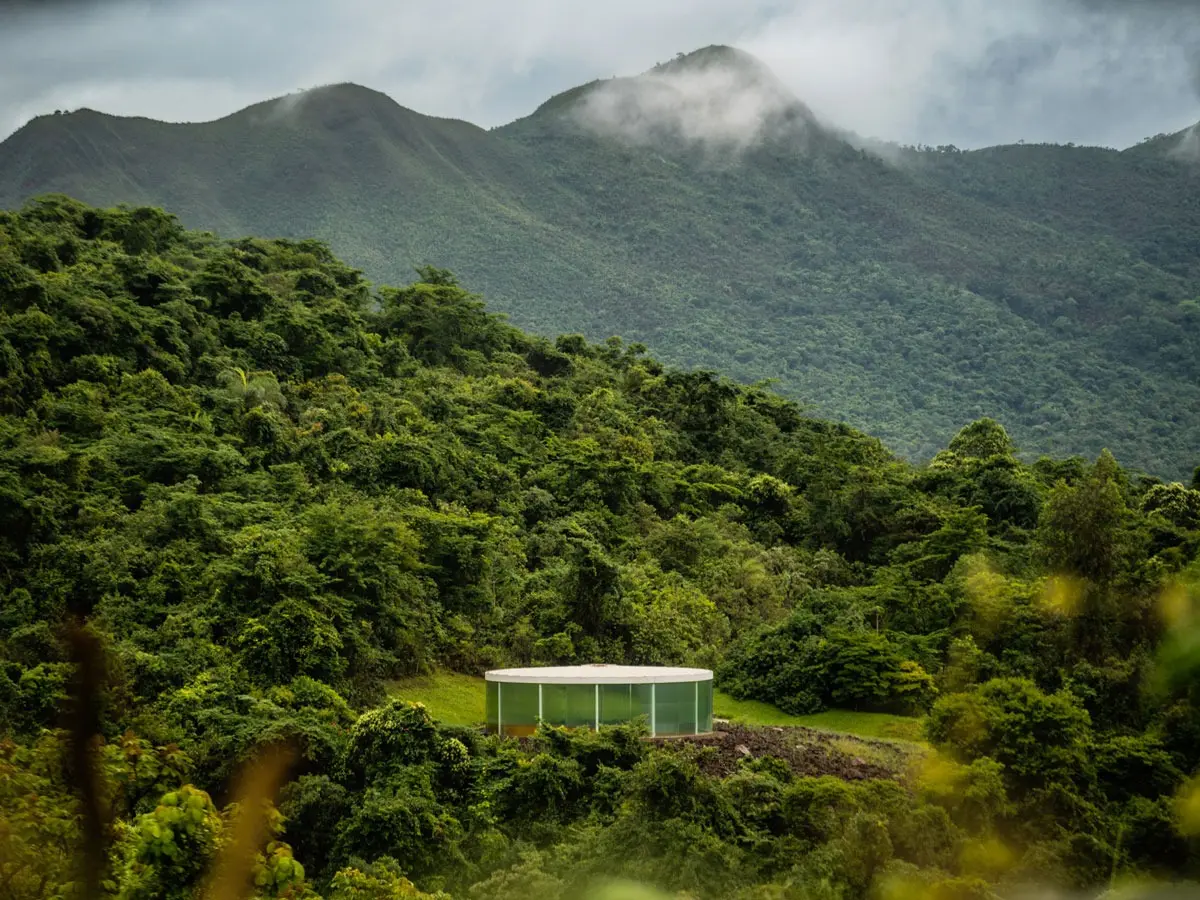
Twenty years after it first opened its gates to the public, the Instituto Inhotim—the sprawling, world-renowned contemporary art museum and botanical garden nestled in the lush mining landscape of Brumadinho, Brazil—is undergoing one of the most consequential transitions in its storied history. Having established itself as a singular global destination where monumental art and tropical flora coexist on an unprecedented scale, the institution is now entering its third decade with a record-breaking performance, even as it fundamentally redefines its relationship with its visionary founder, Bernardo Paz.
In 2025, Inhotim welcomed 365,000 visitors, marking the highest annual attendance in the museum’s existence. Yet, this milestone arrives at a moment of significant structural change. Paz, the former mining magnate who first conceived of the institution and spent over a decade pouring his personal fortune into the acquisition of art and the construction of elaborate, site-specific pavilions, is no longer involved in the museum’s day-to-day operations. In a move that finalized a long-term process of institutional distancing, Paz donated the land, the galleries, and his personal collection of 326 works to the institution in 2022. He has since pivoted toward a new venture: the construction of a separate museum on land adjacent to the Inhotim property—a site that had originally been earmarked for the museum’s own expansion.
Two Halves of a Body: A New Neighbor for Inhotim
The emergence of the forthcoming Museu Bernardo Paz has sparked widespread curiosity within the art world. Allan Schwartzman, a cofounder of Inhotim and currently the chief curatorial adviser to the new project, describes the relationship between the two entities as “two halves of a body.” According to Schwartzman, the two museums share a common lineage, a physical border, and an identical underlying philosophy: the belief that the most profound artistic experiences occur when works are presented in environments that defy the limitations of traditional, white-walled gallery spaces.
Reflecting on the early, uncertain days of the project, Schwartzman recalled that when Inhotim was taking shape ahead of its 2006 opening, there was significant doubt regarding its viability. The museum is located roughly 37 miles southeast of Belo Horizonte, a journey that seemed daunting for potential visitors at the time. “We thought maybe if a couple hundred people came a week, we would be successful,” Schwartzman told ARTnews during a recent interview. “Well, now you get up to 10,000 people on a nice weekend day.”

The evolution from a private passion project to a public institution was a gradual and often complex process. For years, Paz served as the primary financier for the acquisition of artworks and the development of the park’s signature pavilions. However, as the logistical and financial burden of maintaining such a massive footprint grew, it became clear that the institution required a more sustainable, independent governance structure. This led to the formation of a board of directors in 2012, tasked with overseeing fundraising, acquisitions, and strategic decision-making.
The transition was marked by turbulence. In 2017, Paz stepped down as chair of the board, the same year he was convicted of money laundering by a lower court—a ruling that was subsequently overturned by an appeals court in 2020. Five years after that acquittal, the full donation of the estate solidified the separation between the founder’s personal interests and the museum’s future as a nonprofit entity.
A Position of Strength at Twenty
Today, Inhotim marks its 20th anniversary from a position of institutional maturity. The park now encompasses 19 galleries housing more than 900 works, with 12 of those spaces permanently dedicated to individual artists, while seven rotate temporary exhibitions. The museum has become a vital economic pillar for the region, with nearly 70 percent of its workforce residing in Brumadinho. Since its inception, Inhotim has drawn nearly 5 million visitors, cementing its status as a cultural anchor in Brazil.
The museum’s most iconic attractions remain its dedicated pavilions—immersive, site-specific homes for artists such as Yayoi Kusama, Adriana Varejão, Hélio Oiticica, Doug Aitken, and Tunga. These spaces remain the purest expression of the “Inhotim idea”: art conceived in an intimate, often challenging dialogue with architecture and the surrounding botanical landscape.

As the institution looks toward its next twenty years, the curatorial team is signaling a strategic shift. Deri Andrade, an Inhotim curator, emphasized that while the museum will always honor its Brazilian roots, it is broadening its scope. “Brazilian artists will always be part of our curatorial program, but we are also turning our attention to Latin America,” Andrade told ARTnews. “I would say we are looking at the world as a whole, with a very diverse program.”
Anniversary Programming and Future Vision
The current anniversary programming serves as a testament to this evolving vision. Three exhibitions launched in April focus on both the museum’s own history and the depth of the Brazilian contemporary scene. Among these, the most prominent is a major survey of artist Dalton Paula, titled “Dupla Cura.” Curated by Beatriz Lemos, the exhibition spans nearly three decades of work—from 1999 to the present—incorporating painting, installation, photography, and video to interrogate themes of Black memory, Afro-Brazilian spirituality, and the potential for healing.
Outdoors, the museum continues to engage with the landscape through works like Laís Myrrha’s Contraplano. The piece consists of a concrete structure inspired by the modernist architecture of Oscar Niemeyer in Belo Horizonte. Situated in a region fundamentally altered by decades of mining, the work forces a confrontation between the aesthetics of Brazilian modernism, the structures of state and corporate power, and the rugged, scarred terrain of Minas Gerais.
Another highlight of the anniversary season is “Tororoma,” an exhibition by davi de jesus do nascimento. The title, derived from a Tupi term describing a river in full flow, transforms a newly renovated gallery into a sensory landscape inspired by the São Francisco River. The installation features a complex layering of carved carrancas—traditional riverboat figureheads—paintings, video, and a sprawling network of roots cast from molds of trees native to the artist’s hometown of Pirapora.

The anniversary celebrations will continue into the winter, with the November 14 debut of “À Céu Aberto,” an exhibition grounded in deep archival research and existing works from the Inhotim collection, as well as the anticipated reopening of Janet Cardiff’s renowned immersive sound installation, The Murder of Crows.
A New Chapter for the Collection and Governance
For Andrade, the next phase of the museum’s development will be characterized by a renewed commitment to the existing collection. “The next step will be to revisit our own collection,” he said. “If you compare Inhotim with other museums, you will find that our collection is small. We have fewer than 1,000 works.” This realization is prompting a pivot back to the museum’s founding ethos: inviting artists to develop works specifically for the site, while simultaneously reassessing the permanent galleries both structurally and curatorially.
Addressing concerns about the financial impact of Paz’s departure, Andrade was clear that the museum has successfully diversified its funding streams. “On the contrary, with his departure, we began to raise money through cultural incentive laws to maintain the museum, at the municipal, state, and federal levels,” he noted. The institution currently benefits from Brazil’s federal Rouanet Law, the state of Minas Gerais’s cultural incentive programs, and ongoing support from private donors and foundations.
Meanwhile, the proximity of the upcoming Museu Bernardo Paz remains a point of intrigue. According to Schwartzman, Paz began contemplating his next chapter almost immediately after finalizing the donation of Inhotim. “Once he did that, Bernardo said, ‘I’m ready for another project,’” Schwartzman recalled. As one of the largest landowners in the area, Paz moved to develop a portion of his portfolio directly adjacent to Inhotim. Notably, two of the major projects now slated for the new museum—a commission by Michael Heizer and a space dedicated to a major work by Anish Kapoor—were originally intended for Inhotim.

“I think it becomes a kind of part two in his thinking,” Schwartzman said, though he added that the two entities would necessarily need to function as separate institutions. While there have been no formal discussions regarding a merger or collaboration, the possibility of a future partnership remains an open question in the art world.
For now, the team at Inhotim is focused on the task at hand. As Júlia Rebouças, the museum’s artistic director, wrote in an email, the challenge for 2026 and beyond is clear: “to build a lasting Inhotim that continues to be innovative and relevant.” Having survived the transition from a founder’s dream to an institutional reality, Inhotim enters its third decade as a permanent fixture of the global art landscape, ready to define its own future independent of its origins.