
Editor’s Note: This story originally appeared in On Balance, the ARTnews newsletter about the art market and beyond. Sign up here to receive it every Wednesday.
The recovery of the Hong Kong art market is currently defined by a delicate, uneven trajectory. As the city navigates a complex macroeconomic landscape across Asia, collector budgets are under significant pressure, a reality brought into sharp focus during this week’s high-stakes round of autumn auctions. While the region remains a vital financial hub, the confluence of shifting equity markets and geopolitical friction has created an environment where caution has become the defining characteristic of the secondary art market.
The broader economic backdrop remains a primary concern for market participants. Mainland Chinese equities hit a 13-month low earlier this month, signaling domestic economic headwinds that inevitably trickle down to the luxury and art sectors. Simultaneously, the Japanese yen’s slide to a multi-decade low in June has altered the purchasing power of one of Asia’s most consistent collector bases. Conversely, pockets of strength have emerged; South Korea’s economy is showing renewed vigor, buoyed by a global surge in semiconductor demand, and capital from the Middle East continues to find its way into the financial ecosystems of Hong Kong and Singapore, serving as a hedge against global uncertainty.
The Human Cost of Market Headwinds
The impact of these macroeconomic shifts is not merely theoretical; it is manifesting in the physical footprint of the art world. Commercial galleries, which often serve as the first line of defense for the industry, are bearing the brunt of the current contraction. The abrupt closure of Tang Contemporary’s Wong Chuk Hang space in Hong Kong earlier this month sent a jolt through the local art community. The gallery, which cited a sharp contraction in sales and accumulated rent arrears as the primary reasons for the shuttering, serves as a sobering reminder of the difficulties currently faced by even well-established entities. This closure has become a flashpoint for conversations regarding the sustainability of high-overhead gallery spaces in a market where transaction volumes have yet to return to pre-pandemic vigor.

Auction Houses Tread Carefully
The top international auction houses—Christie’s, Sotheby’s, and Phillips—have responded to this climate with a mixture of strategic agility and heightened risk aversion. During the recent season, staged between September 28 and 30, the modern and contemporary art evening sales at these houses generated a combined $184.6 million. While this represents a steady, albeit modest, increase from the $164.9 million achieved during the spring season, the figures mask a more complicated reality regarding the sell-through rates and the appetite for high-value lots.
Unlike the March auctions, which boasted two "white-glove" sales—a term reserved for auctions where every lot is sold—the autumn season yielded only one such result, at Christie’s. Even that achievement came with an asterisk: the house attained its perfect sell-through rate only after strategically withdrawing two major lots, Jonas Wood’s Wood Grain Pot 4 (2016) and Cheong Soo Pieng’s 1926 Paysage (Landscape), prior to the start of the sale.
Sotheby’s: A Tale of Two Auctions
Sotheby’s kicked off the auction season on Monday with a single-owner collection sale featuring the holdings of billionaire Joe Lewis, specifically focusing on paintings and works on paper by Léonard Tsuguharu Foujita. This event served as a continuation of the momentum generated by a similar Sotheby’s London sale held earlier this year. The Hong Kong installment realized $8.7 million, with 80 percent of the 15 works offered selling above their high estimates. The highlight was Foujita’s 1949 oil-and-ink painting Le rêve (Hommage à La Fontaine), which achieved $3.38 million, far exceeding its estimate of $510,000 to $765,000.
However, the mood shifted during the subsequent marquee sale, where buyer hesitation became palpable. While the opening lot—Hu Xiaoyuan’s Wood – Rift I—surpassed its high estimate by over 160 percent to fetch $212,080, setting a new auction record for the artist, the momentum was short-lived. The second and third lots failed to find buyers, and the evening was defined by the high-profile withdrawal of the sale’s anticipated top lot: Mark Rothko’s 1965 Chapel-series masterpiece, Untitled (Plum and Dark Brown). Initially estimated to reach between $9.94 million and $16.3 million, its absence signaled a growing sensitivity to pricing in the current market.

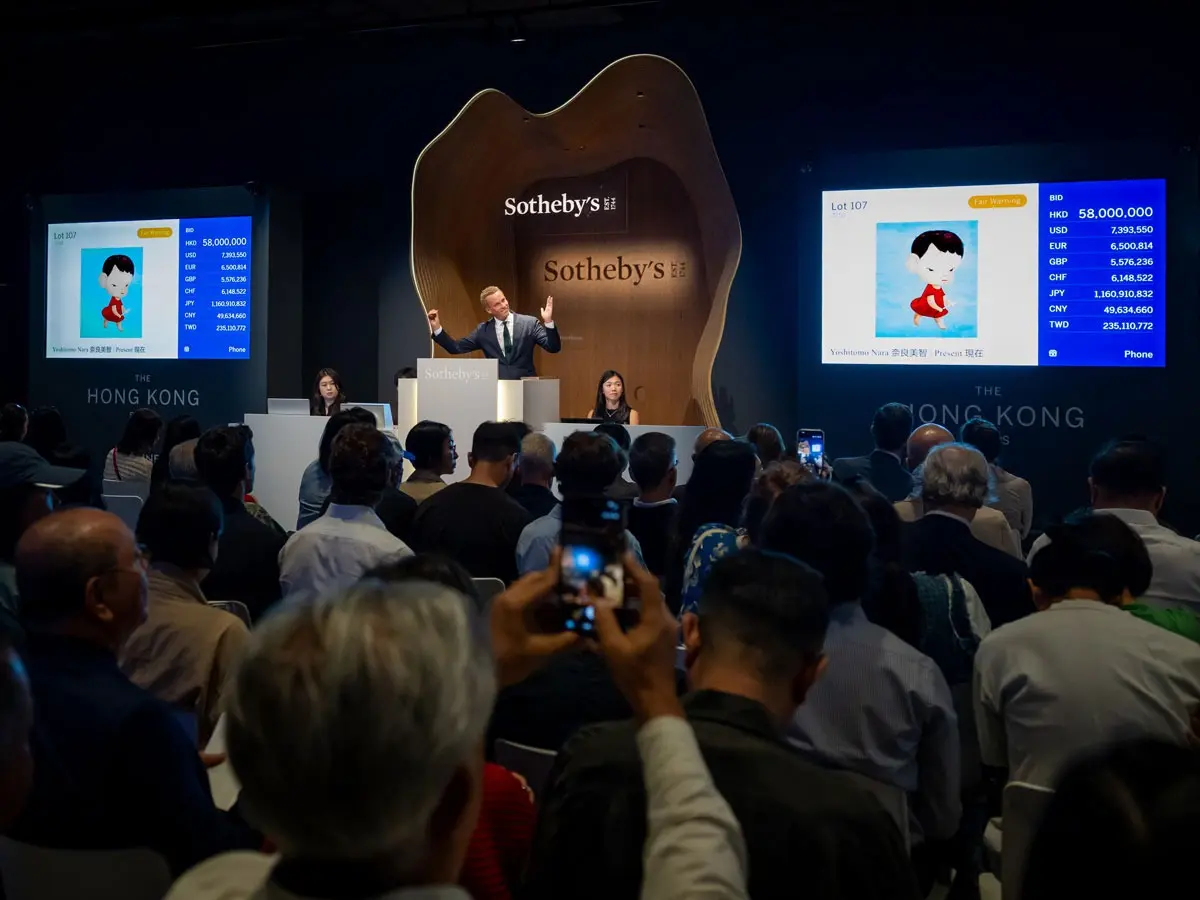
Excluding the Lewis collection, the Sotheby’s evening sale finished with $87.3 million and an 88.5 percent sell-through rate. When combined with the Lewis results, the house reported a 91 percent sell-through rate and a $124.3 million haul—its strongest performance since the fall of 2023. The top lot of the main event was Yoshitomo Nara’s 1994 painting Present, which sold for $9.13 million, returning to the auction block after a 20-year hiatus.
Christie’s and the Quest for Quality
On Tuesday, Christie’s saw buoyant bidding for European Old Masters and established contemporary Asian artists. A standout moment occurred during the Old Master segment, where a spirited battle for Peter Paul Rubens’s Landscape with Willows (1577–1640) saw the price climb to $1.5 million, 150 percent above its low estimate. The result, hammered down by Rebecca Yang, Christie’s China chairman, drew rare applause from the salesroom.
Ada Tsui, vice president for Christie’s Asia Pacific, noted the strong interest in the work of Liu Ye, which sparked a competitive bidding war between a Hong Kong-based collector and a Western buyer. "The underbidding activity was remarkably strong, and the Western collector went all out to fight for that piece," Tsui remarked.
Yet, other marquee lots struggled to gain traction. Yayoi Kusama’s 2011 A-Pumpkin (YHP) hammered at $5.99 million, falling slightly below its low estimate and trailing a comparable work sold by Sotheby’s the previous evening. Similarly, Gerhard Richter’s Abstraktes Bild (1991) hammered at $3.568 million, landing 26 percent below its low estimate. Cristian Albu, head of auction and private sales for Christie’s Asia Pacific, defended the result, noting that this was the first time Christie’s had presented an oil-on-wood painting by Richter in Asia. He suggested that while the house was pleased with the result—given the consignor’s original purchase price in 2006—future success might require more extensive educational efforts to contextualize specific materials for the regional market.

Ultimately, Christie’s marquee 20th- and 21st-century evening sale generated $92.6 million, a 28 percent year-on-year increase, though this was supported by an additional 14 lots compared to the previous year.
Structural Challenges and the Shrinking Pool
Auction veteran Yuki Terase, cofounder of the advisory firm Art Intelligence Global, underscored the structural challenges facing the secondary market. She pointed to a global calendar saturated with fairs, gallery shows, and private inventory as a major factor in buyer fatigue.
"We have a vast pool of collectors who can comfortably and intuitively spend up to a few million dollars, but once you cross into eight figures and above, the buyer pool shrinks dramatically," Terase noted. She highlighted the sale of Jean-Michel Basquiat’s Ancient Scientist (1984), which sold for $9.81 million at Christie’s, as a prime example. While it became the most expensive work sold at auction in Asia this season, its hammer price was only 11.61 percent above its low estimate, suggesting that premier trophy lots now require more effort to attract fresh capital rather than relying on the usual cycle of existing market participants.
Phillips and the Path Forward
The autumn season concluded on Wednesday with the Phillips Modern & Contemporary Art Evening Sale, the house’s first such auction following the departure of Asia chairman Jonathan Crockett and a broader global staff restructuring. Acting as interim lead, Dina Zhang, head of modern and contemporary art for China, worked to project stability, emphasizing that Phillips remains committed to its regional presence.

Zhang noted that the firm is pivoting toward a strategy of client retention through personalized service and flexible consignment terms, often targeting niche categories that larger rivals might overlook. Across a lean 16-lot catalog, the sale generated over $6.4 million with an 87.5 percent sell-through rate. The top lot was another Richter, Abstraktes Bild (522-1) (1983), which sold for $2.93 million.
As the auction houses look ahead, the consensus remains that while the appetite for high-quality art is not gone, the days of easy, across-the-board growth have been replaced by a more selective, value-conscious environment. For collectors and houses alike, the coming months will likely be defined by a continued emphasis on provenance, price accuracy, and the ability to find new buyers in a market that is increasingly testing the limits of its own resilience.