
For decades, historians and archaeologists have engaged in a scholarly tug-of-war over the precise genesis of Paris. While the city’s identity is inextricably linked to its Roman past and its later transformation into a medieval powerhouse, the question of where the very first iteration of the city—the Iron Age settlement of Lutetia—actually stood has remained a point of contention. This summer, a remarkable discovery beneath the Hôpital Hôtel-Dieu on the Île de la Cité, the historic island at the heart of the Seine, may have finally brought that debate to a definitive close.
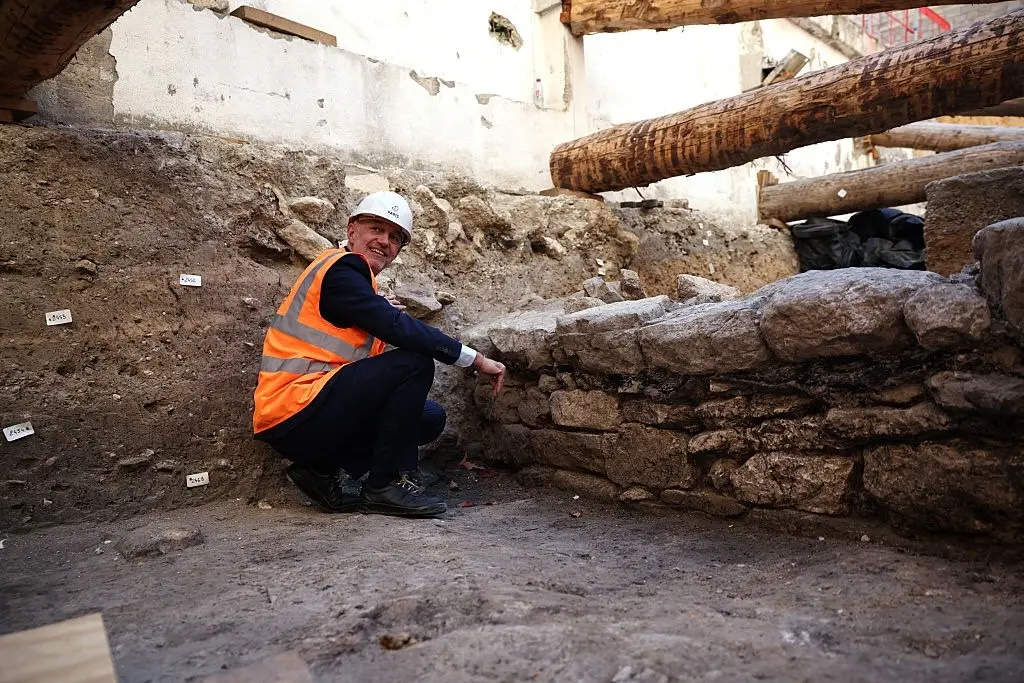
During routine construction work at the hospital, crews uncovered a 72-foot-long structure composed of stone and wood, dating back to a window between 200 BCE and 10 BCE. This discovery, coupled with the recovery of a Gallic spearhead nearby, provides the most compelling physical evidence to date that the foundations of Paris were laid precisely where modern lore suggests: on the island that serves as the city’s geographic and spiritual center.
The Mystery of Lutetia and the Caesar Connection
The historical record regarding the origins of Paris rests heavily on the accounts of Julius Caesar. In his seminal documentation of the Gallic Wars, Caesar described a settlement known as Lutetia, established by the Parisii, the Gallic tribe from whom the city derives its name. According to Caesar’s writings, Lutetia was a fortified town positioned strategically on an island within the Seine. He famously noted that as Roman legions approached in 52 BCE, the local inhabitants opted to burn their own settlement and destroy the bridges leading to it, a desperate scorched-earth tactic meant to impede the Roman advance. Despite these efforts, the Roman conquest was completed that same year.
For generations, however, the physical archaeological record seemed to contradict Caesar’s narrative. While the Île de la Cité has been the subject of countless excavations, evidence of a substantial Gallic settlement remained frustratingly elusive. By the 1990s, the lack of significant pre-Roman artifacts on the island led many experts to look elsewhere. A competing theory gained traction, suggesting that the true Lutetia might have been located in Nanterre, a suburb west of the modern city center where extensive digs had unearthed a wealth of Gallic remains. This shift in academic consensus effectively relegated the island site to a secondary role in the narrative of Paris’s earliest days.
A Turning Point in the Archaeological Record
The recent excavation at the Hôtel-Dieu has effectively overturned these long-held assumptions. The discovery of the wall, which dates precisely to the period of Roman encroachment into Gaul, provides the missing link that connects the physical geography of the island to the historical accounts of the Parisii.
The significance of this find has not been lost on the academic community. Matthieu Poux, a professor of archaeology at the University of Lyon II, has been one of the most vocal skeptics regarding the island-based theory of Lutetia’s origins. For years, Poux and other scholars argued that the lack of evidence on the Île de la Cité made the Nanterre hypothesis far more plausible. Upon reviewing the data from the Hôtel-Dieu site, however, Poux has openly reversed his position. He stated to The New York Times that he now has "no doubt" that the ancient city was indeed situated on the Île de la Cité, describing the single excavation as a find that has increased the available evidence on the subject "tenfold."
Evidence of Conflict and Destruction
Perhaps the most tantalizing aspect of the discovery is the condition in which the wall was found. Researchers identified clear signs that the structure had been subjected to intense fire. Alongside the stone and wood of the wall, archaeologists recovered charred seeds and the remnants of a wooden building. These details bear a striking resemblance to the account provided by Caesar, who claimed the inhabitants burned their city to prevent it from falling into Roman hands.
While the temptation to link this specific wall to the historical event described by Caesar is high, the archaeological community is exercising necessary caution. Representatives from the French culture ministry have noted that while the timing of the destruction aligns with the Roman conquest, further analysis is required to determine the precise circumstances of the fire and the functional history of the wall. Determining whether this was a defensive act of sabotage or a catastrophic accident during the Roman siege remains a central focus for ongoing research.
Filling a Massive Blank in Parisian History
The discovery is particularly significant because it addresses a major deficit in the understanding of Paris’s development. While Roman Paris is exceptionally well-documented—with expansive ruins and remnants of settlements clearly identified beneath modern landmarks like the Latin Quarter and the Luxembourg Gardens—the Gallic period has been notoriously difficult to map. The lack of a clear urban center for the Parisii had left a "massive blank" in the timeline of the city’s history. By confirming that the Île de la Cité served as a hub for the Parisii, this find allows researchers to better understand the transition from an Iron Age tribal settlement to a Roman urban center.
The current excavation is only the beginning of a larger effort. Plans for further research around the Hôtel-Dieu are already underway, with the hope that additional layers of the site will reveal more about the layout and domestic life of the early settlement. As the investigation progresses, the wall will eventually be carefully removed from the construction site. This will allow for more thorough laboratory analysis, ensuring that the structural integrity of the finds is preserved, and eventually, the artifacts will be prepared for public display, offering residents and visitors a tangible connection to the city’s foundational era.
This discovery serves as a reminder of the layers of history that exist beneath the bustling streets of modern Paris. Despite being one of the most thoroughly excavated cities in the world, it continues to reveal secrets that reshape our understanding of its past. As the dust settles on the site at the Hôtel-Dieu, the consensus among experts is clear: the history of Paris is deeper, more complex, and more closely tied to the Île de la Cité than many had dared to believe in recent decades. The city that was once thought to have been elsewhere has, in a sense, finally come home to the heart of the Seine.