
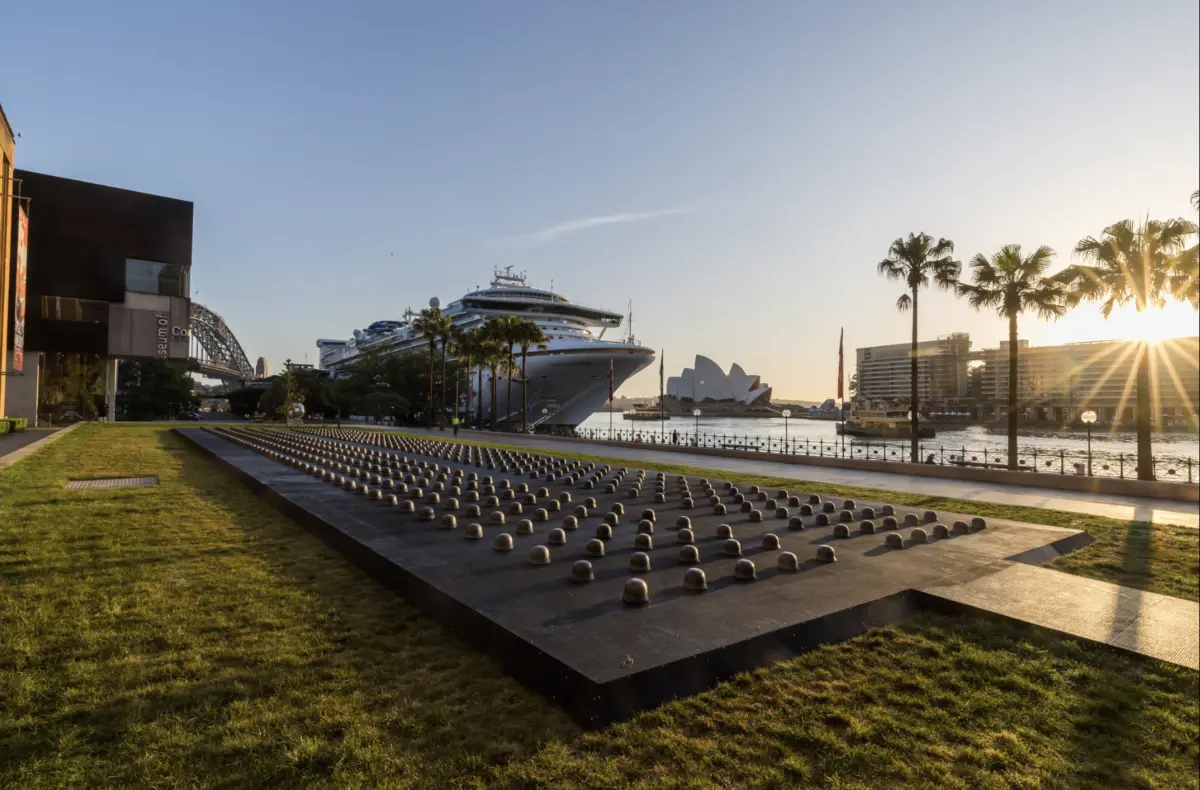
The Museum of Contemporary Art Australia (MCA) in Sydney has unveiled its latest major outdoor commission, a striking and somber installation by the world-renowned artist and activist Ai Weiwei. Situated on the Tallawoladah Lawn—the city’s busiest and most prominent green space nestled between the museum and the iconic Sydney Harbour—the work, titled Mushrooms, features 500 individual cast-iron combat helmets arranged in ten precise, orderly lines. Stretching 131 feet across an elevated platform that is bisected by a public pedestrian walkway, the installation commands the attention of tourists, commuters, and locals alike, turning a site of leisure into a space for profound geopolitical contemplation.
The sheer scale of the installation makes it difficult to overlook for anyone navigating the harbor precinct. Each helmet, meticulously cast in iron, serves as a haunting reminder of the industrial nature of modern warfare. By including the inner padding of the helmets, Ai has imbued the objects with a sense of tactile realism, suggesting the presence of the human bodies they were intended to protect—or, perhaps, the absence of those bodies once the protection failed.
A Symbolism of Growth, Destruction, and Delay
The title of the work, Mushrooms, is intentionally multi-layered, reflecting Ai Weiwei’s penchant for linguistic and historical subversion. According to the artist, the term serves as a evocative metaphor for several intersecting concepts. Visually, the curved silhouette of the helmet mirrors the organic shape of a mushroom. Beyond this physical resemblance, the title evokes the terrifying imagery of nuclear mushroom clouds—the ultimate symbol of existential threat and mass destruction.
Furthermore, in the context of the Chinese language, the word for mushroom carries an additional, more cynical connotation: it suggests "endless delays." In this sense, the installation serves as a critique of bureaucratic stagnation and the paralysis of leadership when faced with urgent global crises. Ai suggests that the "growth in darkness" of these mushrooms—these helmets—mirrors the way that conflict, when left unaddressed or handled with indifference, spreads quietly and insidiously until it erupts into catastrophe.
For Ai, the installation is a direct response to the precarious state of global affairs. "We continue to exist in a time where war and peace interchangeably assume each other’s roles, shaping the identity of our age," the artist stated upon the unveiling. "I hope this work prompts people to reflect on war and peace."
The Context of Global Conflict
While the aesthetic of the work is stark and minimalist, its origins are rooted in a specific and controversial moment in recent history. The inspiration for the piece traces back to 2022, when the German government faced intense international scrutiny and ridicule for its initial response to the full-scale Russian invasion of Ukraine. While Kyiv pleaded for advanced weaponry to defend its sovereignty, the German government offered, among other logistical support, a shipment of 5,000 military helmets. The offer was swiftly mocked by Ukrainian officials as "an absolute joke," a gesture perceived as woefully inadequate and symbolically hollow in the face of an existential military threat.
However, Ai Weiwei is quick to clarify that Mushrooms is not a "political joke." Instead, he positions the work as a broader, more philosophical inquiry into the nature of political leadership. As he explained to The Art Newspaper, the intention of the installation is to "demonstrate how shallow an understanding today’s national leadership can have of the human condition and of what may happen in the future." By isolating the helmet—an object designed for survival—and multiplying it hundreds of times over, Ai forces the viewer to confront the disparity between the tangible realities of those caught in the crossfire and the detached, performative responses often offered by those in power.
Honoring a Legacy of Philanthropy
Mushrooms marks the second iteration of the Neil Balnaves Tallawoladah Lawn Commission. The initiative is a tribute to the late Australian philanthropist and businessman Neil Balnaves, who was a passionate supporter of the arts and a significant figure in Australia’s cultural landscape. Balnaves, whose career spanned the media and entertainment industries, passed away in 2022 following a tragic boating accident near Tahiti at the age of 77. The commission, which will host Mushrooms for a seven-month duration, aims to ensure that his commitment to accessible, high-caliber public art continues to thrive in one of Sydney’s most visited public spaces.
The inaugural commission in 2023 set a high bar for the series. It was awarded to the British sculptor Thomas J. Price, who unveiled Ancient Feelings. Price’s work was a massive, ten-foot-tall golden-bronze sculpture depicting the head of a woman. With a serene yet imposing presence, the sculpture gazed out toward the waters of Sydney Harbour. Much like Ai’s Mushrooms, Price’s work was intended to be more than a decorative object; the artist described it as a vessel for viewers to "reflect on the universal emotions and experiences that connect us all." Where Price sought to bridge divides through the celebration of shared humanity, Ai Weiwei uses his installation to highlight the fractures caused by political failure and the ongoing, unresolved nature of global conflict.
Public Reception and The Role of Public Art
The placement of Mushrooms on the Tallawoladah Lawn is significant. By situating the work in such a high-traffic area, the MCA ensures that the art is not confined to the sanitized environment of a gallery, but is instead integrated into the daily flow of city life. This is a recurring theme in Ai Weiwei’s work, which frequently seeks to bypass institutional barriers to reach a wider, more diverse audience.
As pedestrians walk through the space—perhaps on their way to the Opera House or the ferry wharves—they are confronted by an orderly, almost military-like formation of iron. The contrast between the peaceful, sun-drenched lawn and the grim associations of the combat helmets creates a palpable tension. The installation invites the public to pause, to look down at the objects, and to engage with the artist’s critique of how modern societies—and their leaders—grapple with the weight of history and the inevitability of the future.
The installation will remain on view for seven months, providing ample time for the public to engage with the piece as the seasons change in Sydney. During this time, the MCA expects that the work will serve as a catalyst for ongoing discussions about the role of art in society, the ethics of military support, and the responsibility of governments to truly grasp the gravity of the human condition.
For Ai Weiwei, an artist who has spent his career challenging authority and advocating for those whose voices are marginalized, Mushrooms is another chapter in a long history of provocative public interventions. By transforming the site into a field of iron helmets, he has effectively made the invisible costs of war impossible to ignore. As the installation remains a fixture on the lawn, it serves as a silent, iron-clad witness to the ongoing debates surrounding war, peace, and the often-troubling decisions made by those in positions of power. Whether the viewer sees the work as a critique of a specific moment in 2022 or a timeless reflection on the failures of leadership, the impact of the installation is undeniable, ensuring that the legacy of the Neil Balnaves commission continues to challenge and inspire.