
For the better part of the last decade, New York’s Armory Show has been caught in a restless search for its own identity. It is a fair that has weathered constant upheaval: migrating from the charmingly gritty, industrial piers along the Hudson River to the clinical, high-security expanse of the Javits Center on Manhattan’s West Side, all while grappling with shifting calendar dates. The most significant turning point arrived in 2023 when the fair was acquired by Frieze—an entity that already commands a formidable presence in the city’s art calendar with its own fair at the Shed, a venue frequently cited by critics as among the least hospitable in the global circuit.
Following the acquisition, the Armory Show underwent a period of aggressive restructuring. It appointed new leadership, overhauled its exhibitor list, and pivoted its schedule once again, settling into a late-September slot. As the doors opened on Thursday morning for the fair’s 32nd edition, the central question looming over the Javits Center was as existential as it was practical: In this crowded and increasingly fractured landscape, what—and who—is the Armory Show actually for?
At 11 a.m., just one hour after the fair officially opened its doors, the answer remained elusive. The earlier opening time granted the fair a sense of breathing room, though at times that airiness felt excessive. Attendance appeared lean, at times bordering on anemic, depending on which sector of the expansive floor one occupied. The Javits Center’s floor plan creates a unique, if somewhat disjointed, atmosphere; the vast hall is effectively bisected by the central hub—comprising the VIP lounge, the restaurant, and a champagne bar—which results in a strange experience where one wing of the fair can feel completely deserted while, mere hundreds of feet away, the other is teeming with activity.
The perceived sparseness of the aisles may have been compounded by external competition. Independent 20th Century, a rival fair, opened on the same Thursday morning on the Upper East Side at the Breuer building, now serving as the headquarters for Sotheby’s. Furthermore, anecdotal reports from the floor suggested that the organizers had faced challenges in filling the cavernous footprint of the Javits Center, with more than one dealer noting that they had been invited to participate at the eleventh hour. Yet, for many exhibitors, the measured pace was a welcome departure from the typical high-pressure environments of major art fairs.

Jayne Drost Johnson, of New York’s JDJ Gallery, characterized the slow morning not as a failure, but as a reflection of a fundamental shift in the art market. "We’ve all noticed that fairs have a different pace the last couple of years," Johnson observed. "It’s more consistent, not just all about one crazy morning, and this way you can have better conversations. Even at last year’s Art Basel Miami Beach, which was a success for me, I was making as many sales on the last day as the first. A slow start is simply not a sign of how the entire event is going to go."
Augusto Arbizo, a prominent New York art adviser working with Allan Schwartzman’s firm, echoed this sentiment, suggesting that the revised timing had fundamentally altered the fair’s temperature. "I actually found the new dates gave the Armory a much more relaxed energy," he said. "There was a nice sense of anticipation when I walked in, but without that immediate feeling of being swept up in the frantic frenzy that can sometimes accompany a fair opening."
By 2 p.m., the dynamic had shifted significantly. The aisles began to fill, and the fair hummed with the familiar, frantic energy of an opening day. Despite the structural and leadership changes, the Armory Show continues to perform one vital function for the New York art world: it serves as the definitive marker that summer is over and the professional season has resumed. This role felt particularly reinforced this year. When the fair moved to the Javits Center in 2021, it was scheduled for the week immediately following Labor Day, forcing it to compete for attention with the sudden, overwhelming crush of gallery openings, dinners, and institutional events that define the fall season.
By shifting the dates to September 24–27, the Frieze management team effectively distanced the fair from their own event in Seoul, which ran concurrently. The result was a more civilized experience. Rather than adding to an already claustrophobic September calendar, the fair functioned as a true beginning. The VIP preview saw a notable turnout, including the First Lady of New York, Rama Duwaji, alongside high-profile figures such as Jodie Foster, Paul Rudd, and NBA star Karl-Anthony Towns. The collector base was similarly robust, with industry stalwarts like Beth Rudin DeWoody, Estrellita Brodsky, Komal Shah, Lisa Goodman, Allison Berg, and Jill and Peter Kraus navigating the aisles.

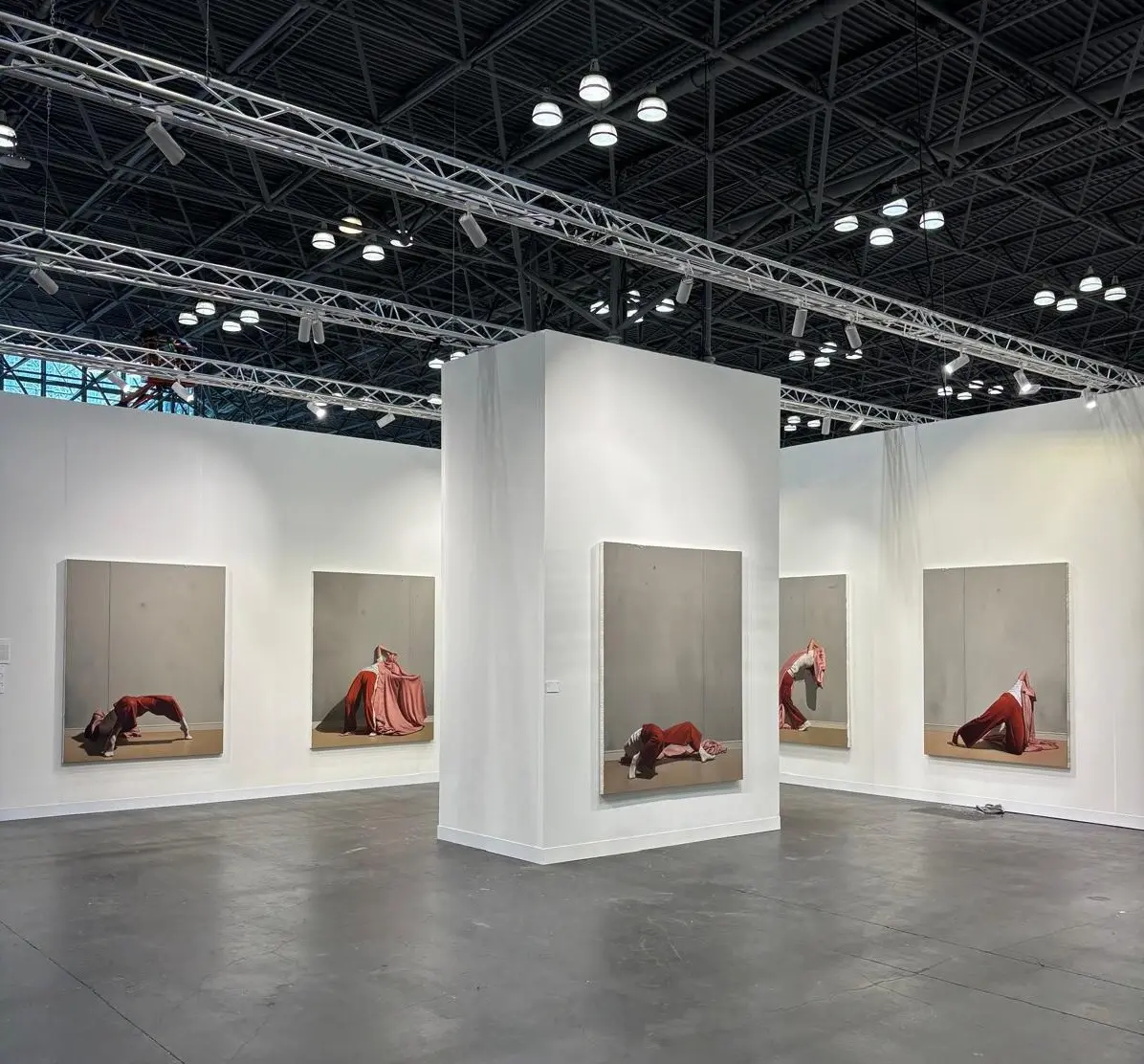
The business of the fair moved forward in earnest. While some galleries reported having closed deals via emailed previews before the doors even opened, others found success on the floor. First-time exhibitor Kamel Mennour reported the sale of seven out of nine paintings by Dhewadi Hadjab by 1 p.m., with two additional works on reserve. Priced at $110,000 each, the works—which depict dancers in various stages of complex choreography—were noted by the dealer for their visual resonance with the motion studies of Eadweard Muybridge.
For New York’s Norr Cohan, this edition marked a significant milestone, as it was the gallery’s first appearance since partner David Norr became the sole owner. By the close of the day, the gallery reported a string of successful placements, including a large multimedia piece by Yinka Shonibare sold to a private collector in the $180,000 to $220,000 range, two large mosaics by Eamon Ore-Giron fetching between $80,000 and $120,000, and a suite of 25 watercolors by Spencer Finch sold for between $50,000 and $75,000.
Smaller galleries also found traction. Shrine, a New York-based gallery, successfully placed approximately 10 paintings by Canadian-born artist Michelle Paterok, discovered by partner Marge Rendell on Instagram, at price points ranging from $5,500 to $11,000. Meanwhile, the international powerhouse Perrotin reported the sale of six paintings by Haitian-born artist Kathia St. Hilaire by late afternoon. Priced between $5,000 and $45,000, the works—which engage with the history of Haitian dictator François “Papa Doc” Duvalier and the 1960s Spiralism literary movement—are notable for their deceptive complexity, appearing as tapestries but constructed from dozens of layered applications of paint.
The international reach of the fair was further exemplified by Southern Guild, a Cape Town-based gallery that recently established a permanent outpost in Tribeca. By early afternoon, they had secured multiple sales, including wallpaper works by Zanele Muholi on aluminum for $52,000 each and paintings on black velvet by Roméo Mivekannin for $56,000 apiece, with two large Muholi sculptures priced at $250,000 each currently held on reserve.

Curatorial focus at this year’s edition leaned heavily toward the Caribbean and its surrounding regions. The "Platform" section, curated by Jovanna Venegas of the SculptureCenter, highlighted large-scale installations, while the "Focus" section, overseen by María Elena Ortiz of the Modern Art Museum of Fort Worth, prioritized solo- and dual-artist presentations. Tern Gallery, based in Nassau, Bahamas, saw success in these specialized categories, selling three Kachelle Knowles paintings for $5,000 each and two Gio Swaby works for $18,000 each.
Kyla McMillan, the fair’s director, maintained that the later dates were a strategic success. According to McMillan, the timing allows collectors to return from their summer holidays before the fair begins, making pre-fair conversations with galleries "a bit more intentional." While she acknowledges that the Armory remains a "kickoff for the season," she is keen to emphasize the fair’s unique position in a market that is increasingly defined by a hierarchy of events.
The 2026 edition hosts approximately 230 galleries, a figure consistent with previous years, but with a notable reallocation of space toward younger dealers and solo exhibitions. The "Presents" section has expanded to encompass 55 galleries, while the "Solo" section includes 25. For veteran art adviser Lara Björk, this evolution is the most important development. She noted that the Armory has spent nearly a decade struggling to regain its footing in the New York market. While Frieze’s acquisition was initially met with surprise, Björk believes it may be exactly what the fair landscape requires. "They’re capitalizing on the lower-priced, more ‘red-chip’ leaning artists and galleries," she said. "Perhaps that’s just what the art market needs. In a market that has many markets and layers, there is in fact room for everyone."
McMillan describes the strategy as an effort to offer something that the industry’s larger, more dominant fairs do not. "This fair has always been one about discovery," she said, highlighting the expanded young-gallery section and the curated sectors. Even established dealers, she argued, utilize the Armory to introduce artists to the New York market or to mount presentations that might not be the primary focus at a more global-scale fair.

Sean Kelly, whose gallery reported the sale of six works by early afternoon, offered a pragmatic view of the fair’s role. "It’s the beginning of our season," Kelly said. "Everybody wants to get back at it. And this is them getting back at it. People are spending money; they’re in here doing it. For me, that’s what the fair is for." His booth reflected this, with the sale of Janaina Tschäpe’s large oil painting Picking Flowers Quietly for $170,000 and Sam Moyer’s marble and plaster work Magic Number for $125,000, alongside other sales ranging from $28,000 to $60,000.
The Azerbaijan-founded Gazelli Art House, which recently opened a 10,000-square-foot space in the former Marlborough location in Chelsea, brought a historical ambition to the fair. Their booth featured Abstract Expressionist Alice Baber, with works starting at $200,000, and canvases by Grace Hartigan, starting at $130,000. By mid-afternoon, they had sold a significant historic work by Lilly Fenichel to a European private museum for approximately $200,000.
Other galleries reported smaller but rapid-fire sales. A Hug From the Art World sold out its entire booth of Camille Fishel paintings—priced between $18,000 and $24,000—before noon. Gavlak, meanwhile, reported a suite of sales totaling between $150,000 and $200,000, including works by Lita Albuquerque, Marilyn Minter, and T.J. Wilcox. At Dimin, the breadth of the market was on full display: the gallery sold paintings by Kelli Vance and a ceramic sculpture by Michelle Im titled The Auctioneer, which portrays the enigmatic Sotheby’s auctioneer Phylis Kao. Though Kao is not currently auctioning the works on the Javits floor, the transaction underscored the sentiment that the Armory Show is positioning itself as a vital, enduring gateway for the next generation of the art market.