
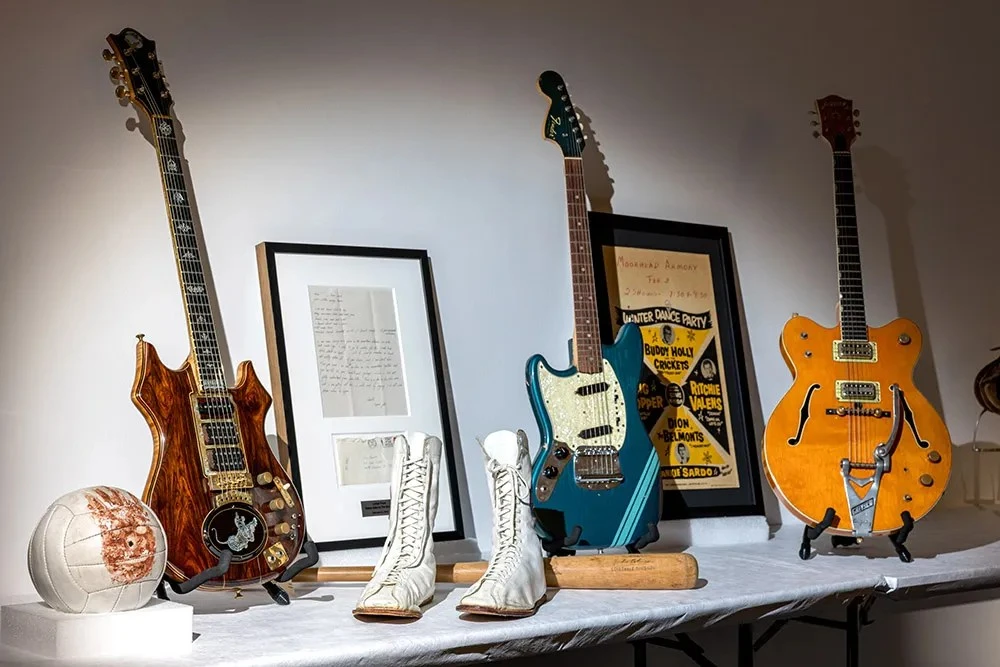
After years of meticulously testing the waters, Christie’s has officially signaled that pop culture has arrived as a cornerstone of the global auction market. The storied auction house, which has spent over two centuries curating fine art and antiquities, confirmed this Wednesday that it is launching a dedicated, permanent pop culture division. This new global operation is designed to host multiple auctions annually, encompassing an expansive range of categories: film and television memorabilia, music history and vintage instruments, sports collectibles, science and technology artifacts, natural history specimens, high-end fashion, and popular design.
To lead this ambitious new chapter, Christie’s has appointed Josh Benesh as the global head of the division, based in New York. Benesh, a veteran of the industry who previously served as a top executive at Heritage Auctions, joined Christie’s earlier this year as a consultant. His transition into a permanent leadership role underscores the seriousness of the auction house’s commitment to capturing this rapidly expanding sector of the market.
A Strategy Defined by Data and Demand
The decision to institutionalize its pop culture offerings follows years of internal assessment regarding the viability and appetite for such a department. Christie’s did not arrive at this conclusion overnight; rather, it relied on a series of increasingly successful pilot projects that measured collector interest. The most significant of these was the recent, blockbuster sale of the Jim Irsay Collection.
The estate of the late Indianapolis Colts owner—a legendary collection that spanned decades of American history, rock and roll, and sports—served as a definitive proof of concept. Across five separate auctions held throughout the current year, Christie’s brought 404 lots to the block, including everything from presidential documents and original literary typescripts by Jack Kerouac to iconic guitars that shaped the history of rock music. The result was a staggering $105.3 million in total sales, a figure that the auction house identifies as the highest total ever achieved for a single memorabilia collection.
"We’ve been testing this market," said Christie’s chief executive, Bonnie Brennan, during a conversation with Puck’s Marion Maneker at the Art of Influence conference in New York. "We feel that right now is at a point of maturity that makes sense for us to really commit."

The Evolution of the Auction House
While the establishment of a dedicated department is a new milestone for Christie’s, the house is certainly no stranger to the world of celebrity-driven sales. Over the decades, it has presided over the high-profile dispersal of collections belonging to cultural icons such as Elizabeth Taylor, Audrey Hepburn, Elton John, George Michael, Mark Knopfler, and David Gilmour.
The shift here is not about a change in what they sell, but in how they organize that business. By centralizing these sales into a dedicated global department, Christie’s is aligning itself with the structural shifts already observed among its major competitors. In 2021, Sotheby’s established its own Science & Popular Culture department, led by Cassandra Hatton, a specialist who had spent years cultivating expertise in niche areas ranging from space exploration to the history of hip-hop. Other houses, such as Bonhams, have long maintained dedicated entertainment memorabilia departments, with director Helen Hall helping the house solidify its reputation as a consistent player in the space. Freeman’s, too, continues to operate a specialized collectibles department that bridges the gap between traditional auctions and modern pop culture.
However, Christie’s is keen to differentiate its approach. During the Art of Influence conference, Brennan made it clear that the goal is not to chase volume for the sake of becoming the largest entity in the space. "We don’t want to be the biggest," Brennan stated. Instead, the house intends to leverage its existing "storytelling machinery"—the same sophisticated curatorial and marketing apparatus it uses for blue-chip fine art and major single-owner estate sales—to elevate these objects. The strategy is to treat a film-worn costume or a legendary guitar with the same level of academic rigor and prestige usually reserved for a Renaissance painting.
Building Community Through Collectibles
The Jim Irsay sale provided a template for this strategy. For the auction house, the sale was not merely a financial triumph, but a social one. The collection, which included such marquee items as Pink Floyd guitarist David Gilmour’s "Black Strat"—which sold for a record-breaking $14.5 million—and Jerry Garcia’s "Tiger" guitar, drew an unprecedented level of engagement.
Reflecting on the atmosphere in the room during the Irsay auctions, Brennan noted a palpable sense of community that she had rarely witnessed elsewhere. She recalled seeing bidders, some of whom had spent millions, sharing moments of genuine camaraderie, backslapping, and celebrating the provenance of the items. "I sat in the Jim Irsay sale room, and that was an experience like I’ve never seen," she said. "There was no better example of auction creating community than that."

This "community-first" approach is essential to the future of the auction house. Brennan acknowledged that attracting younger collectors and new client demographics is an existential priority for a 260-year-old institution. "If we don’t invite people in, if we don’t make the next generation feel like Christie’s is a place for them, we die," she admitted.
The house has already seen success in this area through its luxury division, where items like watches, jewelry, handbags, and fine wines serve as accessible entry points for new buyers. The data confirms this shift: roughly 75 percent of bids in Christie’s luxury auctions now originate from online digital tools, signaling a move toward a more tech-savvy, younger collector base.
The Future of Cross-Category Collecting
Josh Benesh, the newly appointed global head of the pop culture division, believes that the distinction between "traditional art" and "pop culture" is increasingly porous for modern collectors. In an email to ARTnews, Benesh noted that the Irsay sale was a "compelling proof of concept," but emphasized that discussions regarding a formal department had been underway well before the final gavel fell on the Irsay lots.
For Benesh, the goal is to foster a cross-pollination of interests. Collectors, he observed, rarely operate within silos. An individual who starts their journey with a passion for comic books or musical history is often the same person who will eventually explore traditional fine art, and vice-versa. "Collectors rarely stick to one category," Benesh said. "We see tremendous conversion, but that works both ways. Our art clients are just as enthusiastic about these opportunities."
By formalizing this division, Christie’s is essentially betting that the line between high art and high-profile cultural objects is fading. Whether it is a guitar played on a world tour or a draft of a seminal novel, these objects possess a cultural resonance that transcends traditional valuation. As the house pivots to meet this demand, the focus remains on the narrative power of the object, ensuring that the next generation of collectors finds a home within the historic walls of Christie’s. The launch of this division is more than just a new department; it is a declaration that the auction house is ready to evolve, ensuring that the legacy of Christie’s remains relevant in a rapidly changing cultural landscape.