
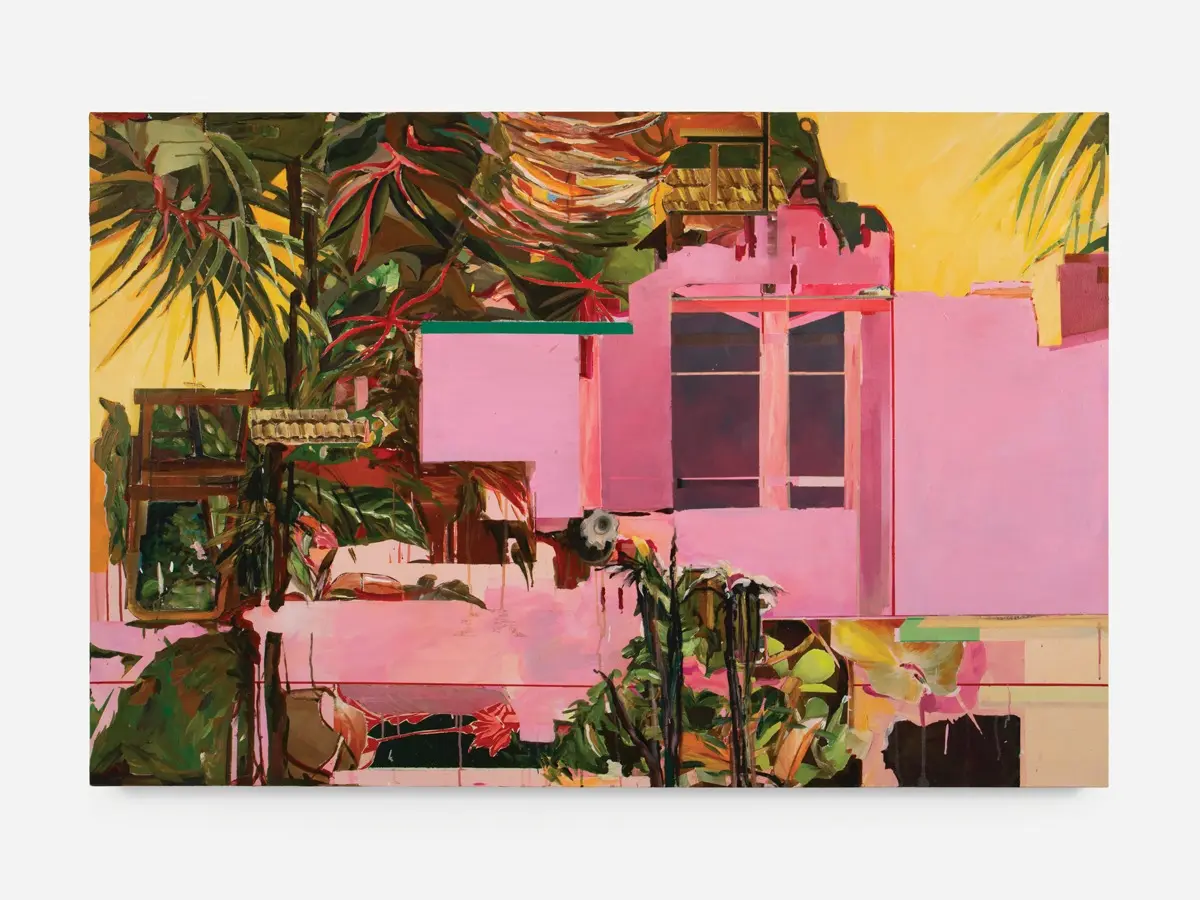
Lucia Laguna, the acclaimed Brazilian painter whose work captured the kaleidoscopic intersection of memory, urban chaos, and the lush, verdant topography of Rio de Janeiro, has died at the age of 85. Her passing was announced by her longtime representatives, the São Paulo-based gallery Fortes D’Aloia & Gabriel, which noted that the artist died in her home in the hills above Rio—the very environment that served as the primary catalyst for her creative vision.
The loss of Laguna marks a somber moment for the Brazilian art community, which is still reeling from the recent death of another gallery artist, Rodrigo Cass, who passed away following a tragic beach accident. In a gesture of mourning and respect, Fortes D’Aloia & Gabriel closed its doors for the day to honor the legacies of both artists, who occupied distinct but vital places within the gallery’s roster.
A Career Defined by Landscape and Language
Throughout a career that spanned several decades, Lucia Laguna developed a visual lexicon that was as intellectually rigorous as it was aesthetically exuberant. Her paintings are characterized by their fractured, overlapping compositions, where dense, brightly colored pigments coalesce into semi-abstract narratives. Her work was rarely a singular, static image; rather, it functioned as a repository of her engagement with the physical landscape, the persistence of memory, and the rhythms of everyday life.
Laguna’s approach to art was deeply informed by her previous professional life as a language and literature teacher. This background provided her with a unique perspective on the act of creation, which she viewed not as a solitary endeavor, but as a dynamic process of layering and dialogue. She became widely recognized for a collaborative creative methodology that invited studio assistants and students into her process. In this unique “pictorial dialogue,” participants were encouraged to lay down an initial layer of paint centered on a chosen theme. Laguna would then respond to these foundational marks, accumulating pigment, painting over existing forms, or strategically erasing sections to reveal the strata beneath.
“Her work, at once intimate and open to the world, occupies a fundamental place in contemporary Brazilian art,” the gallery stated in a tribute. This duality—the intimacy of the studio versus the vast, sprawling openness of the Brazilian landscape—defined her contribution to the canon. Her canvases often feel as though they are vibrating with a hidden internal energy, a reflection of her belief that painting was a method of slowing down time in an increasingly distracted world.
The Geography of the Canvas: Jardim, Paisagem, and Beyond
Laguna’s body of work is frequently categorized into several thematic series, most notably Jardim (Garden), Paisagem (Landscape), Estúdio (Studio), and Azulejo (Tiles). These series serve as windows into the artist’s dual reality: the interior quiet of her workspace and the chaotic, sun-drenched exterior of Rio de Janeiro.
In these paintings, the viewer encounters a collision of figurative and abstract elements. Tropical foliage—a hallmark of the Rio hills—is often juxtaposed against the rigid, geometric lines of city architecture. These forms do not simply coexist; they flow into one another, creating a visual tension that mimics the fragmented way we perceive our surroundings. As noted by the European gallery Karsten Greve, which has also represented her work, “Laguna’s paintings come across sometimes as expressive and full of energy, sometimes as light and free flowing, and nearly always seem pervaded by atmospheric light.”
This atmospheric quality was intentional. Laguna was deeply preoccupied with the role of the artist as an observer in an age of sensory overload. In a 2008 reflection cited in Paulo Herkenhoff’s Economia da Pintura, the artist articulated her philosophy: “I believe that painting can recover a time for gazing that has been lost in the chaos of images that bombard our cities. The slowness, the introspection that painting entails pleases me, asking me to translate reality according to this lost perspective.”
From the Classroom to the Biennale
The trajectory of Laguna’s career was unconventional, marked by a decisive pivot in mid-life. Born in 1941 in Campos dos Goytacazes, Brazil, she spent the better part of her early adulthood immersed in the world of language and literature. It was not until she was 54, in 1995, that she enrolled in the Escola de Artes Visuais do Parque Lage in Rio de Janeiro. Under the tutelage of Charles Watson, her latent artistic talent found a medium, and she experienced a rapid ascent in the art world.
By 1998, just three years after beginning her formal studies, Laguna had secured her first solo exhibition at the Cândido Mendes Cultural Centre in Rio. Her work quickly garnered institutional attention, culminating in a significant breakthrough at the 30th São Paulo Biennale in 2012. This appearance solidified her reputation as a major figure in contemporary art, and her works were subsequently acquired by major museums across Brazil, becoming fixtures of their permanent collections.
Her reach extended far beyond South America. Laguna’s work was exhibited at prestigious international venues, including the Martin Gropius Bau in Berlin and the Museum of Contemporary Art in Antwerp. Her accolades included the prestigious PIPA Prize in Brazil, a testament to the sustained innovation she brought to the medium of painting.
A Lasting Legacy
Lucia Laguna leaves behind a profound legacy that challenges the traditional boundaries between the artist and their environment. By treating the canvas as a space for conversation—not just between her and her assistants, but between the city’s history and its present—she created a body of work that feels both ephemeral and deeply grounded.
Her artistic practice was, in many ways, an act of translation. She translated the light of the Rio mountains, the geometry of the tiles on a city wall, and the slow, deliberate pace of introspection into a visual language that resonated with audiences globally. She proved that it is never too late to begin a new chapter, and that the act of painting can be a radical form of resistance against the transience of modern life.
Lucia Laguna is survived by her daughter, Laura, and her grandchildren, João and Daniel. As the art world reflects on her passing, her canvases remain as evidence of a life spent in pursuit of the "lost perspective," a vibrant testament to the power of slow, deliberate, and deeply human observation. Through her series of gardens, landscapes, and studio studies, she invited us all to look a little closer at the world around us, ensuring that her contribution to the landscape of contemporary art will continue to bloom for generations to come.