
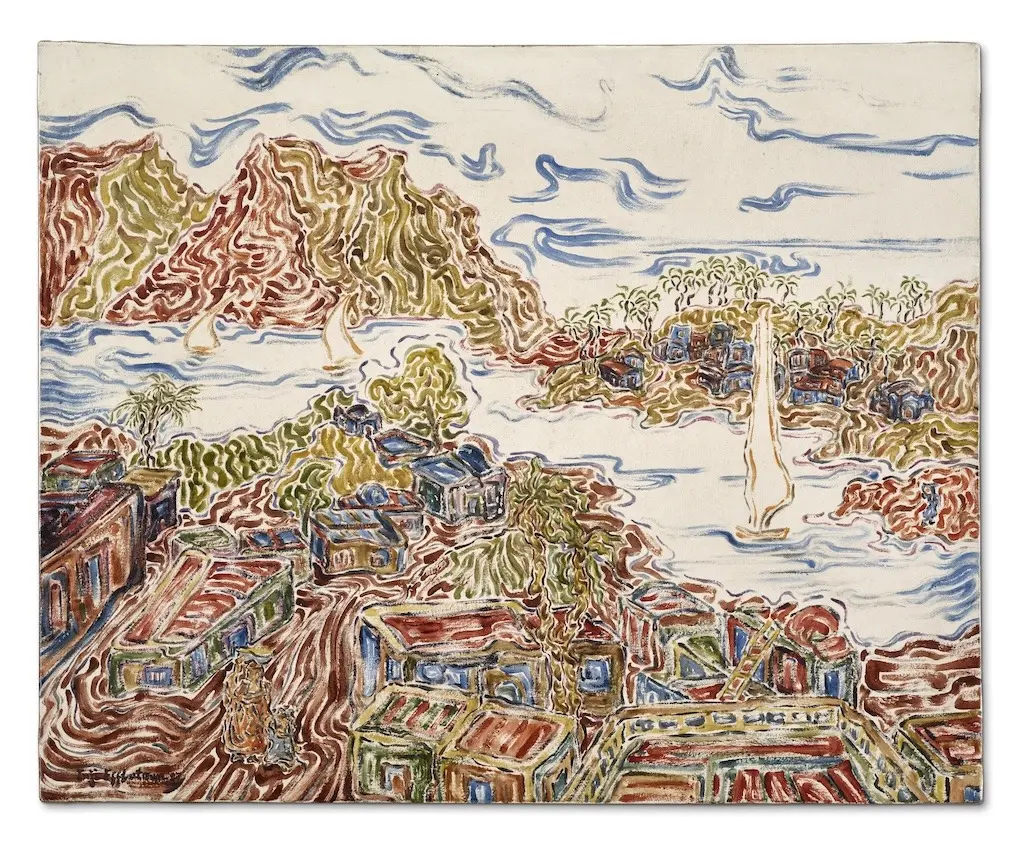
Two decades after Christie’s made history as the first international auction house to stage a sale in the United Arab Emirates, the venerable institution is commemorating the anniversary by shifting its focus to the nation’s capital. On November 1, the house will host "MAWASIM: 20 Years of Modern and Contemporary Middle Eastern Art" at the Abu Dhabi Edition hotel, a high-profile sale featuring more than 70 works by pivotal artists from the Middle East and North Africa (MENA) region.
This move is far more than a simple change of scenery. It represents a significant symbolic and strategic pivot for an auction house that has spent the last twenty years helping to define the art market in the Gulf. The upcoming auction includes an impressive roster of artists, such as Paul Guiragossian, Samia Halaby, Mohamed Melehi, Marwan Kassab-Bachi, Inji Efflatoun, and Nabil Nahas, underscoring a commitment to the regional masters who have defined the artistic trajectory of the area.
A Growing Cultural Infrastructure
The significance of this anniversary is underscored by the evolution of the UAE’s art landscape. When Christie’s held its inaugural auction in Dubai in 2006, it was a pioneering effort in a region that was just beginning to establish its international art credentials. At that time, the now-famed Saadiyat Cultural District in Abu Dhabi was little more than a vision in the planning stages. Today, the landscape is transformed. The Louvre Abu Dhabi has become a fixture on the global cultural map, and the much-anticipated Guggenheim Abu Dhabi is slated to open on December 11.
The decision to host the anniversary sale in Abu Dhabi reflects the city’s rapid development from a center of institutional museum-building into a burgeoning hub for the commercial art market. This transition is not occurring in a vacuum. The presence of major international players has intensified, with Sotheby’s establishing a new, permanent presence in Abu Dhabi last year. Sotheby’s has framed this expansion as part of a "long-term commitment" to the region’s collectors, with an ambitious inaugural program that includes "Collectors’ Week" in early December. That event will showcase a diverse array of luxury goods, including jewelry, watches, cars, and real estate, alongside a fine art exhibition spanning from Old Masters to contemporary works.

Further cementing the capital’s status is the debut of Frieze Abu Dhabi, running from November 19 to 22 at Manarat Al Saadiyat. The fair, developed in partnership with the Abu Dhabi Department of Culture and Tourism, will host 84 galleries from 64 cities and 37 countries. By integrating international powerhouses like Gagosian, Pace, Thaddaeus Ropac, and Timothy Taylor with prominent dealers from the UAE and the broader region, the fair aims to build on the foundation laid by the local Abu Dhabi Art event, which has been active for 17 years.
Strengthening the Collector Base
The "20-year arc" described by Christie’s reflects a maturing collector base that has shown an increasingly sophisticated appetite for regional art. Evidence of this growing demand was on full display last November during the house’s London sale of the Dalloul Collection. The auction achieved £4.1 million ($5.4 million), with an impressive 93 percent of the lots sold by value and 85 percent by volume. Perhaps most significantly, over half of the lots sold well above their high estimates, and eight auction records were set in a single evening.
The demographic data from that sale provides a glimpse into the future of the market. Approximately 38 percent of the buyers were new to Christie’s, and 21 percent of those buyers were millennials, signaling that the appetite for modern and contemporary Middle Eastern art is expanding to a younger, more global audience. Notable results included Saloua Raouda Choucair’s 1966–68 work Poem, which sold for £393,700—363 percent above its high estimate—and Sliman Mansour’s 2014 Untitled, which brought £323,850, an 80 percent increase over its high estimate. Kamal Boullata’s Nocturne I also outperformed, selling for £165,100, more than triple its initial projection.
High-Stakes Lots and Provenance
The upcoming Abu Dhabi auction serves as a litmus test for this momentum. Among the standout lots is Paul Guiragossian’s monumental 1958–59 canvas Noces (Wedding), which carries an estimate of $300,000 to $500,000. Other major works include Samia Halaby’s 1978 abstraction Yesterday (estimated at $200,000–$300,000), Marwan’s 1987 work Kopf (Head), also carrying an estimate of $200,000–$300,000, and Mohamed Melehi’s 1962 painting A30, which is expected to fetch between $100,000 and $150,000.

The sale is further bolstered by the quality of its provenance. Several works are being consigned by institutions that have been instrumental in the preservation and promotion of modern Arab art. This includes eight works from the esteemed Dalloul Collection in Beirut and five works from the Barjeel Art Foundation in Sharjah. Both Basel Dalloul and Sultan Sooud Al Qassemi, the leaders of these respective organizations, are recognized figures on the ARTnews Top 200 Collectors list, lending significant weight to the quality and historical importance of the works on offer.
A Shifting Regional Dynamic
Meagan Kelly Horsman, managing director of Christie’s UAE, noted that this year serves as a marker for the "growing recognition of artists from the Middle East internationally." For years, the roles of Dubai and Abu Dhabi within the UAE art ecosystem were relatively distinct: Dubai flourished as the primary center for the commercial gallery and auction market, while Abu Dhabi focused on monumental museum projects.
That neat division is increasingly dissolving. The fact that Christie’s—an entity so closely associated with the birth of Dubai’s commercial art scene—has chosen to host such a significant anniversary sale in Abu Dhabi is a testament to the capital’s evolving influence. While it remains to be seen whether Christie’s will establish a permanent, recurring fine art auction schedule in Abu Dhabi, the choice of location for this milestone event is undeniably significant. It reflects a wider trend of the UAE cementing its status as a unified, powerful, and essential node in the international art market, bringing the regional story full circle as the next twenty years of development begin.