
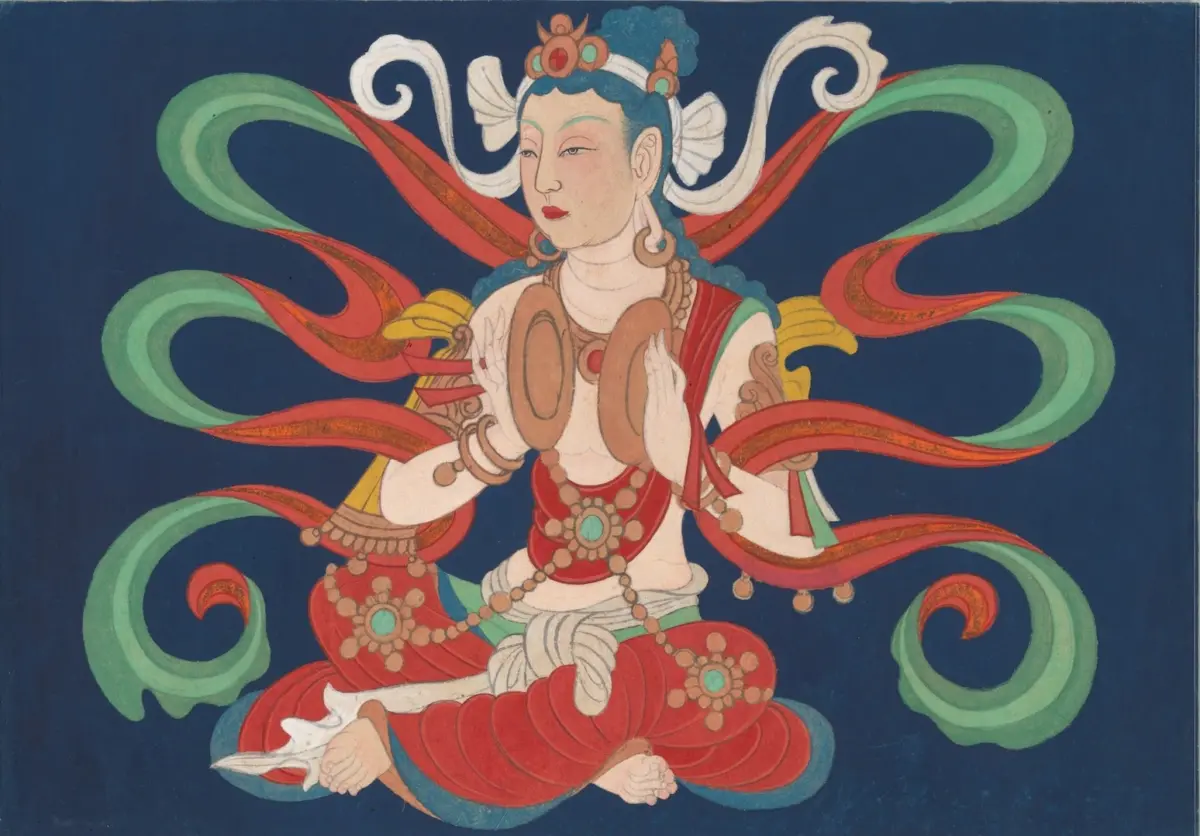
The Metropolitan Museum of Art has announced a significant expansion of its Asian art holdings, securing 38 works by the iconic Chinese ink painter Chang Dai-chien. This substantial acquisition, which spans several decades of the artist’s prolific career, promises to offer museum-goers an unprecedented look at the evolution of one of the 20th century’s most influential artistic figures. The collection serves as a bridge between the traditional foundations of Chinese ink painting and the experimental, modern spirit that defined the latter half of the artist’s life.
The newly acquired trove includes rare studies from Chang’s transformative period in the 1940s at the Dunhuang caves—an ancient Buddhist temple complex situated on the desolate, wind-swept edge of the Gobi Desert. These studies are balanced by a selection of works from the 1960s and beyond, a period when Chang’s signature style began to shift from meticulously rendered, delicate landscapes and still lifes into the radiant, expansive abstractions for which he is internationally celebrated.

"Chang Dai-chien stands as one of the most important painters of the modern era," said Max Hollein, director of the Metropolitan Museum of Art, in an official statement regarding the acquisition. "He combined a deep knowledge of classical Chinese culture with a transnational perspective to fashion a style of ink painting that was both locally rooted and connected to a wider global outlook."
Hollein’s comments highlight the unique trajectory of Chang’s life, which mirrored the geopolitical upheavals of the 20th century. Born in China, Chang spent his life traversing the globe, absorbing influences from South Asia, Japan, and Taiwan before eventually settling in Monterey, California, during the 1970s. This nomadic existence allowed him to synthesize disparate visual traditions, blending the refined techniques of classical masters with a modern, cosmopolitan aesthetic.

According to the museum, the acquisition was finalized last week through a combination of a generous gift and a formal purchase from the artist’s daughter, Sing Sheng Chang. The museum also acknowledged the critical support of a long list of patrons, whose contributions made the acquisition possible.
The story of Chang Dai-chien is as dramatic as the sweeping ink washes he produced in his later years. A titan of the art world, he passed away in 1983 in Taipei at the age of 83. His departure from mainland China in 1949, a move marked by self-imposed exile, forced him to constantly redefine his relationship with his cultural heritage and his physical surroundings. This sense of displacement and searching is perhaps most poignantly captured in a 1951 self-portrait included in the new acquisition. Created during his time in Hong Kong, the work depicts the artist gazing directly at the viewer, his form appearing to float in a weightless, ethereal expanse—a testament to his mastery of space and his reflective state of mind during a period of profound transition.

The inclusion of the Dunhuang studies is particularly significant for scholars and enthusiasts of Asian art. In the 1940s, Chang undertook the arduous journey to the remote Mogao Caves, where he spent nearly three years meticulously copying the ancient Buddhist wall paintings. This experience profoundly altered his artistic trajectory, deepening his technical facility with line and color and reconnecting him with the grandeur of the Tang Dynasty’s aesthetic legacy. These studies are not merely historical records; they represent a formative dialogue between the artist and the ghosts of China’s past, providing a foundation for the sophisticated, modern ink work that would follow in his later career.
As his style evolved throughout the 1960s, particularly during his time in the West, Chang began to push the boundaries of guóhuà—traditional Chinese ink painting. He experimented with vibrant pigments, often incorporating splashes of color that interacted with traditional ink washes in ways that resonated with Western Abstract Expressionism, yet remained firmly rooted in the philosophy and brushwork traditions of his home culture. By the time he reached his later years in California, his works had become atmospheric, fluid, and remarkably bold, reflecting a lifetime of cultural synthesis.

The Metropolitan Museum of Art plans to introduce these works to the public in phases. A selection from the collection will go on display later this year, offering visitors an early opportunity to engage with these newly acquired treasures. Furthermore, the museum has confirmed that the collection will serve as a cornerstone for a comprehensive exhibition dedicated to 20th-century Chinese ink painting, which is currently scheduled to open in 2028. This upcoming exhibition is expected to provide a wider context for Chang’s work, positioning him not only as a master of tradition but as a vital, innovative figure who navigated the complexities of a globalized world.
The acquisition reflects the Met’s ongoing commitment to expanding its representation of 20th-century Asian art, a field that has seen growing academic and institutional interest in recent years. By securing such a large and diverse group of works from a single source, the museum ensures that the narrative of Chang’s development—from his early, rigorous training to his late-career experimentation—remains intact for future study and appreciation.

For those who follow the career of Chang Dai-chien, the acquisition is more than just an addition to a museum registry; it is a long-awaited consolidation of a legacy that has been scattered across private and public collections for decades. As the museum prepares these pieces for public view, the art world turns its attention back to the man who could hold the history of Chinese painting in one hand and the future of global modernism in the other.
The Metropolitan Museum of Art’s acquisition of these 38 works serves as a poignant reminder of the enduring power of ink painting to convey the human experience. Whether in the quiet, focused lines of a 1940s study or the bold, sprawling landscapes of his later years, Chang Dai-chien’s work remains a bridge between worlds—a testament to a life lived in motion, and an artistic vision that refused to be contained by borders, ideologies, or time. As the museum moves toward the 2028 exhibition, the public will have a rare chance to walk the path of an artist who, in his own words and through his own brush, sought to capture the essence of a rapidly changing century.