
For decades, the fashion industry has navigated a complex and often fraught relationship with the gaze, particularly regarding how the human body is presented, framed, and ultimately consumed. Tom Ford, an icon of provocative luxury, long served as the industry’s most outspoken proponent of challenging these norms. Reflecting on his career in a 2015 interview with The Guardian, Ford famously addressed the criticism he had faced for his hyper-sexualized marketing campaigns. "I’ve been criticized for objectifying women," he noted, "but I’m an equal opportunity objectifier—I’m just as happy to objectify men."
Ford’s argument was rooted in a critique of cultural double standards. He noted that while Western society has grown accustomed to the exploitation and exposure of the female form, it remains remarkably guarded when it comes to the male body. "The thing is, you can’t show male nudity in our culture in the way you can show female nudity," Ford explained. "We’re very comfortable as a culture exploiting women, but not men. But I don’t think of it as exploitation [either way]."
Two years later, in a conversation with New York Magazine, Ford doubled down on this observation, pointing to the practical limitations imposed by traditional media and retail standards. "I’ve objectified men just as much in my career, but you just cannot run those images," he remarked. "I put that perfume bottle between a woman’s breasts, but I also put it between a guy’s butt cheeks, but [few] would accept that."
A decade after Ford’s initial musings, the cultural landscape remains just as sensitive, yet Haider Ackermann—Ford’s successor in spirit and design philosophy—is actively continuing the dialogue. With the release of his latest collections, Ackermann is effectively flicking at that same cultural nerve, advocating for a vision of fashion that treats the male and female forms with a mirrored sense of provocative intent. Following a runway show that featured daring, "ass-out" menswear looks, Vogue Runway’s Nicole Phelps succinctly captured the moment, observing that "Ackermann just about out-Forded Tom Ford with this one."
This latest endeavor, delivered through a pre-spring lookbook for women and a simultaneously released brother lookbook for men, marks a definitive exploration of symmetry. Ackermann is not merely designing clothes; he is placing a mirror between the genders, reflecting a broad sense of similarity while masterfully playing with the nuance of difference. As the designer noted in his prepared statements regarding the collections, "The deeper I delve into the signs, the more I find freedom in interpreting them."
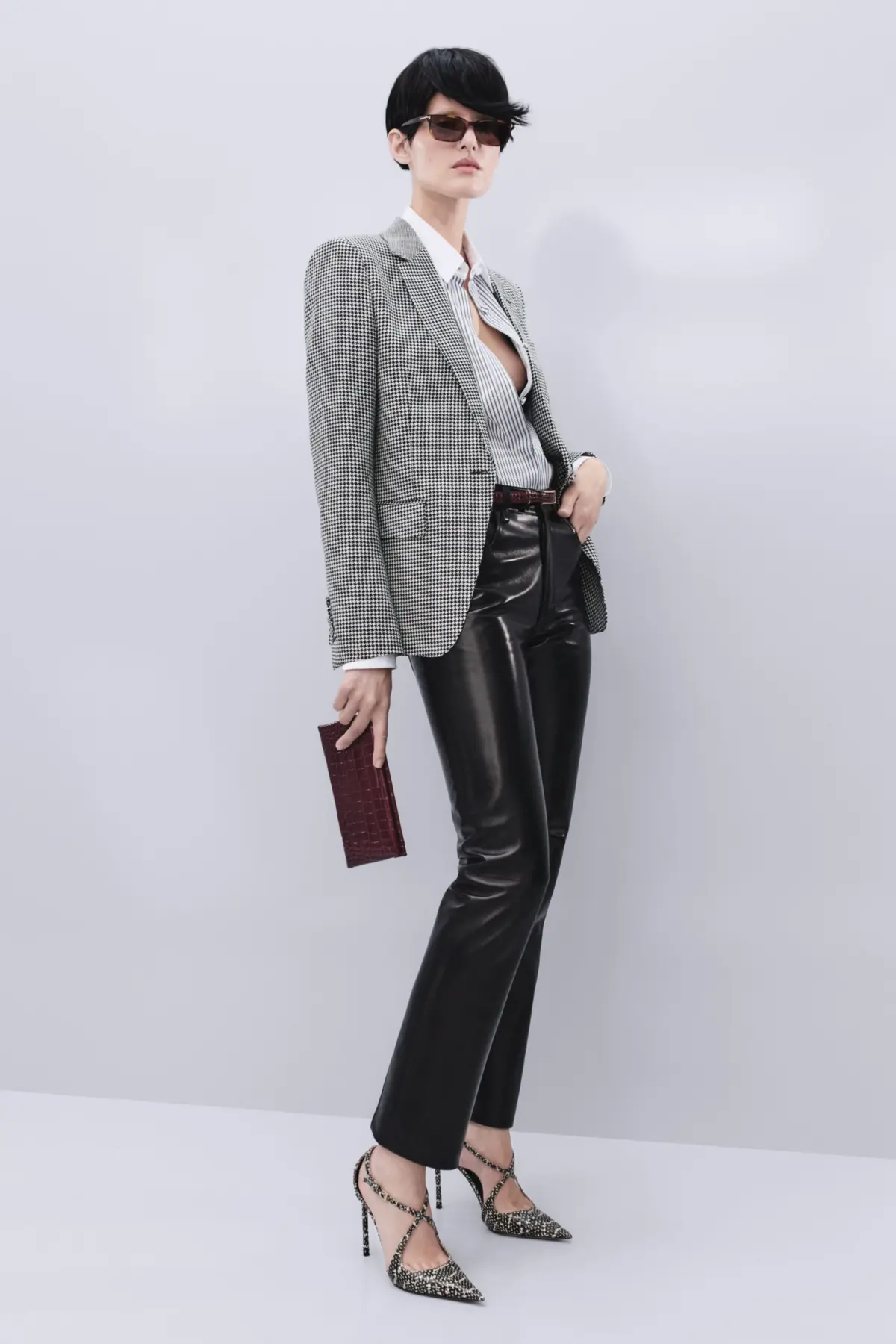
The interpretation begins with tailoring that feels profoundly "correct" in its severity—a nod to the precise, sharp-edged aesthetic that Ford once championed. In these collections, double-breasted jackets are cut with pronounced, strong shoulders, wiry waists, and generous, sweeping trousers. The patterns—pinstripes and dogtooth—evoke a sense of traditional power, yet the execution remains modern. Suiting is frequently broken, such as a checked jacket layered over a crisp, striped shirt paired with stark black leather trousers. This structure is occasionally tempered by the liquid movement of silk or a sudden, jarring injection of brilliant color, ensuring that the silhouette never feels stagnant.
In the menswear collection, the tailoring is equally commanding, though it remains more consistently anchored in the classic traditions of masculine dress. Here, Ackermann appears to be toying delicately with the tensions inherent in masculine convention, seeking to redistribute its power. By adhering to the structures of traditional suiting while simultaneously subverting how those pieces are styled and worn, he allows the clothing to feel both authoritative and subversively fluid.
Beyond the structured world of tailoring, Ackermann pivots toward a refined version of American sportswear and a louche, casually precise aesthetic. Cropped leather jackets, suede bombers, and denim are presented with a ruggedness that feels elevated through the choice of fabrication and the precision of the fit. The inclusion of sharply fitted leather pencil skirts adds an element of calculated tension, grounding the more ethereal, fluid elements of the collection.
As the collection progresses, the discipline of the tailoring gives way to a more liquid form of glamour. This is where the Fordian influence feels most potent: body-skimming silhouettes in sheer fabrics and bias-cut silk dresses drape across the frame, highlighting the body rather than obscuring it. The designs are punctuated by the strategic, often provocative, appearance of underwear—a deliberate styling choice that bridges the gap between high-fashion editorial and the raw reality of the human form.
The parallel nature of the men’s and women’s collections is perhaps their most striking feature. By rearranging similar ingredients—tailored jackets, boxer shorts, and raw, skin-baring silhouettes—across both lookbooks, Ackermann presents the two wardrobes as variations of two closely adjacent personalities. The models, shot in parallel poses, reinforce this sense of duality. The "house-specialty" crotch shots, captured from a between-the-knee perspective, make the founder-established approach to equal-opportunity objectification impossible to ignore.
This aesthetic choice serves a narrative purpose. In Ackermann’s view, the modern woman is "self-possessed, confident in her sensuality, unwilling to be defined by a single attitude." By mirroring this confidence in his menswear, he suggests that the same agency should be afforded to men. The clothing serves as a vessel for this self-possession, stripping away the traditional boundaries that have historically separated the ways in which men and women are allowed to occupy space—and how that space is observed by others.
The collection does not seek to shock for the sake of transgression alone. Rather, it uses the lens of fashion to ask why certain displays of the body are deemed acceptable for one gender and not the other. By creating a visual language that treats the male and female forms with the same level of scrutiny, admiration, and exposure, Ackermann is continuing a lineage of designers who believe that the most powerful tool in fashion is the ability to challenge the viewer’s perceptions.
As the industry continues to evolve, the questions raised by Ford years ago, and now addressed by Ackermann, remain highly relevant. Through his meticulous tailoring, fluid evening wear, and unapologetic embrace of the body, Ackermann is carving out a space where the "signs" of gender are no longer rigid markers, but fluid concepts to be interpreted and reinterpreted. In this latest collection, the mirror he holds up to the industry reveals not just the clothes themselves, but the enduring, complex, and often restrictive expectations we project onto the human form. Whether the wider culture is ready to fully embrace this equal-opportunity approach remains to be seen, but with this collection, Haider Ackermann has ensured the conversation will continue for some time to come.