
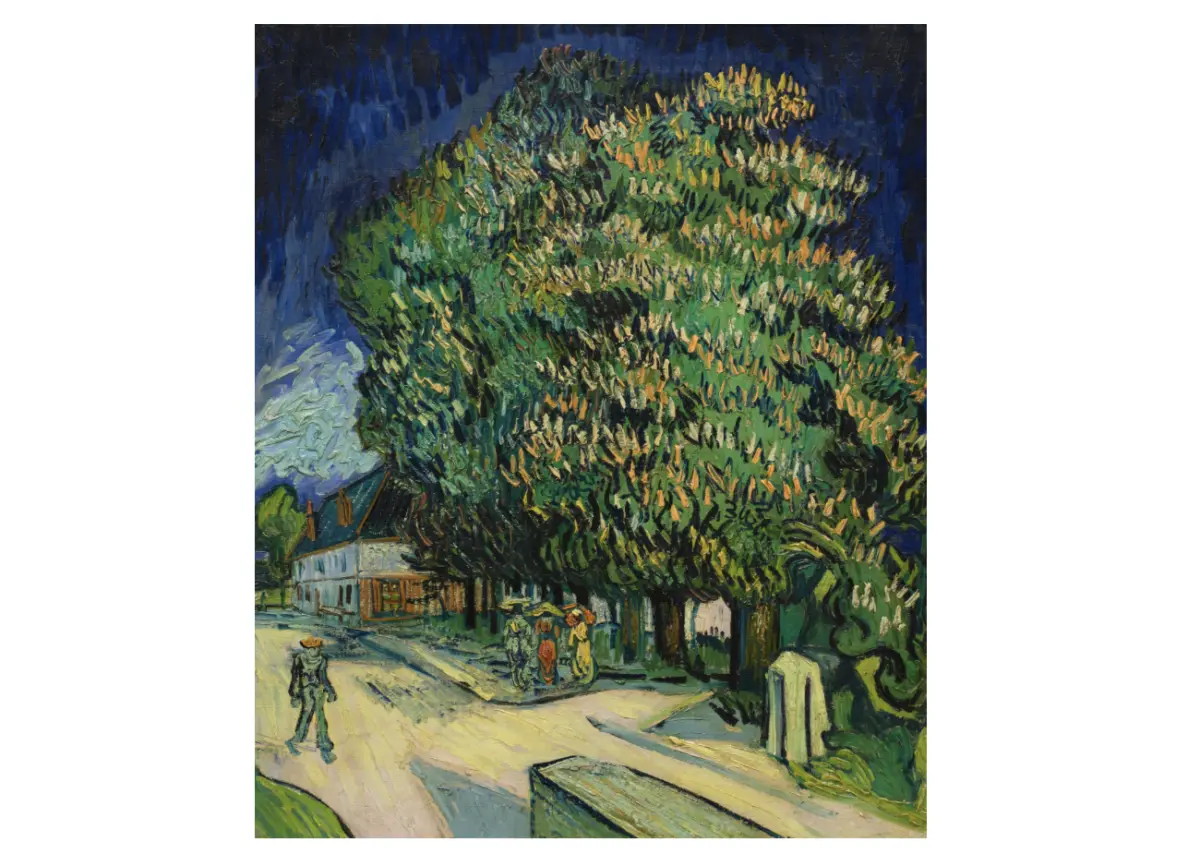
With a masterpiece by Vincent van Gogh valued at an estimated $180 million scheduled to headline a major auction this Wednesday, Sotheby’s finds itself locked in a high-stakes standoff. The auction house is currently pushing back against a last-minute restitution claim filed by the heirs of Samuel Fischer, a prominent Jewish publisher whose family fled Nazi Germany. At the heart of the dispute is Châtaigniers en fleurs (1890), also known as Blossoming Chestnut Trees, a work the Fischer heirs argue was sold under the crushing financial duress of Nazi persecution.
Sotheby’s, however, is standing firm. Represented by legal counsel, the house has released archival evidence suggesting that the 1936 sale of the painting was both voluntary and executed at a fair market price, independent of the political climate in Germany at the time.
The Archive and the Economics of 1936
The auction house recently shared documentation with ARTnews from the archives of the renowned art dealer Paul Cassirer. These records confirm that Châtaigniers en fleurs was sold in June 1936 for 68,000 Swiss francs—the equivalent of roughly $22,000 at the time. Sotheby’s contends that this figure represents a robust price for a Van Gogh during the mid-1930s.
To provide context for this valuation, the house points to the market performance of other historical sales. For instance, Verger avec cyprès (1888), a Van Gogh that was part of the celebrated Paul Allen collection, fetched an extraordinary $117.2 million at Christie’s in 2022. That same painting had sold at Parke-Bernet in 1935 for just $15,000. By aligning the 1936 sale price of the current lot with these historical benchmarks, Sotheby’s is attempting to demonstrate that the transaction was handled through standard commercial channels rather than a fire sale driven by the desperate need to escape the Third Reich.
The Claim and the "Washington Principles"
The controversy erupted following a report by the New York Times on Friday, which revealed that the heirs of Samuel Fischer had formally requested that Sotheby’s withdraw the painting from its November 18 auction. The heirs allege that the Fischer family was compelled to liquidate assets, including the Van Gogh, due to the systematic financial persecution of Jewish citizens by the Nazi regime.
Gunnar Schnabel, the attorney representing the heirs, has issued a sharp challenge to the auction house. In an email correspondence shared with the New York Times, Schnabel demanded that Sotheby’s provide proof that the family received fair market value and that the sale would have proceeded regardless of the geopolitical environment. "Otherwise," he stated, "no auction may take place."
Furthermore, Schnabel noted that his clients are prepared to pursue a resolution in accordance with the Washington Principles, the internationally recognized guidelines for addressing claims involving art confiscated or sold under duress during the Nazi era. While ARTnews reached out to Schnabel for further clarification regarding the specific evidence of duress and the family’s previous restitution efforts, the lawyer did not respond prior to the publication of this report.
A High-Stakes Collection
The Van Gogh serves as the crowning jewel of the Blaquier-Arrieta collection, a prestigious assemblage curated by the Argentine collectors Carlos Pedro Blaquier and Nelly Arrieta de Blaquier. The collection, which includes 12 Impressionist and Post-Impressionist works, is anticipated to command approximately $450 million. The high profile of the sale has invited intense scrutiny, especially given that Sotheby’s has provided a financial guarantee for the Van Gogh, although the specific terms of that guarantee remain confidential.
The competitive nature of the art market was underscored by the fact that Sotheby’s was not the only house vying for the collection. Industry sources familiar with the negotiations indicate that Christie’s also extended offers to secure the collection, with some rumors suggesting that their financial guarantees were potentially more aggressive than those offered by Sotheby’s.
The History of the Fischer Family
Samuel Fischer, who passed away in 1934, was the visionary behind one of Germany’s most significant publishing houses, known for championing literary titans such as Thomas Mann and Hermann Hesse. Following his death, his son-in-law, Gottfried Bermann Fischer, assumed control of the business. As the Nazi regime began to systematically ban the house’s authors and dismantle its operations, the family relocated the business to Vienna in 1936. By 1938, following the Nazi annexation of Austria, the family was forced to flee, and the Gestapo subsequently seized their home, library, and the remaining portions of their art collection.
However, the history of Châtaigniers en fleurs appears distinct from the assets lost during the 1938 seizures. According to the painting’s provenance, the family had consigned the work to Cassirer’s gallery in Amsterdam as early as 1932 or 1933, alongside two Cézannes. The painting remained on consignment for nearly three years, during which time it was included in public exhibitions in Rotterdam and Bern. Sotheby’s emphasizes that the Netherlands remained outside of Nazi control during this period, supporting their assertion that the sale was a commercial transaction between independent parties.
Luke Nikas, legal counsel for Sotheby’s, pointed out that the family retained ownership of other works after the 1936 sale—works that were indeed later confiscated by the Nazis. "The family had pursued and recovered works from the 1938 forced sale, but never the works they sold in 1936, such as this Van Gogh," Nikas explained. He further noted that a postwar brochure compiled by Gottfried Bermann Fischer, which listed items the family sought to recover, did not include the Van Gogh in question.
Legal Precedents and the HEAR Act
The core of the legal disagreement rests on the definition of "duress." Under New York law, a distinction is drawn between the general atmosphere of persecution experienced by Jewish families and a specific transaction where a buyer pressured the seller to sell at an undervalue.
Sotheby’s has cited two prominent cases involving Picassos sold by Jewish families during the Nazi era: Zuckerman v. Metropolitan Museum of Art and Bennigson v. Solomon R. Guggenheim Foundation. In both instances, courts ruled that economic pressure caused by Nazi persecution did not automatically equate to legal duress if the buyer had not contributed to that pressure. While these cases were ultimately dismissed, the dismissals were largely predicated on the statute of limitations—a defense that has been significantly curtailed by recent legislative changes.
In April, Congress amended the Holocaust Expropriated Art Recovery (HEAR) Act, effectively eliminating the laches defense, which had long allowed institutions to dismiss claims based on the argument that heirs had waited too long to file. Judd Grossman, a New York-based art attorney not involved in the current dispute, believes this legislative shift has fundamentally altered the landscape of restitution. "With this year’s amendments… the pendulum has swung dramatically in favor of claimants," Grossman noted, suggesting that the industry may see an increase in "gamesmanship" as claimants approach the final hours before auctions.
A Wait-and-See Approach
The timing of the claim, coming just days before the auction, has placed significant pressure on Sotheby’s. The auction house claims it was first notified of the potential challenge on November 12, even though the sale had been heavily promoted since early October.
Sotheby’s restitution department, currently led by an expanded team following the departures of long-term veterans Lucian Simmons and Richard Aronowitz, maintains that it is conducting a rigorous review of the claim. Meanwhile, the Blaquier family has signaled a willingness to resolve the matter, stating, "While the information available to date has not established that the painting was sold under duress, the family welcomes constructive dialogue with the Fischer heirs and supports efforts to reach a mutually satisfactory resolution."
As the auction date approaches, the art world remains fixed on whether a compromise can be reached before the gavel falls. For now, the painting remains on the auction block, representing both a masterpiece of Post-Impressionist art and a deeply complex intersection of history, law, and justice.