
At Sprüth Magers in Los Angeles, an ambitious new group exhibition titled “Horror” offers a sprawling, visceral examination of the fears that define the human condition. Running from November 21, 2025, through February 14, 2026, the exhibition is curated by the noted figurative painter Jill Mulleady, an artist whose own practice has long been characterized by an engagement with spectral figures, psychological depth, and the lingering presence of mystical phenomena. Rather than presenting a singular, rigid thesis on the genre of horror, Mulleady utilizes the term as a capacious umbrella, gathering a diverse array of works that explore the various manifestations of dread, abjection, and the unsettling nature of the unknown.
The exhibition acts as a temporal bridge, spanning more than half a century of artistic output. By eschewing a linear historical narrative, Mulleady allows for a dialogue between the pioneers of the avant-garde and the most provocative voices of the contemporary moment. The show’s reach is geographically and chronologically vast, beginning with the foundational anxieties of Surrealism—exemplified by a haunting recording from the experimental writer and playwright Antonin Artaud—and extending to the sharp, contemporary critiques of artists such as Anne Imhof, Henry Taylor, and Jordan Wolfson.
A Curatorial Strategy of Chaos and Catharsis
“Horror” is defined by its refusal to be pinned down by stylistic boundaries. Instead, it relies on a series of shrewd, often jarring juxtapositions that force the viewer to confront the visceral nature of the work. The curatorial logic here is one of emotional resonance rather than academic classification. In one corner, a painting by Andra Ursuta, depicting a skeletal figure suspended in a void of deep, bruised purple, sits in uneasy conversation with a sculpture by Bruce Conner that elevates a human skull within a meticulously crafted, shrine-like setting. The dialogue between the two pieces emphasizes the shared human obsession with mortality and the sacredness of the remains we leave behind.
In another section, the exhibition addresses the uncomfortable intersections of identity and trauma. A painting by Pol Taburet, which portrays two brown-skinned figures in the intimacy of a bed, is placed adjacent to a sculpture by Precious Okoyomon that incorporates a racially charged doll. This pairing is indicative of Mulleady’s broader approach: she is not afraid to place deeply personal, private scenes next to objects that carry the heavy, systemic weight of historical and societal malice.
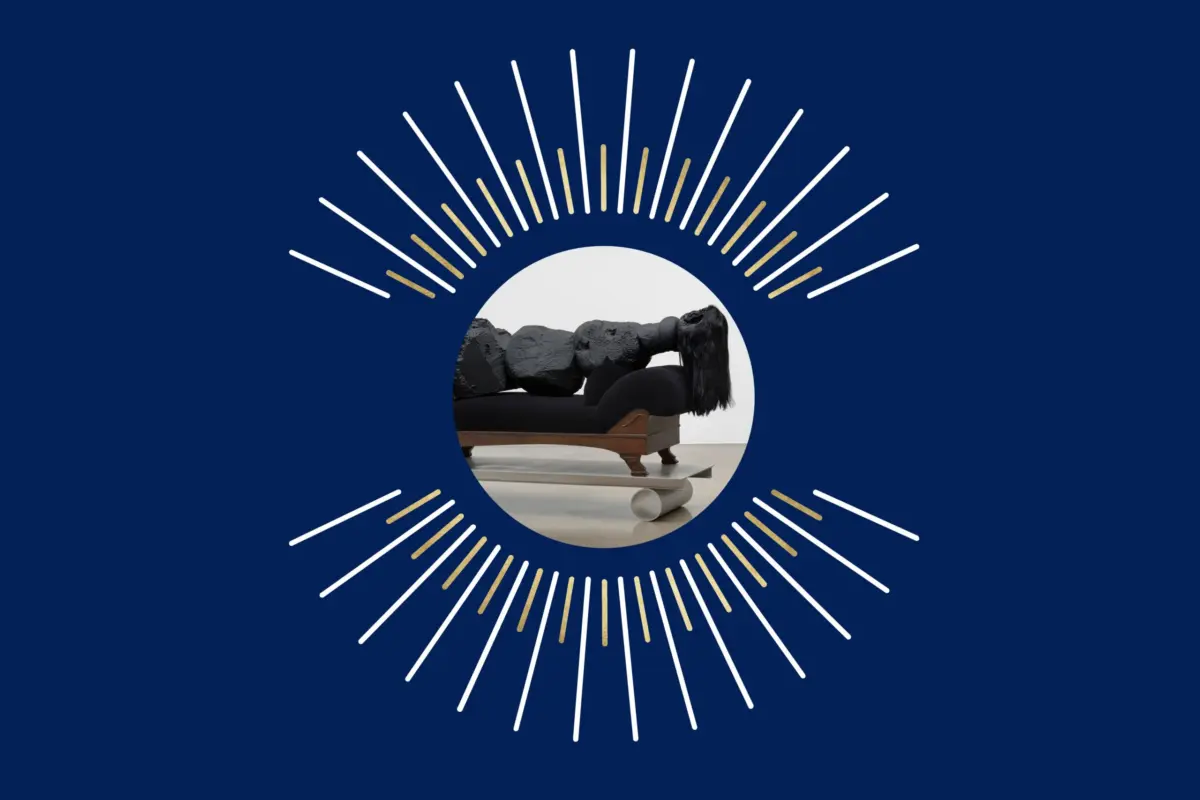
Perhaps the most striking visual confrontation in the show occurs between the late Mike Kelley’s Odalisque—a hulking, blackened mass draped over a divan—and Sondra Perry’s Flesh on Flesh (2021). Perry’s work, which utilizes a 3-D rendering of the artist’s own facial skin, creates a tactile, digital horror that interrogates the boundaries of the self in the age of surveillance and biotechnology. Kelley’s work serves as the intellectual anchor for the entire exhibition. A sculptor who frequently explored the grotesque, the uncanny, and the discarded, Kelley provided the blueprint for this show through his own seminal 1993 exhibition, “The Uncanny.”
By drawing inspiration from Kelley’s investigation into the psychological tension that arises when the familiar is rendered disturbingly strange, Mulleady successfully channels the concept of repressed domesticity. As she notes in the exhibition’s accompanying essay, the show aims to reveal those moments when the mundane surroundings of our daily lives suddenly take on an alien, hostile quality. While the exhibition is not explicitly political in its intent, it succeeds because of this ambiguity. Mulleady does not seek to provide a lecture on the state of the world; rather, she offers a “controlled confrontation with chaos.” As she noted in a recent interview with Wallpaper, the act of viewing such work serves as a vital strategy for processing real-life forces that are otherwise too overwhelming or difficult to digest. There is a palpable sense of catharsis embedded within the gallery walls—a permission to look directly at the things that usually demand we turn away.
The Landscape of Contemporary Curation
The success of “Horror” at Sprüth Magers highlights a broader trend in contemporary curatorial practice, where exhibitions are increasingly judged by their ability to evoke a “vibe” or a sustained emotional state rather than a simple pedagogical goal. Mulleady’s show is a testament to the power of the artist-curator, someone who approaches the gallery space not just as a site for display, but as a medium for artistic expression in its own right. By treating the exhibition as an extension of her own interest in spectrality and the unseen, she has created an environment that feels less like a traditional gallery show and more like an immersive, psychological landscape.
This year’s curatorial landscape remains particularly vibrant, as demonstrated by the diverse range of exhibitions currently being recognized across the art world. Following the thematic depth of “Horror,” several other projects have garnered significant attention for their innovative approaches to space and narrative.
Among these notable projects is “How Beautiful This Living Thing Is,” curated by Andrew Durbin at Ortuzar in New York. Running from April 22 through May 30, 2026, the exhibition promises to offer a contrasting perspective, perhaps focusing on the resilience and vitality of the material world. Similarly, the collaborative project “Snake, Turtle, Alligator,” co-organized by David Peter Francis and the collective Interrobang in New York (January 10–February 7, 2026), suggests a focus on the intersection of biological motifs and symbolic representation.
In the realm of institutional and gallery-led exploration, “Statics of an Egg,” curated by Martin Germann at David Zwirner, New York (May 8–June 27, 2026), highlights the continued interest in minimalism and the structural properties of objects. Meanwhile, the Black Cube Nomadic Art Museum’s “What We Hold On To,” held in Englewood, Colorado (September 5–December 12, 2025), demonstrates the growing importance of regional and nomadic institutions in fostering conversations about memory and cultural preservation.
Each of these exhibitions, including Mulleady’s “Horror,” serves as a marker for how curators are currently grappling with the complexity of the present. Whether through the lens of body horror, the uncanniness of the domestic, or the static nature of the physical object, these shows underscore the necessity of art as a mirror to our deepest, and often most difficult, concerns. As “Horror” continues its run in Los Angeles, it stands as a reminder that the most effective way to address the chaos of the outside world is to bring it inside, frame it, and observe it with the unflinching gaze of the artist. The exhibition at Sprüth Magers does not provide easy answers to the questions it raises, but it provides something perhaps more valuable: a space to inhabit the fear, analyze its contours, and eventually, find a way to move through it.